
A Falsifiable Informational-Physics Mechanism for Field-Generated Artificial Gravity in Spacecraft
Field-generated artificial gravity is usually framed as a problem of producing large spacetime curvature from mass-energy. At spacecraft scale, that route is energetically prohibitive. This work develops a different hypothesis: engineer the local inertial response of matter rather than the background curvature. The proposed Coherence-Gradient Inertial Metric (CGIM) introduces an effective matter-sector lapse, N_I, that is hypothesized to arise only inside an actively maintained, phase-coherent boundary state.
The geometric core is conventional. A lapse profile N(z)=1+gz/c^2 produces the Rindler form of flat spacetime. In the ideal interior, the Riemann tensor vanishes while stationary observers experience proper acceleration. Across a two-meter cabin at one Earth gravity, the required lapse span is only 2.18×10^-16. The new empirical claim is not the Rindler geometry itself, but that an engineered coherent boundary state can control a universal matter-sector lapse through a measurable coherence variable.
CGIM defines a dimensionless boundary-coherence potential from energy-matched mutual phase coherence and a boundary-closure factor. The effective lapse is written as N_I=1+η_I G C_B, where η_I is an experimentally measurable coupling and G is an activation gate. The corresponding slow-motion acceleration is a≈-c^2∇ln N_I. The same lapse predicts a clock-rate gradient and a matter-wave phase response, providing independent cross-checks.
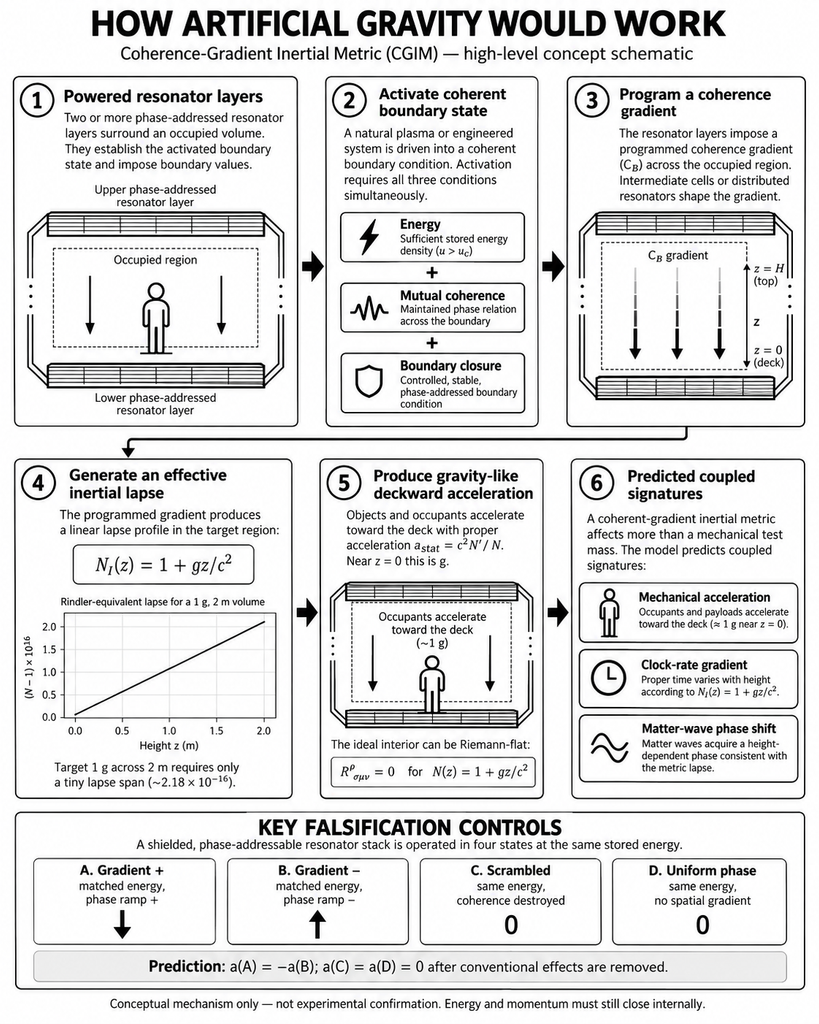
The proposed laboratory test uses four source states at matched stored energy: positive coherence gradient, negative coherence gradient, phase-scrambled control, and uniform-phase control. CGIM predicts sign reversal between the first two states and null response in the two controls. Mechanical acceleration, clock comparison, coherence diagnostics, electromagnetic leakage, temperature, vibration, and conventional force models are recorded independently. A discovery claim requires replicated agreement across the predicted mechanical and metrological channels.
The primary falsifier is straightforward: if η_I remains statistically consistent with zero under the preregistered phase-reversal protocol, or if a mechanical anomaly appears without the corresponding clock-rate signature, the CGIM interpretation is unsupported. The model also requires energy and momentum closure and explicitly excludes reactionless propulsion.
The accompanying reproducibility package freezes the hypothesis, equations, symbols, decision rules, reference calculations, control matrix, data schema, analysis plan, and checksums. It reproduces the Rindler lapse requirement, coupling thresholds, clock prediction, curvature closure, and prospective decision logic. No empirical detection is claimed. The unresolved physical question is whether the coherence-to-lapse coupling exists in nature.
The hypothesis emerged after rejecting several higher-cost routes. Ordinary stress-energy coupling requires impractical source energies; local suppression of the gravitational prefactor produces severe transition-wall costs; and a static reciprocal scalar force reintroduces fifth-force and screening constraints. CGIM instead treats energy as the resource that establishes and maintains an active boundary condition and supplies mechanical work to payloads. This change does not establish new physics, but it moves the decisive unknown into one measurable coefficient. A positive result would motivate microscopic derivation and independent replication before any spacecraft scaling. A null result excludes the coupling range.