
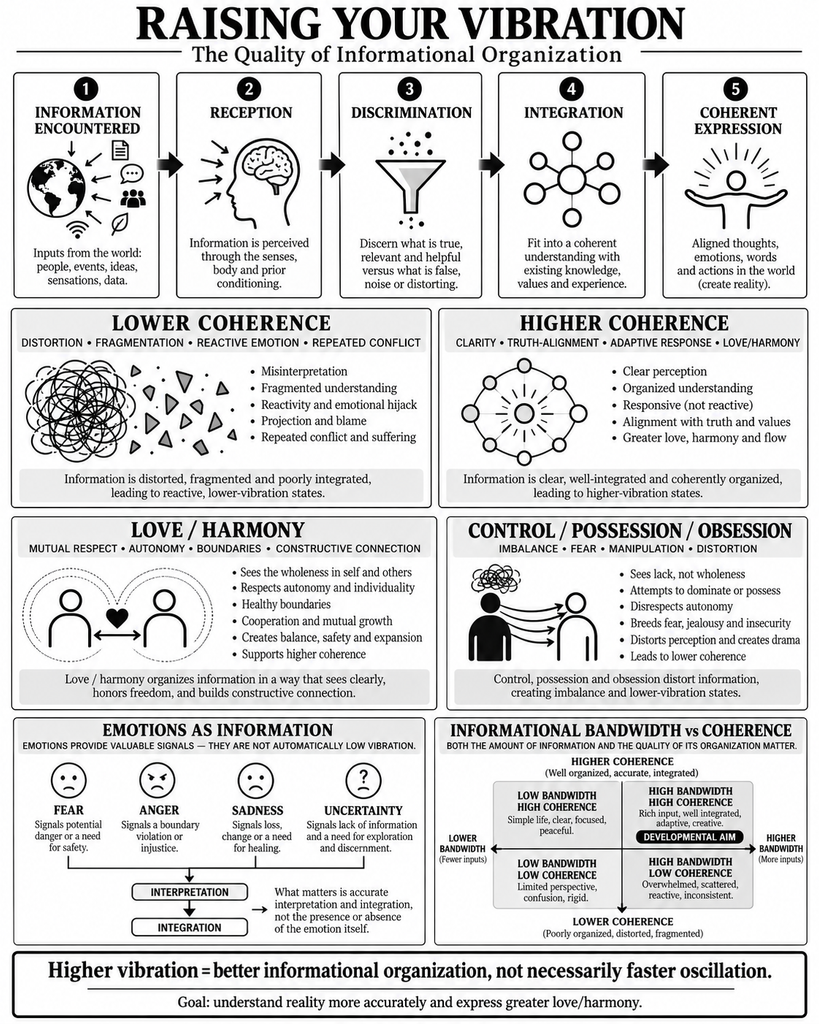
The Quality of Informational Organization
1. What Does It Really Mean to Raise Your Vibration?
One of the most common expressions in modern spirituality is the instruction to “raise your vibration.” It appears in conversations about personal development, meditation, consciousness, healing, relationships, and spiritual awakening. People are encouraged to surround themselves with positive energy, release negative emotions, practice gratitude, and cultivate love as ways of achieving a higher vibrational state. Although some of these practices can support personal well-being, they leave an important question unanswered: What does it actually mean to raise one’s vibration?
The conventional explanation often assumes that people possess an invisible energetic frequency that increases when they experience positive emotions and decreases when they experience negative ones. Happiness, gratitude, and love are described as high-frequency states, while fear, anger, guilt, and sadness are assigned lower frequencies. These descriptions are familiar, but they rarely identify what is physically oscillating, how the supposed frequency is measured, or why a particular emotional experience should correspond to a specific numerical value.
Perhaps the problem is not that the underlying spiritual concept is meaningless, but that the language used to describe it has been interpreted too literally.
What if raising your vibration has less to do with increasing an energetic frequency and more to do with improving how consciousness organizes information? What if spiritual development involves becoming increasingly capable of receiving information, identifying meaningful relationships, recognizing distortion, integrating new understanding, and expressing that understanding through more coherent actions?
This possibility provides a different way of interpreting a familiar spiritual teaching. Rather than treating vibration as a measure of emotional positivity, we can explore it as a metaphor for the quality of informational organization within an individual.
Under this interpretation, someone who raises their vibration is not necessarily becoming happier, more energetic, or more intellectually sophisticated. They are becoming better able to understand reality without unnecessarily distorting it. Their internal beliefs become more responsive to evidence, their emotional reactions become more understandable, and their relationships become increasingly organized around mutual recognition rather than fear, competition, or control.
This proposed interpretation also creates a bridge between metaphysical philosophy and informational approaches to understanding complex systems. Within Informational Physics, reality can be examined through relationships among information, organization, coherence, and change. Applying this perspective to consciousness suggests that what spiritual traditions call vibrational elevation may describe an improvement in the functional organization of awareness.
The central proposition of this article is therefore straightforward: Raising your vibration may mean increasing the quality of your informational organization, allowing you to understand reality more accurately and express that understanding through greater love/harmony.
This is a philosophical and theoretical interpretation, not an experimentally established law of consciousness. Nevertheless, it offers a coherent explanation that can be examined, refined, and potentially tested.
2. Why the Conventional Understanding of Vibration Is Incomplete
In physics, vibration has a specific meaning. It refers to an oscillation or recurring variation in a measurable quantity. A vibrating guitar string moves back and forth, a sound wave produces changing pressure, and electromagnetic radiation involves oscillating fields. These processes can be described mathematically because the relevant quantities, frequencies, and relationships can be measured.
Spiritual discussions frequently use the same word without identifying a comparable physical process. A person may be described as vibrating at a higher level because they appear peaceful, compassionate, or spiritually aware, yet no measurable oscillation is identified that establishes this ranking.
This does not automatically invalidate the subjective experiences being described. Human beings routinely use physical language to communicate psychological and relational experiences. We speak of emotional warmth, heavy sadness, mental clarity, and feeling connected to another person, even though these expressions are not always intended as literal physical measurements.
The difficulty arises when metaphor is presented as measurement.
If someone claims that joy has a particular frequency while grief has another, the claim requires a defined physical variable and a reproducible method of observation. Without those requirements, numerical language creates an appearance of precision without demonstrating that the underlying relationship exists.
An informational interpretation avoids this problem by asking a different question. Instead of attempting to determine how quickly a person’s consciousness vibrates, it asks how effectively that person organizes the information encountered through experience.
The difference between these interpretations becomes clearer when their underlying assumptions are compared.
| Conventional vibrational interpretation | Informational coherence interpretation |
|---|---|
| Higher vibration means a higher spiritual frequency. | Higher vibration represents improved informational organization. |
| Positive emotions indicate higher vibration. | Accurate emotional understanding and appropriate responses indicate greater coherence. |
| Negative emotions lower vibration. | Emotions can carry useful information regardless of whether they feel pleasant. |
| Spiritual advancement means maintaining positive energy. | Development means improving perception, discrimination, integration, and expression. |
| Love is inherently a high-vibration state. | Love/harmony requires constructive connection, mutual respect, and relational integrity. |
| Spiritual growth is difficult to measure objectively. | Specific cognitive, behavioral, and relational capacities may be measurable. |
Consider someone who receives criticism from a colleague. One possible response is immediate defensiveness. The person assumes the criticism is an attack, becomes angry, and rejects the information before considering whether it contains anything useful. Another person may experience the same initial discomfort but remain willing to evaluate the criticism, distinguish accurate observations from mistaken ones, and incorporate whatever information improves their understanding.
The difference is not necessarily that one person possesses a higher physical frequency. The observable difference is how they process information.
The second person demonstrates a greater capacity to hold emotional discomfort while evaluating new evidence. That capacity may lead to better decisions, more productive relationships, and more accurate internal models of the world.
Importantly, this does not mean that the second person must always accept criticism. A coherent response may involve recognizing that the criticism is unfair, establishing a boundary, or rejecting an inaccurate accusation. What matters is that the response follows an appropriate evaluation rather than an automatic distortion.
This distinction also challenges the idea that spiritual growth requires constant happiness.
A person confronting a painful truth may experience grief while developing a clearer understanding of reality. Someone recovering from a harmful relationship may experience anger while recognizing boundaries that were previously ignored. A scientist questioning a long-held assumption may experience uncertainty while moving toward a more accurate explanation.
In each case, emotional discomfort can accompany an improvement in informational organization.
If raising vibration means increasing coherence, then the goal is not to eliminate uncomfortable emotions. The goal is to understand what those emotions communicate and respond in a way that preserves or improves one’s relationship with reality.
3. Consciousness as an Informational Organization System
Every waking moment involves an extraordinary amount of information. Light enters the eyes, sounds reach the ears, sensations arise from the body, memories influence expectations, and thoughts continually interpret ongoing experience. Yet consciousness does not experience all this information as a disconnected collection of signals. Instead, the mind organizes selected information into meaningful objects, events, relationships, and expectations.
When someone recognizes a familiar face, the experience involves more than receiving visual information. Their perception is connected with memory, identity, emotion, and prior experience. When someone hears an unfamiliar opinion, existing beliefs influence how the statement is interpreted. When someone senses danger, incoming information is evaluated in relation to learned patterns of threat and safety.
These processes illustrate an essential principle: Information becomes useful through organization.
A collection of facts does not automatically produce understanding. A person may memorize thousands of isolated statements without recognizing how they relate to one another. Another person may possess much less factual knowledge but understand the governing relationships that explain an entire category of events.
The difference is structural.
Within the Informational Physics perspective developed through Creation Unified, consciousness can be examined as an informational organization system. In this proposed framework, consciousness is considered not merely through the amount of information it encounters, but through its ability to distinguish, relate, integrate, and express meaningful patterns.
This does not require assuming that consciousness has already been proven to exist independently of the brain. Human cognition clearly depends on biological processes, and the relationship between subjective awareness and physical organization remains an active area of philosophical and scientific investigation. Informational Physics provides an additional conceptual lens through which that relationship can be examined.
The proposed insight is that the quality of conscious experience depends partly on the organization of the information available to the individual.
Imagine walking into an unfamiliar city for the first time. Initially, the streets, buildings, signs, and transportation routes may seem confusing. As you explore, you begin identifying landmarks, understanding the road network, and recognizing how different neighborhoods connect.
The city has not necessarily changed. Your internal organization of information has changed.
Eventually, the same environment that once appeared chaotic becomes understandable. You can navigate without constant uncertainty because the relationships among its components have become more coherent within your internal model.
A similar process may occur throughout personal development. Experiences that initially appear disconnected gradually become understandable as a person recognizes recurring relationships, learns from mistakes, and revises earlier assumptions.
This is one possible interpretation of what spiritual traditions describe as expanding consciousness.
Expansion does not necessarily mean that awareness occupies more physical space or receives information from an invisible dimension. It may mean that the individual becomes capable of organizing a wider range of experience into a meaningful and increasingly accurate understanding.
However, there is an essential qualification. An internally consistent interpretation is not necessarily true. Someone can construct an elaborate explanation that connects many experiences while misunderstanding the events themselves.
Therefore, genuine informational development must include the ability to test interpretations against reality.
A coherent consciousness does not merely connect more dots. It becomes better at determining which dots are actually connected.
4. The Four Functional Stages of Raising Vibration
If raising vibration is understood as improving informational organization, the process can be divided into four interacting functions: reception, discrimination, integration, and expression.
These functions are not rigid stages that occur only once or always in the same order. They form a recurring process through which an individual encounters reality, develops understanding, and adjusts behavior.
The four functions provide a useful way to understand how informational development occurs.
- Reception: Becoming aware of relevant information without immediately filtering it through defensive assumptions or preconceived conclusions.
- Discrimination: Distinguishing reliable information from noise, distortion, emotional projection, and unsupported interpretations.
- Integration: Incorporating valid information into an increasingly accurate understanding while remaining willing to revise existing beliefs.
- Expression: Translating understanding into appropriate decisions, communication, relationships, and behavior.
The first function, information reception, requires attention, awareness, and enough psychological flexibility to notice information that may contradict existing expectations.
People often assume they are seeing reality directly when they are actually experiencing an interpretation shaped by prior beliefs, emotions, memories, and learned expectations. Two individuals can observe the same event and arrive at dramatically different conclusions because each notices different features and assigns different meanings.
Improved reception therefore involves becoming aware of both the information being encountered and the assumptions influencing its interpretation.
Consider a disagreement between family members. One person may hear a statement as criticism because previous interactions have established an expectation of rejection. Another may recognize the same statement as an imperfect attempt to communicate concern. Neither interpretation should be accepted automatically. Better reception involves remaining attentive to the actual words, circumstances, and behavior before deciding what the interaction means.
The second function, information discrimination, is equally important because receiving more information is not sufficient. Information varies in accuracy, relevance, and usefulness. Human beings constantly encounter incomplete reports, persuasive claims, emotional impressions, and misleading patterns. The ability to distinguish meaningful signals from noise is therefore essential to coherent understanding.
Discrimination requires asking whether a conclusion is supported by evidence, whether alternative explanations exist, and whether a perceived relationship is reliable.
This function becomes especially important in spiritual and metaphysical exploration, where meaningful personal experiences may be difficult to evaluate independently. A powerful intuition can motivate investigation, but its emotional intensity does not establish its accuracy.
Greater informational coherence allows curiosity and skepticism to coexist. An individual can consider unfamiliar possibilities without automatically accepting them and can question conventional explanations without assuming that every alternative must be correct.
The third function, information integration, concerns what happens after information has been evaluated. New understanding must be incorporated into an existing internal model, sometimes requiring modifications to long-held beliefs or recognition that an earlier explanation was incomplete.
Integration does not mean forcing every idea into a single worldview. Sometimes the most accurate form of integration involves recognizing that two claims genuinely contradict one another and that one, both, or the available evidence must be reconsidered.
A person who learns that a trusted assumption was mistaken faces an informational challenge. They can reject the evidence to preserve their existing model, or they can revise the model to accommodate what has been learned. The latter response may temporarily create uncertainty, but it can ultimately produce a more reliable understanding.
The fourth function, information expression, concerns the relationship between understanding and action.
Someone may intellectually understand the importance of patience while repeatedly reacting impulsively. Another may recognize the value of honesty but continue communicating misleading information to avoid discomfort. In both cases, expressed behavior is not fully aligned with stated understanding.
Informational coherence increases when knowledge and behavior become more appropriately connected.
This does not demand perfection. Human behavior is affected by fatigue, stress, biological conditions, social pressures, and circumstances beyond individual control. Nevertheless, a pattern of greater alignment between accurate understanding and constructive behavior provides a meaningful indicator of development.
Together, these four functions describe a continuing informational cycle. An individual encounters information, evaluates its meaning, integrates what is useful, and expresses the resulting understanding through action. The consequences of those actions then generate new information, allowing the process to continue.
Under the proposed framework, raising vibration is not a single achievement. It is the continuing refinement of this entire process.
5. Love/Harmony: Why the Meaning of Love Requires Clarification
The word love occupies a central position in spiritual teachings, religious traditions, philosophical discussions, and everyday relationships. People are encouraged to love themselves, love others, and cultivate love as a path toward greater spiritual awareness.
Yet in modern usage, the word has become so broad that it can describe relationships and behaviors with fundamentally different structural characteristics.
Someone may claim to love another person while attempting to control their decisions. A partner may describe extreme jealousy as evidence of deep love. A parent may justify excessive restrictions by insisting that every action is motivated by love. An individual may become so emotionally fixated on another person that the relationship develops into obsession, yet still describe the experience as profound love.
The problem is not that every expression of love has become corrupted, but that the word alone does not reliably distinguish constructive connection from possessiveness, control, dependency, or obsession.
These behaviors can be presented under the language of love even when they diminish another person’s freedom, dignity, or well-being.
Control attempts to subordinate another person’s choices to one’s own preferences. Possession treats another individual as something to be held or owned rather than recognized as an independent participant in a relationship. Obsession can narrow attention so severely that the desired connection becomes more important than the other person’s actual needs or expressed wishes.
Each represents a potential distortion of the relational process.
This is why the present framework intentionally uses the combined expression love/harmony.
The word harmony adds a structural requirement that helps clarify what kind of love is being discussed. In this context, love/harmony refers to a relationship in which connection supports the legitimate integrity, autonomy, and development of those involved.
The distinction becomes especially clear when different expressions of attachment are compared.
| Expression | Underlying relational organization | Likely consequence |
|---|---|---|
| Love/Harmony | Mutual understanding, respect, autonomy, and constructive connection | Supports individual integrity and relational development |
| Control | One person’s preferences dominate another person’s choices | Restricts autonomy and creates imbalance |
| Possession | Another person is treated as something to retain or own | Encourages entitlement and dependency |
| Obsession | Attention becomes fixated on maintaining a desired connection | Can override boundaries, judgment, and well-being |
| Manipulation | Information or emotion is used to influence another person through deception or pressure | Undermines trust and informed choice |
| Healthy boundaries | Individual integrity is preserved while connection remains possible | Allows independence and mutual respect |
Harmony does not mean that every participant must think alike, behave identically, or remain in constant agreement. A musical composition becomes harmonious through the meaningful relationship among different notes, not because every instrument produces the same sound.
Similarly, a coherent relationship allows individuals to retain distinct identities while participating in a constructive and mutually respectful connection.
A parent expressing love/harmony may establish necessary boundaries while gradually supporting a child’s growing independence. A romantic partner expressing love/harmony may communicate needs honestly without attempting to control another person’s identity. A friend expressing love/harmony may challenge a harmful decision while respecting the other person’s responsibility for their choices.
These relationships may involve conflict, disappointment, and difficult conversations. Their harmony lies not in the absence of differences, but in how those differences are understood and addressed.
This distinction also prevents harmony from being confused with submission.
Someone who continually abandons personal boundaries to avoid conflict may appear agreeable, but the resulting relationship may be deeply unbalanced. Similarly, a community that suppresses disagreement through intimidation may exhibit outward uniformity without genuine coherence.
Authentic love/harmony requires conditions under which differences can be expressed, information can move honestly between participants, and harmful patterns can be corrected.
Within Informational Physics, we can interpret this as relational coherence: the ability of distinct informational systems to interact constructively without unnecessarily destroying or suppressing their individual organization.
Under this hypothesis, love/harmony becomes more than a pleasant emotion. It becomes a functional principle describing how coherent relationships can preserve individuality while supporting constructive integration.
This does not mean that love/harmony has been established as a separate physical force. Rather, it provides a proposed structural interpretation of why compassion, cooperation, understanding, and respect are so consistently valued in human development.
The implication for raising vibration is significant.
A person does not demonstrate greater coherence simply by saying loving things, experiencing intense affection, or declaring spiritual unity with others. The more meaningful question is whether their actions support accurate understanding, mutual recognition, appropriate boundaries, and constructive relationships.
Love/harmony is not possession disguised as connection, control disguised as protection, or obsession disguised as devotion. It is connection organized in a way that respects the integrity of those involved.
6. Fear, Anger, and Distortion: What Actually Lowers Coherence?
Popular discussions of vibration frequently classify emotions according to a hierarchy, assigning fear, guilt, anger, and sadness to lower levels while placing gratitude, joy, peace, and love at higher ones.
This approach can create a misleading impression that emotional discomfort indicates spiritual failure.
A more useful informational model distinguishes the emotional signal from the way the individual interprets and acts upon it.
Fear is not automatically a distortion. It can provide information about danger, uncertainty, or vulnerability. Anger can indicate perceived injustice, violated boundaries, or unmet needs. Sadness can communicate the significance of loss, while guilt can motivate accountability when someone recognizes that their actions have caused harm.
These emotions can serve constructive functions when they are interpreted accurately and expressed appropriately.
The relationship between emotion and informational coherence becomes clearer when we examine how the same emotional state can support either constructive or destructive outcomes.
| Emotional experience | Potential informational value | Possible distortion |
|---|---|---|
| Fear | Recognizing danger, uncertainty, or vulnerability | Treating harmless situations as persistent threats |
| Anger | Identifying injustice, violated boundaries, or unmet needs | Assuming hostile intent without sufficient evidence |
| Sadness | Recognizing loss, attachment, and the need for adjustment | Interpreting temporary suffering as permanent hopelessness |
| Guilt | Recognizing responsibility and motivating corrective action | Assuming responsibility for events outside one’s control |
| Joy | Recognizing rewarding experiences and meaningful progress | Mistaking pleasant feelings for proof that a belief is accurate |
| Peace | Supporting reflection, patience, and reduced reactivity | Using emotional calm to avoid necessary confrontation |
| Love/Harmony | Supporting connection, understanding, and constructive relationships | Confusing attachment, control, or dependency with genuine connection |
The table illustrates why emotions cannot be reliably ranked according to a simple spiritual hierarchy. Their value depends partly on whether they correspond appropriately to circumstances and whether the resulting response improves or damages the individual’s understanding and relationships.
Research on emotional regulation provides relevant, although not metaphysical, support for this distinction. Psychological studies examine how people reinterpret experiences, direct attention, regulate expression, and adapt responses to changing circumstances. These findings suggest that flexible regulation is often more useful than automatically suppressing unwanted feelings.
From an informational perspective, the goal is to develop a more accurate relationship with emotion.
Imagine someone who becomes angry after discovering that a business partner has withheld important information. A superficial interpretation of raising vibration might encourage the person to release the anger immediately and focus only on positive thoughts.
A more coherent response would recognize that the anger may contain useful information about a violation of trust. The individual could examine the evidence, distinguish intentional deception from misunderstanding, establish appropriate boundaries, and decide how the relationship should proceed.
The anger itself does not determine whether the response is coherent. The quality of the resulting understanding and action does.
Likewise, someone experiencing grief after losing a loved one is not necessarily operating at a lower level of consciousness. Their sadness may reflect the depth of a meaningful relationship and the process of adapting to its absence.
Forcing positivity in such circumstances may interfere with honest emotional integration.
This leads to an important revision of conventional vibrational language: what reduces coherence is not necessarily the presence of uncomfortable emotion, but the persistent distortion, suppression, misinterpretation, or destructive expression of information.
Raising vibration may therefore involve becoming more capable of experiencing the full range of human emotions without allowing any single emotional state to completely determine one’s understanding of reality.
7. Informational Bandwidth Versus Informational Coherence
One of the most important distinctions in this proposed framework is the difference between informational bandwidth and informational coherence.
Bandwidth concerns the amount or range of information a system can potentially receive and process. Coherence concerns how successfully that information is organized into accurate, meaningful, and functionally useful relationships.
These are related capacities, but they are not identical.
Consider someone who reads extensively, follows numerous information sources, explores complex spiritual teachings, and continually searches for new explanations. This person may encounter an extraordinary variety of ideas, yet still struggle to determine which claims are reliable or how the information fits together.
Their exposure to information is broad, but the resulting understanding may remain fragmented.
Now consider someone who studies a smaller number of subjects carefully, evaluates evidence, recognizes important patterns, and applies what they learn consistently. Their informational exposure may be narrower, but their organization of that information may be more effective.
Neither person should be assigned an inherent spiritual ranking. The comparison simply illustrates that more information does not automatically produce greater understanding.
The relationship between bandwidth and coherence can be represented through four general conditions.
| Informational bandwidth | Informational coherence | Functional condition |
|---|---|---|
| Low | Low | Limited available information combined with difficulty organizing what is received |
| High | Low | Extensive exposure to information without reliable discrimination or integration |
| Low | High | Accurate organization and effective use of a relatively limited information set |
| High | High | Broad information reception combined with strong discrimination, integration, and adaptive expression |
The fourth condition represents the proposed developmental direction, but the goal is not simply to maximize the volume of information encountered. A person must also recognize which information is relevant, when additional input is unnecessary, and when existing understanding is sufficient to support responsible action.
This distinction also applies to intelligence.
A highly intelligent person can construct elaborate arguments supporting mistaken assumptions. Sophisticated reasoning may even make certain errors more difficult to recognize because the individual becomes skilled at defending an existing worldview.
Conversely, someone without extensive formal education may demonstrate exceptional practical wisdom through accurate observation, careful judgment, and an ability to understand human relationships.
Therefore, raising vibration should not be equated with greater intellectual ability, faster thought, specialized knowledge, or the accumulation of spiritual concepts.
Within the proposed informational model, development occurs when increased awareness is accompanied by improved discrimination and integration.
A person may become aware of more possible relationships in the world, but that expansion becomes useful only when they can distinguish genuine connections from imagined ones.
This is particularly important when discussing intuition.
Intuition can arise from subtle pattern recognition based on prior experience, sometimes allowing someone to reach a useful conclusion before they can fully explain the reasoning involved. However, intuition can also be influenced by expectation, emotional association, and cognitive bias.
A stronger informational organization system would not automatically reject intuition or treat it as infallible. It would use intuitive impressions as possible signals worthy of examination.
The development of greater informational bandwidth without adequate discrimination can increase confusion, while strong discrimination without openness to new information can produce rigidity.
A balanced process requires both the willingness to encounter unfamiliar possibilities and the ability to evaluate them responsibly.
The proposed relationship is therefore not simply that higher vibration equals greater awareness. Rather, meaningful development involves expanding awareness while improving the coherence with which information is organized.
8. Spiritual Awakening as Informational Reorganization
Spiritual awakening is often described as a sudden realization that reality is different from what a person previously believed. Individuals may report seeing familiar experiences from an unfamiliar perspective, recognizing connections that once seemed invisible, or questioning assumptions that previously organized their understanding of life.
These experiences can be profound, but they do not all require the same explanation.
One possibility is that at least some experiences described as awakening involve substantial informational reorganization.
Every person develops an internal model of reality through accumulated experiences, cultural influences, education, memory, and personal interpretation. This model helps organize expectations, but it is necessarily incomplete.
As new information is encountered, the model may require adjustment.
Sometimes those adjustments are gradual. A person develops a new understanding through years of observation, reflection, and experience. At other times, several previously disconnected insights may become integrated within a short period, creating the subjective impression of a sudden transformation.
A familiar analogy is solving a difficult puzzle.
Before the solution becomes apparent, the pieces may seem unrelated. Once the governing relationship is recognized, many earlier observations acquire a new meaning. The person has not necessarily acquired entirely new sensory information. Instead, the existing information has been reorganized into a more coherent structure.
This may help explain why certain personal realizations feel transformative.
Someone who has spent years interpreting disagreement as rejection may eventually recognize that another person’s differing perspective does not necessarily threaten their identity. That insight can reorganize numerous relationships and emotional expectations.
Another person may recognize that a recurring pattern of conflict comes from an unexamined assumption rather than from the behavior of everyone around them. Once the assumption changes, experiences that previously seemed confusing become easier to interpret.
In both cases, the transformation is informational.
From the perspective of Informational Physics, one can hypothesize that personal growth involves transitions between different states of informational organization. A previously stable interpretation becomes inadequate, new relationships are recognized, and a revised structure emerges.
Triune Harmonic Dynamics offers a related conceptual language for examining the interaction among differentiated components, changing relationships, and the emergence of more coherent organization. Applied cautiously to consciousness, this perspective suggests that meaningful transformation may occur when formerly conflicting elements are reorganized into a more functional relationship.
However, informational reorganization does not guarantee greater accuracy.
A person can experience an intense moment of apparent revelation and adopt an explanation that is less accurate than the one it replaces. The feeling that everything suddenly makes sense can emerge from genuine understanding or from a compelling but mistaken interpretation.
This is why the concept of raising vibration must include truth alignment.
A useful awakening should improve the individual’s ability to understand observable relationships, evaluate contradictory evidence, act constructively, and revise conclusions when necessary.
The depth of a subjective experience deserves acknowledgment, but the accuracy of its interpretation remains a separate question.
Under this framework, spiritual awakening is not measured by how extraordinary an experience feels. It is evaluated by whether the resulting informational organization becomes more coherent, accurate, and adaptive.
9. How Do You Actually Raise Your Vibration?
If raising vibration refers to improving informational organization, then the practical process becomes more accessible than many conventional spiritual explanations suggest.
It does not require discovering a hidden frequency, forcing oneself into constant happiness, or claiming access to information unavailable to others. Instead, it involves developing habits that improve the relationship among perception, understanding, emotional experience, and behavior.
The following seven practices offer a practical starting point.
- Observe before interpreting. Learn to distinguish what actually happened from the meaning you initially assigned to it.
- Remain curious about unfamiliar information. Consider new possibilities without automatically accepting or rejecting them.
- Evaluate the reliability of information. Examine evidence, assumptions, alternative explanations, and the possibility of error.
- Integrate emotions rather than suppressing them. Understand what feelings may communicate before deciding how to respond.
- Examine contradictions between beliefs and actions. Identify where behavior does not reflect stated understanding or values.
- Practice love/harmony in relationships. Encourage mutual understanding, respect boundaries, and avoid confusing control or possession with connection.
- Revise understanding when new evidence warrants it. Treat uncertainty and correction as opportunities for development rather than threats to identity.
These practices are simple to describe, but their significance becomes clearer when they are considered as parts of a continuous process.
The first practice, observing before interpreting, addresses one of the most common sources of informational distortion. Human beings often respond to events through automatic assumptions. A delayed message may be interpreted as rejection, a disagreement as hostility, or an unfamiliar idea as a threat. These interpretations can feel immediate and convincing because prior experience influences perception.
Developing greater coherence begins with recognizing the difference between what happened and what one believes happened.
For example, the observable fact may be that someone did not respond to a message. The interpretation may be that the person is deliberately ignoring you. Recognizing this distinction allows alternative explanations to remain available until sufficient information is obtained.
This does not eliminate emotional reactions, but it reduces the likelihood that incomplete information will be treated as established reality.
Curiosity provides another important function because existing beliefs naturally influence which information receives attention. When individuals become strongly attached to a particular interpretation, they may overlook evidence that challenges it.
Remaining curious does not require abandoning personal convictions. It means allowing those convictions to be examined when relevant information becomes available.
Someone exploring an unfamiliar scientific or metaphysical explanation can remain open to its possibilities while distinguishing the claims already supported by evidence from those that remain hypothetical.
This relationship between openness and discrimination is essential. Without openness, a person may reject useful information before understanding it. Without discrimination, they may accept inaccurate claims simply because they appear meaningful or exciting.
Emotional integration also plays a central role.
When an uncomfortable emotion arises, the individual can examine the circumstances that produced it, consider what information it may communicate, and determine whether the interpretation is accurate.
Fear might indicate a genuine threat or an outdated expectation. Anger might reveal a necessary boundary or an exaggerated interpretation. Sadness might signal an important loss that deserves recognition rather than avoidance.
The aim is not to remove emotional experience from consciousness, but to incorporate it into a more complete understanding.
Another important practice involves recognizing contradictions between beliefs and actions.
Someone may value honesty while avoiding difficult conversations, value independence while attempting to control others, or speak frequently about love/harmony while participating in relationships characterized by possession and dependency.
These inconsistencies provide information about aspects of the individual’s internal organization that may require attention.
Recognizing such contradictions need not produce self-condemnation. Instead, it can become an opportunity to understand why certain patterns persist and what changes might allow behavior to better reflect genuine values.
Relational understanding extends this process beyond the individual.
Every meaningful relationship involves information moving between distinct people. Effective relationships require listening, communication, recognition of differences, respect for boundaries, and the capacity to correct misunderstandings.
Love/harmony can be developed by approaching relationships as opportunities for mutual understanding rather than competitions for control.
This may involve asking questions before assigning motives, acknowledging another person’s perspective without abandoning one’s own, and recognizing that disagreement does not automatically represent disconnection.
It may also require leaving situations in which respectful reciprocity is not possible. Harmony does not obligate an individual to tolerate manipulation, coercion, or abuse.
The final practice, revising understanding when new evidence warrants it, ties the others together.
People often prefer a confident explanation to an unresolved question, even when the explanation is poorly supported. Uncertainty can feel uncomfortable because the mind naturally seeks patterns and predictability.
Yet an accurate admission of not knowing can represent a more coherent informational state than a confident false conclusion.
Developing this capacity allows understanding to remain open to revision.
Together, these practices describe a process of ongoing informational refinement. The person becomes increasingly attentive to reality, more capable of evaluating information, more willing to revise mistaken assumptions, and better able to express understanding through constructive action.
This approach also changes how progress is evaluated.
Rather than asking whether one’s vibration feels higher today, one might ask whether recent experiences were interpreted more accurately, whether an unnecessary conflict was resolved, whether a mistaken assumption was corrected, or whether greater love/harmony was expressed without sacrificing truth or personal boundaries.
These questions translate an abstract spiritual goal into observable patterns of development.
The process will not always feel pleasant. Sometimes improved coherence requires confronting uncomfortable facts, acknowledging personal mistakes, recognizing harmful relationships, or abandoning explanations that once provided emotional security.
Nevertheless, those difficult transitions may be precisely where meaningful informational development occurs.
10. Can Informational Coherence Be Measured?
A major advantage of interpreting vibration through informational organization is that the hypothesis can be developed toward measurable predictions.
Rather than assuming that spiritual advancement corresponds to an invisible frequency, researchers could examine the functions proposed in this article and determine whether they can be operationally defined.
Information reception might be evaluated through tasks involving attention and the recognition of relevant evidence. Discrimination could be examined through the ability to distinguish reliable signals from misleading information. Integration could involve measuring how appropriately an individual revises beliefs after encountering new evidence. Expression could be studied through the consistency between accurate understanding and effective behavior.
These components could form the basis of a preliminary Informational Coherence Capacity model.
A conceptual model could represent coherence through the relationship among four capacities:
Informational Coherence Capacity = Reception × Discrimination × Integration × Adaptive Expression
If each component were normalized between zero and one, the multiplication would illustrate how a severe weakness in one function could limit the effectiveness of the overall process. This mathematical form is provisional, however, and would require empirical justification before being treated as a validated measurement.
The model must also distinguish truthful integration from mere internal consistency.
A person whose beliefs fit together perfectly but consistently contradict reliable evidence should not receive a high coherence score simply because the belief system is internally organized.
Likewise, greater social agreement should not automatically count as greater coherence. Independent thinking and justified disagreement can improve the accuracy of a larger informational system.
A useful research program could examine whether people who improve in these capacities also demonstrate better decision-making, more flexible emotional regulation, and more constructive relational behavior.
If the model failed to predict such outcomes, its assumptions would need revision.
Even successful findings would not establish the existence of a metaphysical frequency or prove that consciousness directly accesses a universal informational substrate. They would support the narrower claim that informational coherence is a meaningful and measurable dimension of psychological functioning.
This distinction matters because the proposed framework becomes more credible when it identifies what evidence would support it, what evidence would challenge it, and where its metaphysical implications remain uncertain.
11. Beyond the Individual: From Personal Coherence to Collective Harmony
Although raising vibration is usually discussed as an individual practice, the proposed informational interpretation has broader implications.
Human beings do not develop in isolation. Their understanding is influenced by families, communities, organizations, institutions, and the larger informational environments in which they participate.
These environments also possess patterns of organization.
A family may operate through honest communication, mutual respect, and the ability to resolve misunderstandings, or it may become organized around secrecy, rigid authority, and unresolved conflict. A workplace may encourage useful disagreement and learning, or it may punish individuals for presenting information that contradicts established assumptions.
The quality of these relationships influences how effectively information moves through the larger system.
Within this framework, collective coherence refers to the capacity of a group to preserve meaningful differences while sharing accurate information, resolving destructive contradictions, coordinating appropriate action, and adapting to changing conditions.
This is not the same as uniformity.
A community in which everyone is required to hold identical opinions may appear highly organized, but it can become informationally fragile because dissenting observations are suppressed. When important evidence cannot be communicated, the group loses the ability to correct mistaken assumptions.
By contrast, a community that protects legitimate disagreement while maintaining shared standards for honesty and cooperation may achieve a more adaptive form of coherence.
The relationship among individual, relational, and collective coherence can be summarized as follows.
| Level of coherence | Primary function | Expression of love/harmony |
|---|---|---|
| Individual | Organizing perception, emotion, beliefs, and actions accurately | Self-understanding, responsible choices, and internal consistency |
| Relational | Coordinating understanding between distinct individuals | Mutual respect, communication, constructive boundaries, and cooperation |
| Collective | Organizing information and decisions across groups and institutions | Shared learning, fair participation, meaningful coordination, and adaptation |
These levels are interconnected, but they are not interchangeable. Someone may demonstrate considerable personal clarity while functioning within an institution that discourages honest communication. Conversely, well-designed institutions can sometimes support reliable decisions even when individual participants have limited knowledge.
Love/harmony becomes relevant at this larger scale because constructive relationships depend on recognizing the value and legitimate autonomy of participants.
A society organized around domination, possession, and coercive control may achieve temporary coordination, but that coordination should not be confused with genuine harmony. When relationships depend primarily on suppressing information or restricting independent judgment, the capacity for constructive adaptation can deteriorate.
This suggests a possible progression from individual coherence to relational coherence and eventually to collective coherence.
As individuals become more capable of recognizing distortion, revising beliefs, communicating accurately, and acting constructively, they may become better participants in relationships and institutions that require those same capacities.
The progression is not automatic. A highly reflective individual may still encounter institutions that resist correction, while well-designed institutions can sometimes support coherent decisions even when individual participants possess limited knowledge.
Nevertheless, the relationship between individual and collective informational organization deserves attention.
Within the broader Informational Physics hypothesis, this possibility invites investigation of whether recurring principles of coherence, differentiation, feedback, and adaptation operate across different levels of organization.
The relevant processes may differ substantially between biological organisms, conscious individuals, social organizations, and physical systems. Similar structural language does not by itself establish that identical mechanisms govern them all.
Yet comparing these domains may reveal useful organizational principles that can be formally defined and tested.
The broader implication is that raising vibration, understood as improving informational coherence, need not be limited to an inward spiritual experience. Its practical expression may extend into the quality of relationships, institutions, and the ways people cooperate in understanding and responding to reality.
12. Conclusion: Higher Vibration Is Better Organization, Not Faster Oscillation
The expression “raise your vibration” has become familiar enough that its underlying meaning is rarely examined. It is frequently associated with positivity, happiness, gratitude, and spiritual elevation, yet these associations do not explain what is actually changing within the individual.
The informational interpretation proposed here offers a more precise possibility.
Raising vibration may describe the continuing improvement of consciousness as an informational organization system. This development involves becoming more receptive to relevant information, more capable of distinguishing truth from distortion, more effective at integrating new understanding, and more consistent in expressing that understanding through appropriate action.
The central principles can be summarized through four distinctions.
- Higher vibration is not necessarily faster oscillation. It may describe improved informational organization rather than an increase in physical frequency.
- Greater awareness is not automatically greater understanding. Information becomes useful when it is accurately discriminated, integrated, and expressed.
- Uncomfortable emotions do not automatically represent lower coherence. Their significance depends on whether they are interpreted and expressed appropriately.
- Love/harmony is not control, possession, or obsession. It describes constructive connection that respects individuality, truthful communication, and relational integrity.
These distinctions change the meaning of spiritual advancement.
Within this framework, love/harmony represents the relational expression of coherence. It describes a form of connection that supports understanding, respect, autonomy, and constructive integration rather than control, possession, or obsession.
Fear, anger, sadness, and uncertainty are not automatically signs of lower consciousness. They can provide meaningful information when they are interpreted accurately and incorporated into a coherent response.
Likewise, intelligence, extensive knowledge, spiritual terminology, and intense subjective experiences do not automatically demonstrate greater informational coherence. The central question is whether the individual has developed a more accurate, adaptable, and constructive relationship with reality.
The most important implication may be that genuine development does not require escaping the world as it is. It requires becoming increasingly capable of understanding the world as it is, including aspects that challenge existing beliefs or create emotional discomfort.
The proposed relationship between vibration and informational coherence remains a hypothesis. It does not establish a literal spiritual frequency, nor does it prove a particular metaphysical account of consciousness. Its value lies in providing a clearer functional interpretation that can guide practical reflection and eventually support empirical investigation.
If this interpretation is correct, spiritual advancement is not primarily about becoming happier than others, knowing more than others, or claiming access to a higher dimension of reality. It is about improving the organization of one’s understanding so that perception, emotion, belief, and action become increasingly aligned with accurate information and constructive relationships.
In this sense, what people call raising vibration may be understood as the refinement of consciousness toward greater informational integrity. The process extends beyond the pursuit of pleasant feelings because a genuinely coherent relationship with reality sometimes requires discomfort, uncertainty, disagreement, and personal change.
As the individual becomes better able to receive information without unnecessary defensiveness, evaluate it without avoidable distortion, integrate it without sacrificing accuracy, and express it without undermining the integrity of others, the quality of their informational organization improves.
The same principles can then influence relationships and larger social systems, where constructive cooperation depends on an appropriate balance between individuality and integration.
Raising your vibration is not about escaping uncomfortable information. It is about becoming increasingly capable of understanding and harmoniously integrating reality as it actually is.
The highest expression of informational development may therefore be something much simpler, and far more meaningful, than an invisible increase in frequency: the growing capacity to encounter reality clearly, understand it accurately, and participate in it through love/harmony.