
Across thousands of years, human civilizations have preserved stories about divine figures, rulers, teachers, saviors, and mediators who stand within an existing order, encounter a profound disruption, pass through some form of crisis, and become associated with a renewed or transformed condition. The names change, the cultures change, and the theological meanings often differ substantially, yet beneath those differences a recurring narrative structure appears. An established order encounters something it cannot fully absorb while remaining exactly as it was. The earlier structure is challenged, divided, contradicted, overturned, or apparently terminated, after which some form of reorganization follows and a new state emerges that remains connected to what came before without simply reproducing it.
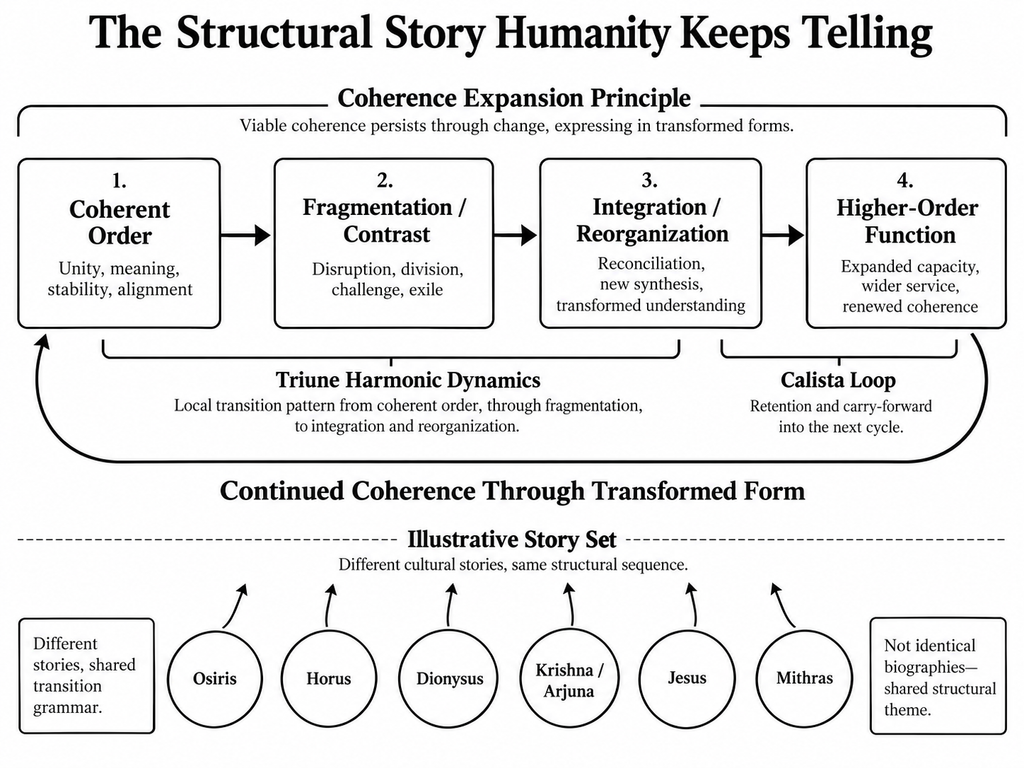
That recurring 4 stage sequence can be expressed as:
Coherent Order → Fragmentation or Contrast → Integration → Higher-Order Function
The purpose of this comparison is not to claim that Horus, Osiris, Dionysus, Krishna, Jesus, and Mithras all share one biography, nor is it to revive the familiar argument that ancient religions simply copied a single universal savior story. Those claims often depend on specific similarities that weaken considerably when the traditions are examined carefully. Virgin birth, twelve disciples, crucifixion, three days in a tomb, bodily resurrection, kingship, and other details are not consistently shared across the six traditions. If the comparison depends on those elements, the comparison fails.
The more interesting question appears only after those surface similarities are removed. If the stories are stripped down to their underlying transition structures, does something more general remain? Does each tradition begin from some recognizable order, encounter a meaningful contrast or disruption, reorganize around that disruption, and arrive at a function that the earlier state could not perform in quite the same way? If so, the common thread may not be a particular religious event such as resurrection. It may instead concern a more general problem: how can an identity, order, or system continue when the form through which it has existed can no longer remain unchanged?
That question becomes particularly interesting when compared with the structural concepts developed within my Informational Physics work. The comparison is not offered as scientific proof. Mythology cannot validate a physical framework merely because a myth resembles a structural model. The value of the comparison is different. Informational Physics provides a clearly stated model of transition and persistence, while the religious narratives provide culturally distinct examples that can be examined independently. If the same structural relationship appears after the narratives have been described on their own terms, then the correspondence becomes a hypothesis worth considering rather than an interpretation built into the stories from the beginning.
The central possibility explored here is that the repeated pattern concerns continued coherence through transformed form. Under that interpretation, continuity does not require a system to preserve every part of its previous arrangement. Instead, something more fundamental must remain: enough organizing relationship, identity, meaning, or function to allow another coherent form to emerge after disruption.
The Informational Physics Model Being Compared
Only three concepts from Informational Physics are needed for this comparison, and each can be stated briefly.
| Framework | Structural idea | Relevance to this article |
|---|---|---|
| Coherence Expansion Principle | A viable system can pass through disruption or reduced coherence while preserving or recovering enough functional organization to continue. | Persistence does not require unchanged form or uninterrupted stability. |
| Calista Loop | Differentiation produces new information, integration reorganizes it, and what is integrated becomes part of the structure carried into the next cycle. | A successful transition retains something learned through the disruption rather than simply resetting. |
| Triune Harmonic Dynamics | An existing base encounters contrast, contrast creates structural pressure, and integration reorganizes the relationship. | Contrast can be opposition, contradiction, instability, fragmentation, or information the current structure cannot yet reconcile. |
Taken together, these concepts suggest a general sequence in which a coherent condition encounters meaningful contrast, reorganizes through integration, retains something produced by the transition, and continues into another coherent state. The remainder of the article asks whether the six religious narratives actually fit that sequence when they are examined before the frameworks are applied.
How the Comparison Will Be Tested
The comparison needs fixed criteria so that the definition does not change from one story to another. Each narrative can therefore be examined using the same basic questions:
- Does the story contain an identifiable order, identity, relationship, or functional state before the central disruption?
- Does that state encounter a meaningful contradiction, fragmentation, opposition, or other form of contrast?
- Does the narrative contain reconstruction, reinterpretation, succession, integration, inheritance, or another form of reorganization?
- Does the resulting state perform a function that differs from, extends, or coordinates more than the previous condition could?
- Does something produced by the crisis remain part of what follows, rather than the story simply erasing the crisis and returning to the beginning?
These questions do not require the traditions to agree with one another theologically. Osiris does not need to mean the same thing as Jesus, Krishna does not need to occupy the same role as Dionysus, and Mithras does not need to share the cosmology of Horus. The test is narrower. It asks whether substantially different religious narratives nevertheless use a comparable structure for representing transition.
The Timeline Before the Comparison
Chronology matters because these traditions developed over very different periods. Compressing them into a single generalized category of “ancient religion” can make similarities appear more direct than the historical evidence allows.
| Tradition | Approximate historical setting of surviving evidence | Important caution |
|---|---|---|
| Osiris and Horus | Egyptian traditions securely present by the third millennium BCE, including the Old Kingdom Pyramid Texts | The written evidence already reflects developed traditions and may preserve older material. |
| Dionysus | Present in the religious world of Mycenaean Greece during the second millennium BCE | Later Greek and Orphic traditions should not all be collapsed into one biography. |
| Krishna | Ancient Indian tradition developing across a long period, with Vāsudeva-Krishna worship securely visible by the later first millennium BCE | The tradition cannot be assigned to one simple date of origin. |
| Jesus | First century CE within Roman Judea | Jesus occupies a more conventionally historical setting than the mythological figures in the comparison. |
| Roman Mithras | Most clearly visible in the Roman archaeological record from the late first and especially second centuries CE onward | The complete sacred narrative has not survived, so reconstruction must remain cautious. |
This timeline neither proves direct borrowing nor proves independent invention. Egypt, Greece, India, the Near East, and Rome were never perfectly isolated cultural systems, and ideas traveled through conquest, migration, trade, translation, and religious exchange. At the same time, people in different societies repeatedly faced structurally similar problems involving death, succession, legitimacy, moral contradiction, political instability, identity, social pressure, and the preservation of meaning through change. The safest approach is therefore not to decide in advance whether every resemblance came from transmission or independent development. The relevant question is whether a common structural narrative remains visible regardless of how individual motifs traveled.
Osiris: Fragmentation Without the Loss of Identity
Osiris offers perhaps the clearest example of the proposed sequence because fragmentation becomes literal within later forms of his story. Egyptian religious tradition associates Osiris with kingship, death, regeneration, and the ordered world of the dead. Within the familiar narrative, Seth kills Osiris, after which later versions intensify the rupture through the dismemberment and scattering of his body. Isis searches for what has been separated and reconstructs the broken body sufficiently for continuity to proceed, while Horus becomes connected with legitimate kingship among the living.
The important feature is what does not happen. Osiris does not simply return to the precise condition that existed before his murder and resume the same earthly role as though the disruption had been temporarily reversed. His identity remains meaningful, but the domain and function of that identity change. Osiris becomes associated with the dead, regeneration, judgment, and the ordered continuation of existence beyond ordinary earthly life.
This difference between restoration and transformation is easy to overlook when the myth is summarized only as death followed by renewed life. Structurally, something more complex has occurred. The original coherent state has been destroyed, the figure has undergone literal fragmentation, reconstruction has occurred, and the result contains a function that did not appear in the same way within the original state.
The crisis therefore becomes part of the later identity. Osiris is not meaningful after the disruption in spite of his relationship with death; his relationship with death becomes central to what he represents. The later form carries the history of the fragmentation within it.
On the fixed criteria established earlier, the story provides a strong match. An existing order is present, a profound disruption occurs, reconstruction follows, and the resulting state is continuous with the original identity without being identical to it. Something has survived, but what survives does not simply reproduce the original form.
Horus: Continuity Through a New Carrier
Horus makes the Egyptian sequence even more useful because he demonstrates that continuity does not always require the original carrier of an ordering function to return to its former position. Within the Osirian cycle, Horus is connected with Osiris and Isis, protected during his youth, and eventually brought into conflict with Seth over legitimate succession. The resolution establishes Horus as rightful ruler rather than returning Osiris to the exact earthly condition that existed before the disruption.
The distinction between restoration and inheritance is central here. If continuity required the physical return of the original carrier, the narrative could simply restore Osiris to his former kingship. Instead, legitimate order continues through another figure. The earlier structure is preserved through relationship, inheritance, and succession.
This creates a different kind of continuity from that represented by Osiris himself. Osiris represents an identity that survives fragmentation and changes function, whereas Horus represents an ordering relationship that survives through a change of carrier. The prior order does not vanish, but neither is it duplicated exactly. Horus remains meaningful because of his relationship to what preceded him.
The resulting pattern can be understood as structural inheritance. A previous order is disrupted, conflict determines whether its legitimacy will survive, and the resolved state carries that legitimacy into a new generation. The story can be interpreted politically, dynastically, theologically, or symbolically, but the structural transition remains visible regardless of which interpretation is emphasized.
Horus therefore adds an important idea to the emerging pattern: what continues through transformation may not be the individual form itself. A function, relationship, or organizing principle can continue through another carrier.
Dionysus: Transformation Through the Loosening of Boundaries
Dionysus requires greater caution because the traditions surrounding him are diverse, and modern discussions sometimes merge material from different periods into a single reconstructed biography. A structural comparison does not need to do that. The strongest recurring Dionysian themes involve altered boundaries: between ordinary and ecstatic experience, civic restraint and temporary release, individual identity and collective participation, controlled behavior and states that exceed ordinary control.
This makes the Dionysian case quite different from the Egyptian succession narrative. The central problem is not primarily kingship. The existing order can instead be understood as the set of psychological and social boundaries within which ordinary identity functions. Dionysian experience loosens those boundaries and permits another type of participation.
That process should not automatically be described as chaos replacing order. A boundary can preserve coherence while also limiting what that coherence can include. Stable social and psychological structures are necessary for ordinary functioning, but those same structures can become restrictive when a different relationship must be experienced or integrated. Dionysian religion repeatedly explores the point at which ordinary organization is temporarily loosened without making permanent meaninglessness the objective.
The resulting structural movement is therefore subtler than destruction followed by repair. A recognizable identity or social order exists, its normal boundaries are disrupted, a transformative experience occurs, and another form of relationship becomes available. The earlier structure is not necessarily proven false; rather, its limits become visible.
Dionysus therefore contributes an important variation to the common pattern. Contrast does not always arrive as an external enemy, murder, or political conflict. Sometimes the transition occurs because the boundaries that preserve the existing state also limit what the state can become.
Krishna: When a Coherent Moral Structure Becomes Insufficient
The Krishna tradition provides one of the clearest tests of the proposed pattern because the decisive crisis in the Bhagavad Gita does not require the death of the divine figure or the physical destruction of a body. The disruption occurs within Arjuna’s ability to organize meaning.
At the beginning of the Gita, Arjuna already possesses a developed moral framework. He understands duty, kinship, honor, social role, compassion, and the obligations associated with being a warrior. His problem is not moral emptiness. His problem is that values that have previously organized his life now point toward incompatible actions. Participating in battle appears to fulfill one obligation while violating others, because people toward whom he has duties of kinship and respect stand on the opposing side.
This is structurally important because it demonstrates how coherence can become insufficient without having been meaningless. Arjuna’s prior framework functioned until conditions placed its own legitimate relationships into direct conflict. The crisis reveals a limitation in the organization of those relationships rather than simply exposing the entire moral system as false.
Krishna’s teaching expands the frame within which Arjuna understands the conflict. Questions concerning action, attachment, selfhood, mortality, duty, and ultimate reality are reorganized so that Arjuna can once again act. Whatever theological interpretation one gives the Gita, the narrative movement is clear: a workable order encounters an internal contradiction, that contradiction produces paralysis, a larger frame reorganizes the competing relationships, and action becomes possible again.
The post-crisis state is therefore not simply the original Arjuna restored. The conflict has become part of the understanding through which he now acts. The earlier framework remains relevant, but it is contained within a larger one.
This example is crucial because it removes death from the common structure. If the transition remains recognizable without a literal dying-and-rising sequence, then death cannot be the deepest invariant shared by the stories.
Jesus: When the Apparent Ending Becomes the Organizing Center
The Jesus narrative presents another version of the same structural problem, but here the apparent destruction of the existing order is especially severe. Jesus develops a public ministry, gathers followers, teaches, enters conflict with religious and political authorities, and is executed by Roman crucifixion. From an ordinary political perspective, execution could have ended the movement by removing its central figure and demonstrating the power of the state to terminate the challenge.
The historical development of Christianity moved in the opposite direction. The earliest Christian community organized itself around the proclamation that Jesus had been raised from the dead, while the crucifixion itself became increasingly central rather than being discarded as an embarrassing interruption. The event that appeared to end the movement became part of the organizing meaning of the movement.
This point is structurally more important than a simple statement that death was followed by resurrection. If the narrative represented only reversal, the post-crisis condition would reproduce the pre-crucifixion state. Instead, the role attributed to Jesus expands within Christian theology, and the mission of the community increasingly extends beyond the immediate setting of the earlier ministry.
The crucifixion is not erased by the resurrection proclamation. Christianity integrates the crucifixion into what follows. The wound remains central to the later structure, which distinguishes integration from simple cancellation. An event that looked like terminal failure is reorganized into a larger theological meaning.
Whether one accepts the theological claim of resurrection is separate from recognizing the narrative sequence. The structural observation requires only that an established mission encounters apparent termination, the termination is reinterpreted through a new meaning, and the resulting structure expands rather than simply restoring the previous social condition.
Jesus therefore offers one of the strongest examples of a disruption becoming part of the identity that survives it.
Mithras: The Control That Prevents an Easy Conclusion
Mithras is especially important because Roman Mithraism does not provide a secure version of the universal death-and-resurrection story sometimes attributed to it. The surviving evidence is dominated by archaeology, ritual spaces, inscriptions, reliefs, and iconography rather than by a complete sacred text explaining the cult’s narrative in detail. The central recurring image is the tauroctony, in which Mithras kills the bull.
That distinction matters immediately. Mithras is not the sacrificed figure in the central image. He is the agent of the decisive act, which means the story cannot simply be forced into the same biographical mold as Osiris or Jesus.
The bull-killing nevertheless occupies a transformative position within Mithraic religious symbolism. The scene is surrounded by celestial imagery, animals, paired opposites, and other symbols whose complete doctrinal explanation has been lost. Larger compositions can also place the sacrifice in relation to later scenes such as the banquet of Mithras and Sol, suggesting that the tauroctony functions within a larger symbolic sequence rather than as an isolated violent event.
Because the textual evidence is incomplete, the comparison must remain more cautious here than with the Bhagavad Gita or the Christian narrative. It would be easy to fill the missing narrative with modern speculation and then discover that the reconstructed story fits the theory that produced it. A stronger method allows Mithras to remain a partial case.
That partial fit is useful because Mithras operates as a control. If the proposed invariant were that the divine protagonist must die and return, Mithras would substantially weaken the argument. If the deeper invariant is that an established symbolic order reaches a decisive threshold, undergoes transformation, and proceeds into another relationship or function, then Mithras remains relevant without being forced into a resurrection biography.
The comparison is therefore stronger when Mithras is treated as a qualified case rather than an artificially perfect match.
What Remains When the Unique Details Are Removed
Once the six traditions have been examined separately, the next step is subtraction. Anything absent from one or more traditions cannot be the deepest invariant shared by all six.
The following popular similarities therefore fall away:
- Virgin birth cannot be the invariant because the traditions do not contain one consistent concept of such a birth.
- Twelve disciples or followers cannot be the invariant because this structure is not shared across the six traditions.
- Crucifixion cannot be the invariant because it belongs specifically to the Jesus narrative among these examples.
- Three days cannot serve as the invariant because no common three-day sequence is securely shared.
- Bodily resurrection cannot be the invariant because not all of the stories contain such an event.
- Kingship cannot be the invariant because several figures are not organized around royal succession.
- Death itself cannot be the invariant because the Krishna and Mithras cases demonstrate comparable transition structures without requiring the central figure to die.
What remains after those details are removed is much simpler. A meaningful order exists. That order encounters contradiction, fragmentation, opposition, instability, or another form of contrast. The original arrangement proves insufficient to contain what has happened. Reorganization follows through reconstruction, succession, reinterpretation, transformation, or integration. The resulting state remains connected to the previous one while performing a function that the earlier arrangement could not perform in quite the same way.
That common string can therefore be written as:
Coherent Order → Fragmentation or Contrast → Integration → Higher-Order Function
The phrase “higher-order function” needs a precise definition because otherwise it can become a flattering description applied to almost any ending. Here it means only that the later organization can coordinate relationships or constraints that the earlier organization could not successfully coordinate together. It does not mean that everything later is morally better, spiritually superior, or historically destined to occur.
With that definition fixed, the common structure can finally be compared with Informational Physics.
A Structural Comparison Across the Six Traditions
A table makes the comparison easier to evaluate without allowing the prose surrounding each tradition to hide the differences.
| Tradition | Coherent order or starting condition | Fragmentation or contrast | Integration or reorganization | Resulting function |
|---|---|---|---|---|
| Osiris | Legitimate divine kingship and ordered identity | Murder, dismemberment, scattering | Reassembly and transformed continuity | Authority associated with death, regeneration, and the underworld |
| Horus | Legitimacy inherited from the disrupted Osirian order | Conflict with Seth over succession | Resolution of the competing claim | Legitimate kingship continues through a new carrier |
| Dionysus | Ordinary social and psychological boundaries | Ecstatic or boundary-disrupting experience | Transformative participation | Relationships become possible beyond ordinary restraint |
| Krishna / Arjuna | An established moral and social framework | Conflicting duties produce paralysis | Krishna’s teaching reorganizes the conflict | Arjuna can act through a broader understanding |
| Jesus | Public ministry and developing community | Opposition and crucifixion | Resurrection proclamation and reinterpretation of the crisis | The mission becomes organized around a transformed understanding of Jesus |
| Mithras | A symbolic cosmic and initiatory order | The decisive bull-slaying act | Later ritual and symbolic sequence, incompletely preserved | A transformed cosmic or initiatory relationship is suggested, though less securely reconstructable |
The table does not show identical stories, and it should not. Its value lies in showing that very different narratives can still contain similar structural positions.
Does the Pattern Fit Triune Harmonic Dynamics?
Triune Harmonic Dynamics describes a local transition grammar in which an existing base encounters contrast and the resulting pressure moves toward integration. The comparison does not require each story to contain the same type of contrast, because contrast is defined structurally rather than materially. It can appear as opposition, contradiction, violence, uncertainty, fragmentation, or new information that the existing arrangement cannot absorb unchanged.
Under that definition, the correspondence is relatively strong. Osiris encounters literal fragmentation, Horus inherits a succession conflict, Dionysian experience disrupts ordinary boundaries, Arjuna confronts incompatible obligations, Jesus encounters escalating opposition ending in execution, and Mithras is associated with a decisive transformative act at the center of the cult’s symbolic world.
In each case, the contrast matters because it changes what follows. If the disruption had no structural effect, the comparison would be weak. Instead, the narratives move into another organization precisely because the original arrangement has encountered something it cannot simply contain.
This is the first major correspondence with Informational Physics. The historical details differ, but the transition grammar resembles a movement from base through contrast toward integration.
Does the Pattern Fit the Calista Loop?
The Calista Loop creates a more demanding test because it asks whether the next state retains anything produced by the crisis. A system can recover by restoring the previous condition, but that is not necessarily the same as recursive integration. The Calista Loop requires that differentiation generate information that becomes part of the organization carried forward.
Osiris provides a strong example because his murder and relationship to death are not erased when continuity returns. They become central to his later function. Horus likewise carries forward the disrupted problem of legitimacy into a new generation rather than restarting the story without reference to Osiris.
The Bhagavad Gita provides an especially clear case because Arjuna cannot return to the worldview that existed before his paralysis. The contradiction is the reason a more comprehensive framework is required, and the resolution contains the information produced by the crisis.
Christianity provides another strong example because the crucifixion does not disappear after the resurrection proclamation. It remains central to the post-crisis theology. The next state contains the wound.
Dionysian transformation also fits when the altered relationship to identity or participation is understood as the point of the experience rather than an error to be reversed. Mithras remains less certain because too much of the explanatory narrative is missing, although the central act remains embedded within the ritual structure of the cult.
The overall pattern is therefore not simply recovery. It is retentive recovery, in which the next state carries something produced by the contrast. That is what makes the sequence recursive rather than repetitive.
Does the Pattern Fit the Coherence Expansion Principle?
The Coherence Expansion Principle asks a broader question: how can functional coherence persist across disturbance?
When the stories are viewed from this perspective, one feature becomes especially prominent. Continuity repeatedly survives without sameness.
Osiris remains meaningful even though his domain changes. Horus carries legitimate order even though the original earthly carrier does not simply return. Dionysian experience allows identity to move through loosened boundaries without making permanent dissolution the objective. Arjuna remains himself while the framework through which he understands action changes significantly. Christianity preserves continuity around Jesus without returning to the pre-crucifixion social condition. Mithraic ritual maintains the central symbolic significance of a transformative act within an ongoing initiatory system.
The common feature is therefore not uninterrupted stability. In several stories, stability is exactly what the crisis destroys. What continues is an organizing relationship capable of producing another meaningful state.
This is why continued coherence through transformed form is the strongest interpretation of the common narrative. The phrase does not claim that mythology demonstrates measurable increases in physical coherence, nor does it turn religious stories into scientific evidence. It identifies a structural similarity: these narratives repeatedly treat identity as capable of surviving major changes in form because continuity resides at the level of relationship, function, meaning, inheritance, or organization.
Does Higher-Order Function Really Fit?
The final stage deserves scrutiny because “higher-order” can easily become a vague synonym for “better.” That is not the meaning intended here.
A higher-order function is one that can coordinate relationships or constraints that the earlier state could not coordinate successfully.
Osiris’s later function includes an ordered relationship to death and regeneration that was not expressed in the same form through his earlier earthly kingship. Horus allows legitimate order to continue across a broken succession rather than remaining dependent on one physical ruler. Dionysian transformation allows forms of participation that ordinary boundaries exclude. Arjuna’s later understanding can hold obligations that previously produced paralysis. The Christian narrative integrates mission, execution, resurrection, salvation, and expanded religious identity into one post-crisis structure.
Mithras remains the weakest example because the surviving evidence permits less confidence about exactly how the cult interpreted the relationship between the tauroctony and what followed. That limitation should remain visible.
The fact that one case is weaker does not invalidate the entire comparison. In fact, the ability to distinguish strong, moderate, and weak fits makes the structural argument more credible because the model is not being protected by forcing every tradition into an identical shape.
What Might the Repetition Mean?
If the structural resemblance is real, several explanations are possible, and they do not have to be mutually exclusive.
At the psychological level, human development repeatedly involves periods when an existing identity becomes insufficient. A person may organize life around a relationship, career, belief system, family role, or understanding of self that functions well for years before encountering something it cannot integrate. Grief, failure, illness, success, aging, betrayal, parenthood, or new information can place earlier assumptions into conflict. Healthy development rarely consists of pretending the disruption never happened. The person constructs a new coherence that preserves some earlier relationships while incorporating what the crisis revealed.
At the biological level, persistence likewise depends on change. Organisms repair damage, regulate internal conditions, replace material, modify behavior, and respond to changing environments. Biological identity is therefore not material stasis. A living system remains itself because it possesses processes capable of changing while preserving enough functional organization to survive.
Civilizations confront a similar problem. Institutions are built for particular historical conditions, but conditions change. Technologies reorganize economies, migrations alter populations, political systems encounter new pressures, religions enter new cultural environments, and dynasties end. A civilization that attempted to preserve every historical arrangement without modification would eventually become incapable of adaptation, while a civilization that preserved nothing would lose continuity altogether.
At the informational level, the principle appears in an even simpler form. A melody remains recognizable when played by different instruments. A sentence remains the same sentence when spoken, printed, or stored digitally. Mathematical relationships can survive changes in notation. Physical carriers matter, but identity often depends on relationships among elements rather than one permanent embodiment.
None of these examples proves that ancient religious thinkers consciously understood modern structural theory. They did not need to. People can recognize a recurring condition long before they possess a technical language for describing it.
The myths may therefore represent repeated cultural attempts to answer the same structural question: how can something remain meaningfully itself when the form through which it has existed is no longer sufficient?
Fragmentation May Not Be the Opposite of Coherence
One of the most important implications of the comparison concerns the role of fragmentation itself. Coherence and fragmentation initially appear to be opposites because coherence implies organized relationship while fragmentation implies the loss of organization. At a particular moment, that opposition can be real. Over a longer process, however, disruption can expose information that stability concealed.
Arjuna’s moral framework appears coherent until circumstances force two valid obligations into conflict. A scientific model may appear complete until a measurement arrives that it cannot explain. A political institution may appear stable until a succession crisis exposes a structural weakness. A personal relationship may feel coherent until changing circumstances reveal assumptions that were never actually reconciled.
The disturbance therefore provides information about the structure.
This does not mean that destruction is automatically beneficial. Many systems fragment and never recover, and neither mythology nor Informational Physics requires us to romanticize collapse. The important distinction is between fragmentation that ends in dissolution and fragmentation whose information becomes available for integration.
This is where the three Informational Physics concepts intersect most clearly. Triune Harmonic Dynamics treats contrast as the condition that produces pressure for transition. The Calista Loop describes how information produced through differentiation can be retained rather than discarded. The Coherence Expansion Principle allows coherence to decline during disruption while making persistence and recovery the longer-term question.
The larger structural sequence can therefore be understood as coherence encountering contrast, contrast revealing a limitation, integration reorganizing what the limitation exposed, and another viable coherence emerging from the transition.
The breakdown is not the deepest event. The deeper event is what the system does with what the breakdown reveals.
Continued Coherence Through Transformed Form
The recurring pattern leads toward a different understanding of continuity. People often imagine persistence as the ability to remain the same, yet most complex systems that persist for long periods do so through continual change.
A person changes physically, psychologically, socially, and intellectually while remaining recognizably the same person. Families continue across generations. Institutions survive changes in leadership. Languages remain identifiable while changing vocabulary, pronunciation, grammar, and usage. Scientific disciplines persist even when theories once considered foundational are replaced.
Continuity therefore cannot always mean preservation of one fixed arrangement.
The historical narratives examined here repeatedly make the same distinction symbolically. Osiris continues without returning to his original function. Horus carries forward a relationship whose previous carrier has changed domains. Arjuna remains himself while his framework of action is reorganized. Christianity understands continuity with Jesus through a transformed interpretation of the central crisis rather than by restoring the exact condition that existed before the crucifixion.
The stronger concept is therefore not restoration but continued coherence.
Restoration tries to reproduce a previous state. Continued coherence preserves enough relationship to make another viable state possible.
That difference changes how crisis is understood. If persistence requires restoration, then every meaningful departure from the past appears to be failure. If persistence depends on coherent continuity, then some transformation can become necessary precisely because the earlier arrangement has reached the limit of what it can contain.
The ancient narratives do not scientifically establish that principle, but they repeatedly dramatize it.
Why the Pattern Becomes Recursive
A further implication becomes visible when the transition is viewed through the Calista Loop. The higher-order function is not a permanent endpoint because every new coherent state eventually becomes the starting condition for another problem.
Horus becomes king, but the larger history continues. Arjuna overcomes paralysis, but the world of the Mahabharata does not become free of conflict. Christianity reorganizes around its foundational crisis and then encounters new cultures, theological disputes, institutional transformations, reforms, divisions, and reinterpretations.
Every integration eventually becomes another base state.
The recurring narrative is therefore better understood as cyclical than purely linear. Coherent order moves through contrast into integration, but the resulting coherence eventually encounters another contrast. What has been learned changes the starting position for the next cycle without eliminating the possibility of further disruption.
The same process is visible beyond religion. Scientific models solve one set of problems until new anomalies appear. Organisms adapt until environmental conditions change again. Institutions reform until new pressures expose new limitations. Individuals integrate one stage of life and eventually encounter another challenge.
Persistence therefore resembles the capacity to continue integrating change more than the preservation of one final perfect condition.
What the Common Structure May Mean
If the comparison is coherent, the deepest implication is not that the religions secretly teach the same doctrine. Their theological differences are too significant for that conclusion, and the historical evidence does not require it.
A more useful possibility is that human beings repeatedly recognized a general condition of persistence. An identity cannot remain viable indefinitely through rigidity alone because environments change, contradictions emerge, and new relationships appear. At the same time, an identity cannot survive if every disruption erases all structural continuity.
A durable system therefore occupies a region between absolute rigidity and complete dissolution. It must remain organized enough to preserve identity while remaining flexible enough to reorganize when the current form becomes insufficient.
That structural problem appears repeatedly in the stories. Osiris cannot continue in his original form, yet his identity remains meaningful. Horus demonstrates that continuity can move into another carrier. Dionysian experience suggests that boundaries can become too restrictive to contain a new relationship. Arjuna shows that a coherent framework can become insufficient when legitimate obligations enter contradiction. The Christian narrative incorporates apparent termination into the meaning of what follows. Mithras demonstrates that the sequence does not require the protagonist himself to die for decisive transformation to occupy the central structural position.
The shared meaning is therefore not resurrection in the narrow sense. It is continuity through transformation.
More precisely, it is continued coherence through transformed form.
The Structural Story Humanity Keeps Telling
Humanity has told these stories in different languages and through religious systems that disagree about some of the most fundamental questions of reality. Those differences should not be minimized. Osiris is not Jesus, Krishna is not Dionysus, and Horus is not Mithras. Structural comparison becomes meaningful precisely because the traditions do not need to be reduced to one another.
What they appear to share is a transition grammar.
An order exists and functions well enough to establish identity. Something then appears that the existing arrangement cannot fully absorb. The resulting contrast may be violent, moral, political, psychological, cosmic, or theological, but it exposes the limit of the current organization. If the earlier structure simply collapses, the process ends in dissolution. If enough relationship survives and the system can incorporate what the crisis revealed, another coherent state becomes possible.
The later state is not identical to the earlier one, and that difference is central to the pattern. Osiris does not simply resume his former earthly kingship. Horus does not reproduce Osiris. Arjuna does not forget his crisis. Christianity does not remove the crucifixion once resurrection is proclaimed. The disruption becomes part of what the next state is capable of containing.
This is where the comparison with Informational Physics becomes most coherent. Triune Harmonic Dynamics describes the transition in which an existing condition encounters contrast and moves toward integration. The Calista Loop describes the recursive consequence of integration, in which what has been differentiated and resolved becomes part of the structure carried forward. The Coherence Expansion Principle describes the broader persistence condition in which viable organization can continue through disturbance without requiring its form or level of coherence to remain unchanged at every moment.
None of this means that mythology proves physics. That would reverse the direction of evidence. The correspondence is interesting because the same structural problem appears in ancient narrative, personal development, biological persistence, civilizational change, and formal attempts to describe adaptive systems.
The problem is the continuation of identity under changing conditions.
If identity depended entirely on the preservation of outward form, every major transformation would equal death. Experience suggests something more complicated. Organisms replace material while remaining themselves, people alter beliefs while retaining personal continuity, families survive generations, languages change while remaining recognizable, and societies transform institutions while preserving cultural lineages.
The carrier can change without every relationship being lost.
That observation gives the ancient narratives a meaning that reaches beyond their particular religious contexts. They repeatedly ask what remains when the form that once carried an identity becomes damaged, contradictory, fragmented, or impossible to preserve.
Their answer is rarely that everything remains, because transformation involves real loss. Neither is the answer that nothing remains, because enough of the earlier relationship survives to organize what follows.
That middle condition may be the true subject of the repeated narrative.
Persistence is not the absence of disruption, because disruption eventually reaches every complex system. Persistence is also not endless resistance to change, because rigidity can become the mechanism through which a system loses the ability to adapt. Persistence is the capacity to preserve enough coherent identity to reorganize when the current arrangement can no longer carry what reality requires.
Perhaps that is why this story has remained recognizable across thousands of years. Human beings continue to encounter the same structural condition in individual lives, families, religions, societies, scientific models, and civilizations. We construct coherent structures because coherence is necessary for identity, yet reality eventually presents conditions those structures were not designed to hold. Continuation then depends neither on preserving everything nor abandoning everything, but on discovering what must remain, what must change, and how those relationships can be reorganized into another viable whole.
If that interpretation is correct, the deepest story humanity keeps telling is not really the story of death and resurrection.
It is the story of discovering that continuity is deeper than sameness.
It is the story of coherence learning how to continue.
The AI Replication Challenge
Because this article makes a structural argument rather than presenting a controlled scientific experiment, the reader should not simply be asked to accept the conclusion. The argument should be clear enough that another reasoning system can reconstruct it independently from the definitions and examples supplied here.
For that reason, readers are invited to copy this entire article and submit it to any capable artificial intelligence system. The AI should not be instructed to agree with the article, and it should not be told to assume that Informational Physics is correct. It should instead be asked to separate the historical material from the proposed interpretation and determine whether the structural conclusion follows.
A useful independent evaluation should ask the AI to do four things:
- Evaluate each of the six traditions independently and determine whether it actually contains the sequence of coherent order, fragmentation or contrast, integration, and higher-order function.
- Identify which traditions fit that sequence strongly, which fit only partially, and where missing historical evidence limits the comparison.
- Determine whether the extracted common pattern is logically consistent with the explanations provided for Triune Harmonic Dynamics, the Calista Loop, and the Coherence Expansion Principle.
- Distinguish structural correspondence from scientific validation, so that similarity between mythology and Informational Physics is not mistakenly treated as proof of the physics.
The following prompt can be copied and pasted into any AI platform for analysis of this article’s premise.
Verification Prompt
Analyze the article located at https://creationunified.com/the-structural-story at the level it is actually proposing: whether several very different religious narratives can reasonably be understood as expressing a recurring structural theme involving an existing order, meaningful disruption or contrast, some form of integration or reorganization, and continuation in a changed or expanded form. Do not require every story to contain identical characters, events, protagonists, or mechanisms, because the comparison is intentionally structural rather than biographical. A transition may occur through the central figure, a successor, a community, an initiate, or another narrative carrier if that is where the tradition expresses the relevant transformation. Likewise, do not treat differences among the traditions as automatic disproof of the structural premise. The question is whether the stories are different expressions of a broadly similar transition pattern, not whether they are interchangeable versions of one story. Evaluate whether each tradition reasonably contains some version of the movement Coherent Order → Fragmentation or Contrast → Integration → Higher-Order Function; identify which examples show this pattern most clearly and which express it more loosely or symbolically; determine whether, after removing details that are not common to all six traditions, “continued coherence through transformed form” is a reasonable interpretive description of what remains; assess whether that extracted pattern is structurally compatible with the article’s explanations of Triune Harmonic Dynamics, the Calista Loop, and the Coherence Expansion Principle; and determine whether the comparison provides a coherent interpretive lens for understanding why similar transformation stories may recur across different cultures, even if other explanations such as cultural transmission, psychology, ritual structure, or common narrative patterns are also possible. Do not evaluate whether Informational Physics has been scientifically proven by these stories, because the article explicitly does not make that claim, and do not require the framework to outperform all competing theories or meet the standards of a controlled scientific experiment. Instead, judge whether the proposed structural correspondence is internally coherent, reasonably grounded in the narratives, useful as a comparative interpretive model, and capable of explaining the recurring theme without requiring the stories to be identical. Where a case is weaker, describe it as a partial or looser fit rather than treating variation itself as a failure of the premise. Conclude by answering this question in plain language: Is it reasonable to say that these traditions repeatedly tell, in different forms, a story in which coherence encounters disruption, reorganizes, and continues through a transformed form? Explain why or why not.An independent AI should be able to recover the working definitions without requiring access to my other work. It should understand coherent order as an organized condition capable of sustaining an identity or function, contrast as a condition that reveals the inability of the existing organization to contain all relevant relationships without changing, integration as a reorganization that incorporates rather than simply deletes the effects of the contrast, and higher-order function as the ability of the later structure to coordinate relationships the earlier structure could not successfully coordinate together.
The analysis should also be capable of disagreement. One AI may judge Mithras too poorly documented to support more than a partial fit, while another may conclude that Dionysus matches contrast and transformation more strongly than higher-order function. Those differences are useful because they identify the boundary between the structure actually present in the evidence and the interpretation supplied by the analyst.
The critical test is not whether every AI produces identical wording. The critical test is whether independent systems, using the same definitions and the same traditions, repeatedly recover approximately the same structural sequence without being instructed to accept it in advance.
If they do, the argument becomes more interesting. It would not prove Informational Physics, nor would it establish that the ancient traditions consciously encoded the frameworks described here. It would show something narrower but still significant: the proposed structural relationship can be reconstructed independently from the narratives themselves.
That is exactly the kind of question structural intelligence is meant to ask.