

The Source to Oversoul Model
An efficient architecture for energetic exploration and integration
The Source to Oversoul Model proposes that a structured, hierarchical identity architecture is an efficient solution to a recurring systems problem: how can one whole explore a large possibility-space through many differentiated perspectives without losing coherence, overwhelming the integrator, or duplicating the same information?
In the model, Source differentiates into Oversouls, Oversouls differentiate into SoulStreams, and SoulStreams express through multiple embodied experiences. The structure is not presented as preferable merely because a tradition describes it. Its coherence comes from the same optimization pressures seen in many natural and engineered systems: broaden coverage, preserve useful differences, limit coordination cost, and integrate what is learned.
- ✓Explore a theme through differentiated perspectives
- ✓See how multiple local experiences broaden integrated understanding
- ✓Understand why the hierarchy is coherent and efficient
- ✓Compare the model with plausible alternative structures
- ✓See how structural burdens change as the system scales
Human Archetype: Source → Oversouls → SoulStreams → Embodied Experiences
One identity creates multiple perspectives so that a broader theme can be explored under different conditions.
What is learned through local experiences is gathered upward into a broader, more coherent understanding.
Selected Perspective Details
Select a SoulStream in the diagram to explore its role.
Exploration Coverage
Conceptual coverage map — not a measurement or score.
Theme in Context
Why This Structure Is Coherent
The model is not meant to be an arbitrary metaphysical preference. It is presented as an optimized structure for exploration. The key question is: what architecture lets one whole sample more of a theme, preserve meaningful differences, and still integrate what is learned without collapsing into bottlenecks or redundancy?
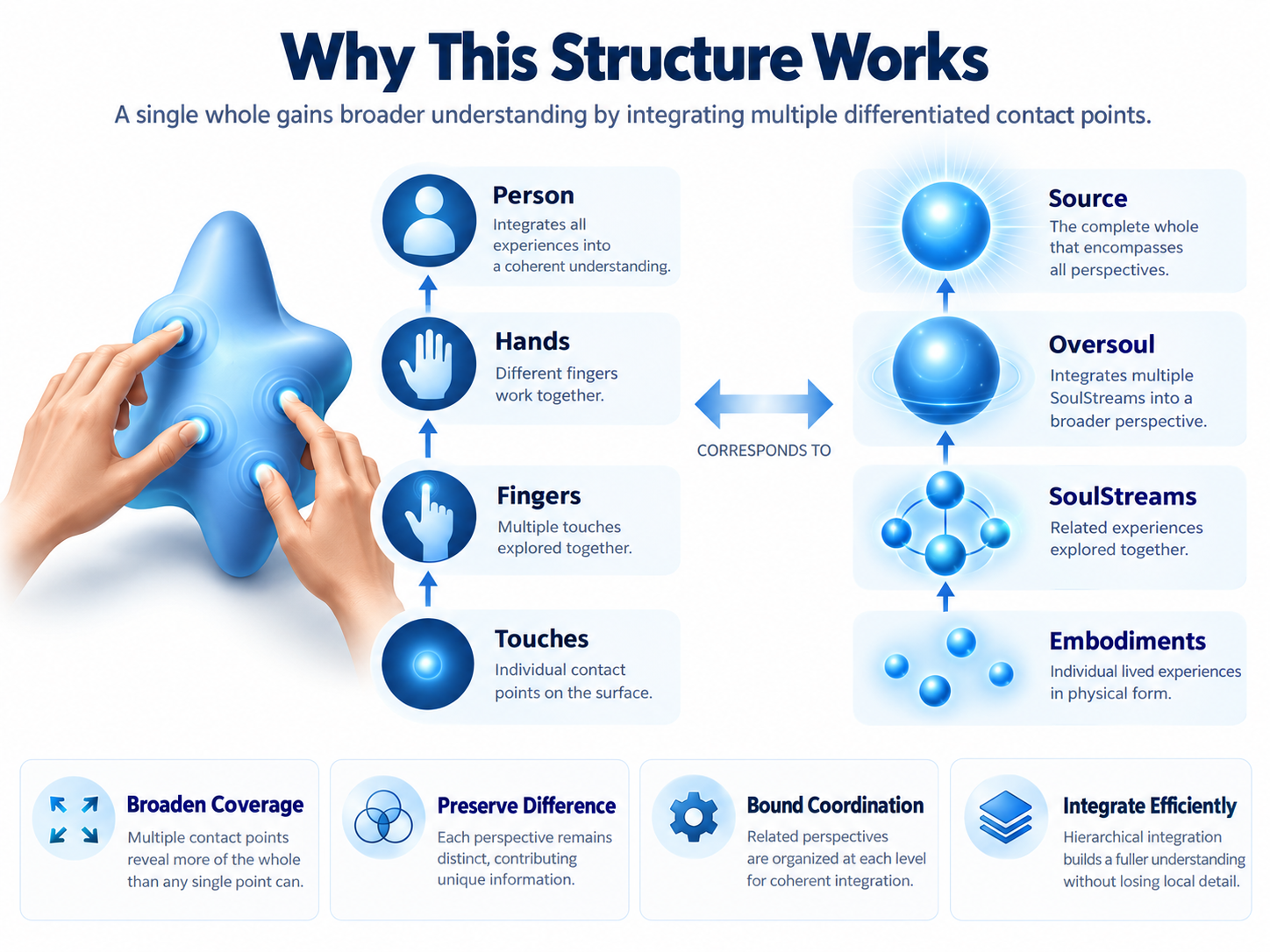
The hands analogy makes the logic intuitive. A person can learn an object through multiple touches. Different fingers contribute different local information. Each hand coordinates local touch channels, and the person integrates bilateral information into one coherent representation. The functional mapping used in this tool is: Person → Source; Hands → Oversouls; Fingers → SoulStreams; Touches → Embodied encounters.
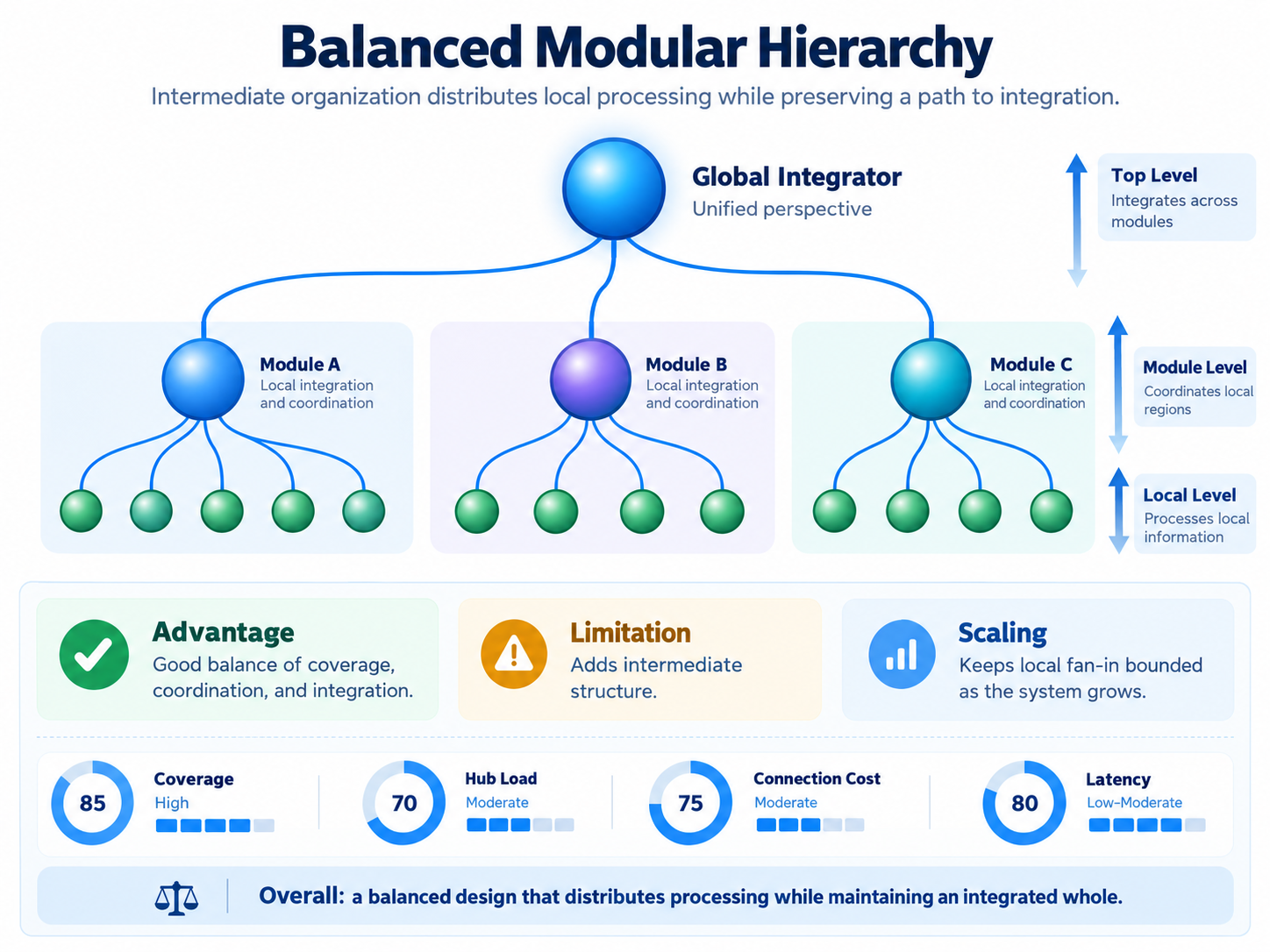
The bilateral human form is an example, not a universal branch-count rule. In the formal model, the number of Oversoul modules is adaptive: one, two, or more modules may be favored depending on information gain, coordination burden, integration latency, redundancy, and recoverability.
Structural Scaling Illustration
Move the slider to compare the coordination burden created by different structures as the number of local experiential nodes increases.
Repercussion: the single integrator becomes progressively more overloaded as every new node connects directly to it.
Repercussion: the longest information path becomes slower and more vulnerable to delay as the chain grows.
Repercussion: connection and coordination requirements expand extremely rapidly as nodes are added.
Repercussion: intermediate integration keeps the heaviest local burden comparatively small as the system grows.