
A Falsifiable Model for Matter Teleportation
Matter teleportation is often discussed as though it were an extension of quantum teleportation, but the two problems are physically different. Quantum teleportation transfers a quantum state between carriers; it does not relocate the material system itself. This paper develops a stronger and deliberately falsifiable question: what additional physical structure would be required for the spatial support of a conserved material system to transfer from one physical node to another without an ordinary matter flux through the intervening three-dimensional region?
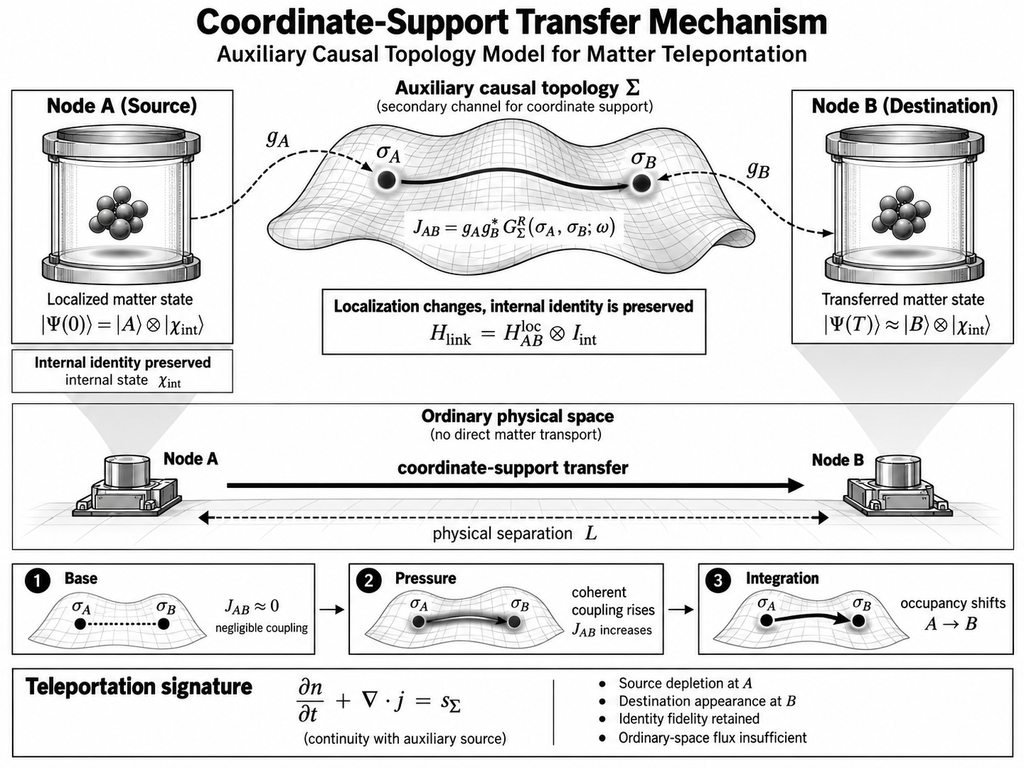
The paper begins with a no-transfer result. If all applied controls remain diagonal in the source/destination localization basis, they may change phases, energies, or coherence but cannot change localization occupancy. A genuine matter-transfer theory therefore requires a nonzero off-diagonal coupling between the two localization sectors.
The proposed effective model introduces an auxiliary causal topology, denoted $\Sigma$. Source and destination localization modes map to auxiliary locations $\sigma_A$ and $\sigma_B$ and couple locally to an auxiliary link sector. Eliminating that sector yields an effective interaction
$J_{AB}(\omega,t)=g_A(t)g_B^*(t)G_\Sigma^R(\sigma_A,\sigma_B;\omega)$.
The auxiliary propagator is required to be retarded and finite-speed in its own topology; the manuscript does not assume instantaneous transfer, faster-than-light signaling, or backward time transfer. The material state is factored into localization and internal components so that the ideal interaction changes coordinate support while approximately preserving internal identity.
A three-mode adiabatic realization, mathematically related to established STIRAP, coherent tunneling by adiabatic passage, and spatial adiabatic passage, is used to demonstrate the control logic. The novelty is not the dark-state mathematics itself, but the physical hypothesis that the intermediate connectivity could belong to a distinct auxiliary topology rather than to a known ordinary-space channel. Synthetic numerical integration verifies the stated dimensionless equations and produces near-unit endpoint transfer for the frozen illustrative parameter set. These calculations are internal model validation only and are not empirical evidence for $\Sigma$ or for matter teleportation.
The decisive experimental signature is conjunctive: source depletion, destination appearance, preservation of a preregistered internal-state marker, transfer dependence on the frozen control sequence and detuning, destination selectivity, and ordinary-space flux that is quantitatively insufficient to explain the paired occupancy change. A staged experimental program begins with isolated single-particle systems before any mesoscopic or macroscopic extension is considered.
The accompanying reproducibility package contains the frozen manuscript, equation and symbol ledgers, falsification record, synthetic model code, regression tests, generated data tables, figures, assumptions, and adversarial-review records. No empirical matter-transfer data are included.