
Ultra-weak microwave photon-regeneration experiments face a measurement problem that can become more important than detector sensitivity itself: an apparent regenerated signal may instead be ordinary electromagnetic leakage from the source into the receiver. This methods paper develops a falsifiable metrology framework for placing a quantitative upper bound on conventional source-correlated power that can occupy the same receiver mode as a hypothesized weak signal.
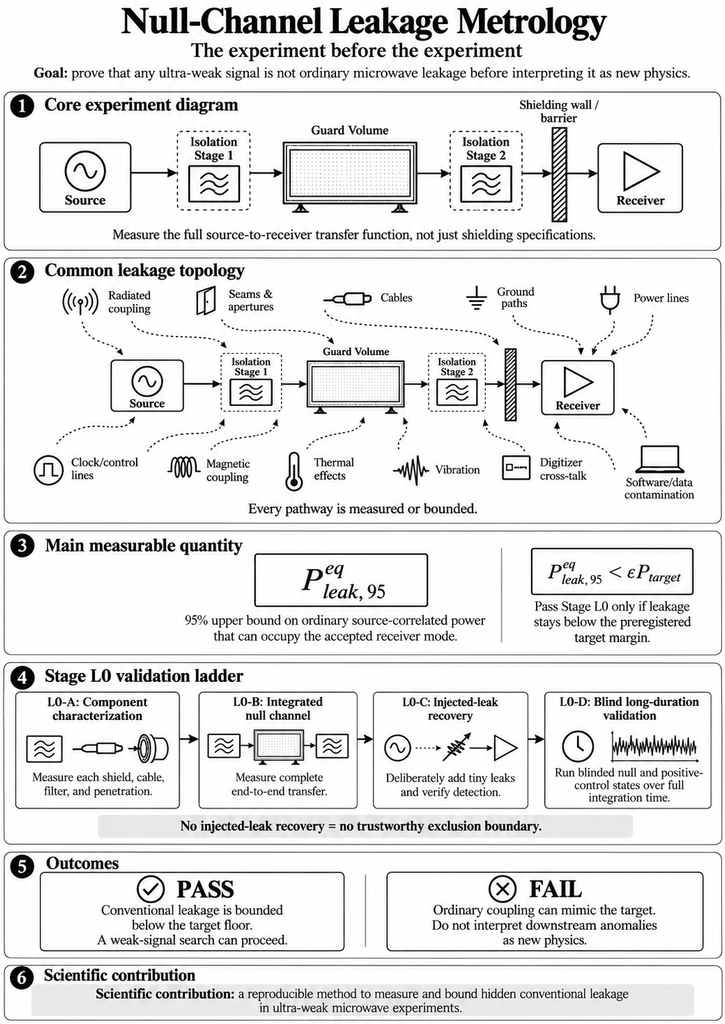
The central observable is the receiver-mode equivalent leakage ceiling, denoted \(P_{\mathrm{leak},95}^{\mathrm{eq}}\): a 95% upper confidence bound on conventional source-correlated power after the experiment’s accepted spectral, spatial, phase, temporal, and polarization conditions are applied. The framework distinguishes raw enclosure attenuation, end-to-end source-to-receiver transfer, and receiver-mode isolation. These quantities are not treated as interchangeable.
The proposed Stage-L0 validation sequence contains four layers. Component characterization measures individual shielding stages, penetrations, cables, grounds, filters, control paths, and other plausible coupling routes. Integrated null-channel testing then measures the complete source-to-receiver transfer function rather than inferring system performance by adding nominal attenuation values. Adversarial injected-leak tests deliberately introduce calibrated conventional signals and verify that the apparatus and analysis recover them near the claimed exclusion boundary. Finally, a long-duration blinded validation stage measures drift, guard bands, receiver-mode discrimination, false positives, and run-duration stability.
For potentially coherent leakage paths, the method combines upper bounds conservatively at the field-amplitude level rather than adding decibel values. When a genuine physics-null state is available, it may support direct null estimation only after transfer congruence is demonstrated. When no valid physics null exists, the candidate science response is prohibited from estimating its own leakage background; the conventional ceiling must instead be constructed independently from validated leakage paths.
The manuscript derives confidence-region and injected-signal detection thresholds for a complex transfer coefficient and provides synthetic validation of the statistical procedure. These synthetic calculations test the analysis method; they are not experimental Stage-L0 data. A worked power-budget example shows how a target signal floor can be translated into a required equivalent isolation threshold.
The primary decision rule is \(P_{\mathrm{leak},95}^{\mathrm{eq}} < \epsilon P_{\mathrm{target}}\), with the margin \(\epsilon\) fixed before validation. Failure to satisfy this condition blocks interpretation of a downstream weak-regeneration search but does not itself falsify any underlying particle or field hypothesis.
The method is intended to be useful independently of any specific exotic-physics model, including microwave light-shining-through-wall searches, hidden-sector searches, cavity-to-cavity weak-coupling experiments, and other measurements where conventional cross-talk can mimic an ultra-weak signal.
A companion reproducibility package contains the frozen equations, decision rules, synthetic-validation code, tests, expected outputs, assumptions, and falsification records. No empirical Stage-L0 dataset or exotic-physics detection is reported.