
A Falsifiable Structural Hypothesis for Resonance-Assisted Stone Transport and Positioning
This deposit contains the manuscript and reproducibility materials for “Acoustic Resonance and Megalithic Construction: A Falsifiable Structural Hypothesis for Resonance-Assisted Stone Transport and Positioning,” by Kevin L. Brown.
The work proposes a testable intermediate mechanism for prehistoric megalithic engineering. It does not invoke levitation, gravity modification, unknown energy, non-human intervention, or a universal ancient frequency. Instead, it asks whether deliberately generated vibration, amplified through structural or acoustic resonance, could have reduced the external force required to initiate, sustain, rotate, or precisely position large stone masses.
The proposed mechanism combines established physical principles from tribology, rock mechanics, granular dynamics, acoustics, and structural vibration. The central hypothesis is that movement resistance can decrease when excitation is tuned to a measured coupled stone-support-interface resonance and produces useful motion at the load-bearing contact. Longitudinal, transverse, vertical, and combined longitudinal-vertical excitation are treated as separate causal variables. The primary laboratory search band is 5–150 Hz for large loaded systems, while approximately 70–120 Hz is treated only as a secondary archaeological candidate band motivated by published acoustic measurements from the Hal Saflieni Hypogeum in Malta.
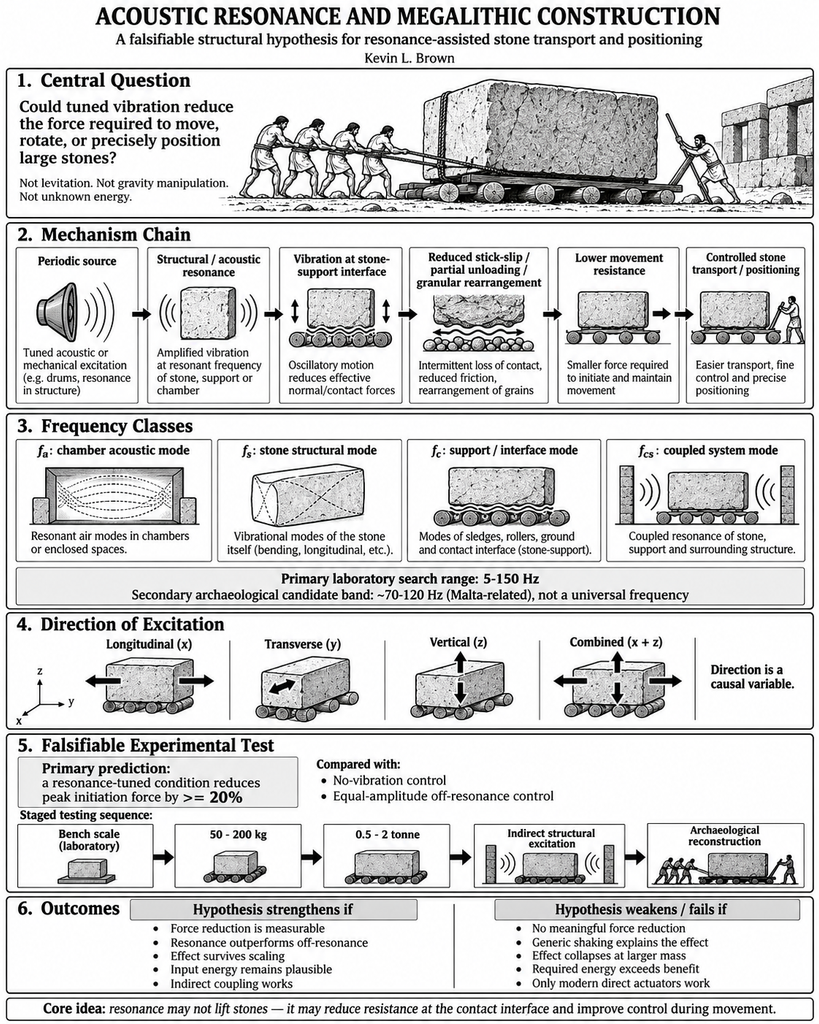
The primary confirmatory endpoint is peak initiation force. The proposed minimum effect of interest is a reproducible reduction of at least 20% relative to both matched no-vibration controls and equal-amplitude off-resonance controls. Secondary outcomes include steady draw force, stick-slip behavior, displacement, interface acceleration, contact state, source energy, wear, and temperature.
The experimental program progresses through five stages: metrology and interface characterization; bench-scale stone and granular-interface testing; 50–200 kg scaling; 0.5–2 tonne testing; indirect structural excitation using archaeologically plausible source classes; and reconstruction-scale testing with site-relevant materials and transport systems. Archaeological interpretation is intentionally separated from laboratory mechanism testing.
The reproducibility package includes the manuscript, a frozen hypothesis record, staged experimental protocol, factor matrix, systematics matrix, minimum data schema, analysis plan, falsification matrix, archaeological feasibility criteria, README documentation, and SHA-256 file manifest. No empirical dataset is included because confirmatory experiments have not yet been conducted.
The hypothesis is weakened or rejected if resonance provides no practically meaningful advantage over matched controls, if benefits are explained by generic shaking rather than resonance, if effects collapse with scale, if required energy exceeds plausible engineering value, if indirect coupling fails, or if archaeological source systems cannot reproduce the required interface motion. A positive laboratory result would establish only a vibration-assisted mechanical effect. Historical use by any ancient culture would require additional archaeological evidence, independent replication, and site-specific comparison against conventional construction explanations. The deposit is intended to replace speculative claims with a measurable research program that can succeed, fail, or be constrained by experiment.
Future reports should preserve the separation between physical mechanism and historical attribution. They should publish complete denominators, null results, calibration records, source-energy measurements, uncertainty estimates, and all preregistered exclusions. A resonance effect that cannot survive equal-amplitude off-resonance controls, scale-up, indirect coupling, or comparison with conventional transport methods should not be interpreted as evidence for lost technology. The purpose of this archive is prospective transparency, reproducibility, and direct experimental criticism by others.