A Preregistered Precision-Torque Experimental Proposal, Phenomenological Model, and Reproducible Device Specification
This deposit provides the preregistered experimental proposal and reproducibility materials for “Phase-Locked Asymmetric Gravitational Energy Extraction: A Preregistered Precision-Torque Experimental Proposal, Phenomenological Model, and Reproducible Device Specification,” by Kevin L. Brown. John Sefton is credited with the conceptual hypothesis that motivated the gravitational-energy-extraction research direction; the research program, formalization, phenomenological model, literature synthesis, metrology architecture, experimental design, falsification framework, device specification, and manuscript were developed by Kevin L. Brown.
The work does not report an empirical detection of gravitational energy extraction. It defines a prospective precision-torque experiment intended to determine whether an internally phase-modulated mechanical system can produce a reproducible external residual torque that exceeds a preregistered conventional/systematic uncertainty budget and follows a predetermined phase-reversal law. The central hypothesis predicts that the fitted phase-correlated residual torque reverses sign when the active reference phase is shifted by pi while hardware settings and amplitudes remain fixed.
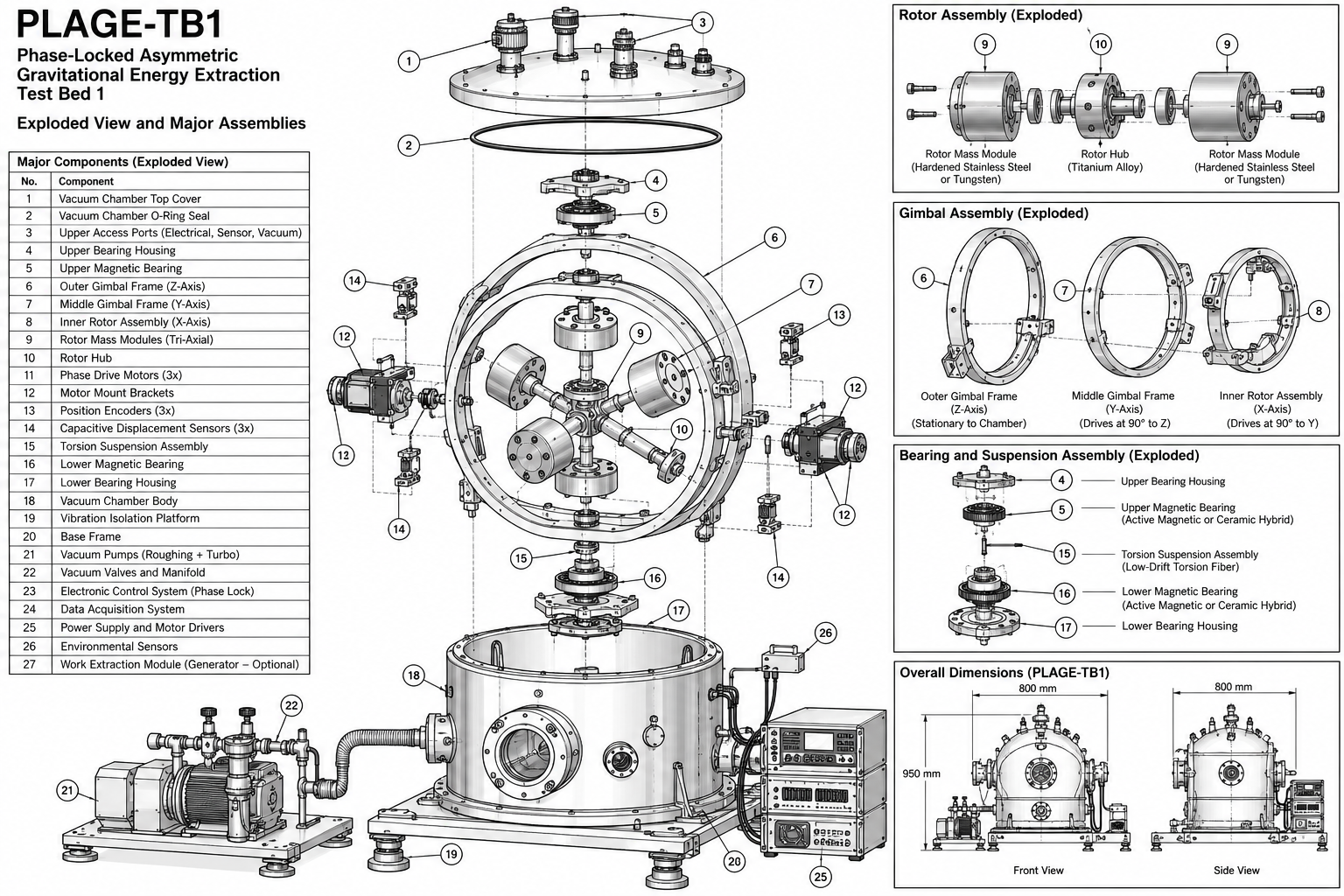
The experimental architecture uses the PLAGE-TB1 torsion-balance platform, which contains three orthogonal reaction-balanced torsional oscillator modules, dual capacitive and optical readouts, environmental monitoring, high-vacuum operation, hardware timing, blinded phase labels, and a calibration firewall. Before any hypothesis-bearing run, a Stage-0 metrology program must demonstrate the actual torque noise floor, calibration stability, reaction-torque rejection, nuisance-transfer functions, and combined residual systematic budget. If the instrument does not satisfy the frozen sensitivity gate, the experiment is classified as non-adjudicating rather than interpreted as a null result.
The primary H1 experiment is separated from the secondary 432-Hz spectral prediction. The primary operating frequency is selected prospectively from the Stage-0-qualified band using a frozen engineering rule based on low residual coupling, stable actuator response, and readout sensitivity. A separate spectral experiment tests 400, 416, 432, 448, and 464 Hz, or a prospectively frozen equivalent symmetric family, with multiplicity control and explicit conventional-resonance checks.
The reproducibility package contains the manuscript, device specification, preregistration protocol, frozen experimental-record template, systematics and falsification matrices, data dictionary, configuration template, analysis-code template, bill of materials, validation checklist, provenance notes, and file hashes. No empirical data are included because data acquisition has not yet occurred. The package therefore distinguishes frozen requirements from parameters that must be fixed after Stage-0 pilot characterization but before confirmatory unblinding.
A positive torque anomaly would not by itself establish an entropic theory of gravity, identify gravity as the source, demonstrate a violation of energy conservation, or establish net energy extraction. Those interpretations require subsequent source-discrimination, independent replication, and a separate full energy-ledger experiment. A null result constrains the tested realization and parameter region. The deposit is intended to make the experimental claim auditable before data collection, reduce researcher degrees of freedom, and enable independent laboratories to reproduce the protocol from the archived specification.
The package also preserves the separation between the phenomenological test equation and the broader Unified Informational Physics interpretation. The effective coupling term is treated as an experimentally rejectable ansatz rather than a microscopic derivation. Conventional explanations including vibration, thermal drift, residual gas, magnetic and electrostatic coupling, encoder or readout effects, and internal reaction torque are treated as measured nuisance channels.