A Falsifiable Framework for Testing Functional Integration in the Great Pyramid
The Great Pyramid at Giza is securely embedded in the Fourth Dynasty archaeological landscape and is strongly associated with Khufu’s building program, yet the function of every internal architectural subsystem remains unresolved. This paper presents a falsifiable archaeological and physical framework for testing whether the monument’s geometry and material distribution produce coordinated cross-structure behavior beyond that required by burial, construction, structural support, or ordinary environmental response.
The central physical hypothesis is deliberately narrow. The Great Pyramid may exhibit mechanical or acoustic coupling that is unusually strong or specific relative to structurally and constructionally constrained counterfactual architectures. Testing proceeds in two stages. First, a conventional-physics digital twin must reproduce held-out measurements of the real monument. Second, the validated model is compared with preregistered counterfactual geometries and feature ablations using a frozen coupling-specificity objective.
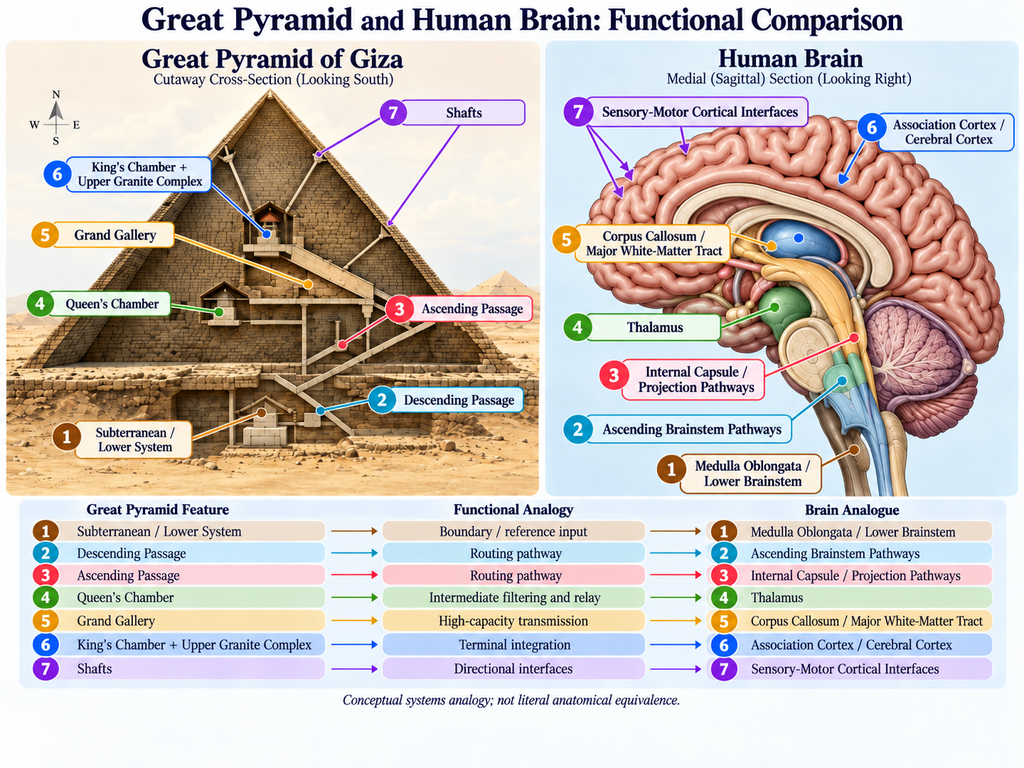
The paper also introduces a secondary comparative network-analysis module using distributed neural systems as a functional comparator. The comparison is role-based, not anatomical. It asks whether measured pyramid subsystems behave like differentiated network components performing boundary input, routing, intermediate relay or filtering, high-capacity coupling, integrative localization, and directional input/output. The proposed correspondences include the lower system as a boundary/reference region, passages as routing pathways, the Queen’s Chamber as an intermediate relay/filter candidate, the Grand Gallery as a high-capacity coupling stage, the upper granite complex as an integrative or localization node, and the shafts as directional interfaces.
This neural comparison is explicitly analogical. It is not presented as evidence that the pyramid is a brain, that the builders copied human neuroanatomy, or that the monument possessed cognition or consciousness. The comparison is scientifically useful only if it generates predictions that survive physical measurement, feature ablation, generic-network nulls, comparator monuments, and reasonable changes in node or edge definitions.
The strongest physical claim is also bounded. A positive result could support architectural tuning or functional integration, but physical response cannot uniquely recover historical builder intent. Archaeological, constructional, textual, or cultural evidence is required to infer why the architecture was selected.
The framework therefore combines conventional physics, counterfactual design testing, comparative network analysis, prospective predictions, and explicit falsification criteria. No new empirical dataset is reported, and no claim is made for a power plant, unknown force, nonlocal communication mechanism, pre-Khufu construction date, recovered builder instructions, literal brain mimicry, or biomimetic design.
The intended contribution is a research architecture that converts competing interpretations into measurable tests. Future work can determine whether the Great Pyramid is simply a complex monument whose physical responses follow from its surviving form, or whether its subsystems display unusually coordinated physical and network roles that justify a broader functional interpretation.
The network comparison adds a discovery tool: if the proposed analogy is meaningful, the lower system should preferentially couple to environmental forcing, passages should behave mainly as transmission paths, the Queen’s Chamber should show selective intermediate transfer, Grand Gallery ablation should reorganize cross-node coupling, the upper granite complex should show differentiated integration, and the shafts should preserve directional behavior. These predictions are falsifiable and can fail.