
A Falsifiable Hypothesis for Progressive Human Memory and Identity Recognition, 2026–2036
Across religious, philosophical, mystical, and consciousness traditions, human beings have repeatedly described some form of separation between ordinary waking identity and a deeper or more complete form of knowing. The language differs considerably from one tradition to another. Some describe spiritual amnesia associated with entering physical life. Others refer to forgetting one’s origin, losing awareness of a larger identity, or entering ordinary human experience behind a veil that limits access to knowledge that would otherwise alter how life is perceived. Although these traditions differ in theology and interpretation, the recurring structural idea is surprisingly similar: human consciousness may operate with access to only a portion of the information associated with its larger identity.
The recurrence of this idea across cultures does not establish that such a mechanism exists. Similar beliefs can spread historically, arise from common psychological tendencies, or emerge independently because human beings confront similar questions about identity, death, memory, purpose, and consciousness. A recurring idea is therefore not the same thing as a recurring physical phenomenon. The more useful scientific question is whether the underlying proposition can be translated into a form precise enough to be tested.
Instead of beginning with the assumption that a literal metaphysical veil exists, we can ask a narrower question. Is there any measurable evidence that access to information concerning identity, continuity, relationships, or life structure changes systematically over time? If such a change exists, does it occur only at the level of individual psychology, or does it also appear across populations? Does it increase steadily, fluctuate randomly, or occur in identifiable waves? Most importantly, can a model state in advance what should happen, when it should happen, and what observations would count against it?
Within the Unified Informational Physics Ontology, this question can be approached through the distinction between information that no longer exists and information that remains structurally present but is inaccessible from a particular state. UIPO deliberately separates conceptual definitions, mathematical proposals, empirical hypotheses, protocols, and applications, and it explicitly warns against treating conceptual unity as empirical confirmation. A framework can be internally coherent without thereby proving that nature behaves according to it. Unified_Informational_Physics_R… This distinction is essential because the hypothesis developed here does not require us to assume that pre-incarnational memory, nonlocal consciousness, reincarnation, or continuity beyond a lifetime has already been established. It requires only that we define what would be expected if some form of extended identity information existed but were normally inaccessible.
Under that interpretation, the traditional idea of a veil can be reformulated as an information-access problem. The veil becomes shorthand for restricted access to information associated with a larger identity structure, while thinning refers to an increase in the accessibility of that information. This formulation does not decide in advance what the information ultimately represents. It could reflect genuine continuity beyond ordinary autobiographical identity, unconscious integration of previously encountered information, neurological reorganization, symbolic reconstruction, culturally induced interpretation, or some mixture of mechanisms. The purpose of the hypothesis is not to select the metaphysical explanation first and then search for confirming evidence. The purpose is to state what pattern should appear if the proposed phenomenon is real and then compare that prediction against alternatives.
The central hypothesis is therefore as follows: if the phenomenon traditionally described as “thinning of the veil” corresponds to a real increase in access to identity-related information, then measurable forms of functional, relational, structural, and possibly episodic recognition should increase according to non-random temporal patterns rather than appearing only as isolated anecdotes. More specifically, the model predicts that this change should occur in waves rather than as a smooth, continuous progression. The anticipated structure is one of opening, integration, partial retreat, and deeper opening.
In simplified form, the expected pattern is:
thinning → integration → partial re-thickening → deeper thinning
The reason for predicting this wave structure is not primarily mystical. It is structural.
Stable systems do not generally absorb unlimited novelty without periods of reorganization. When a system receives information that does not fit its existing identity architecture, the system must decide, either explicitly or implicitly, what to do with it. The information may be rejected, ignored, compartmentalized, interpreted through an existing model, or used to reorganize the model itself. In the language of systems analysis, the introduction of unfamiliar information represents load. The ability of the system to preserve identity while incorporating that load depends on its capacity, internal organization, constraints, and ability to integrate change.
This principle appears throughout broader systems work. The Geometry of Systems describes systems in terms of boundary, identity, exchange, and persistence, and emphasizes that pressure travels through structure rather than appearing randomly. When the demands placed on a system exceed its ability to integrate them, the system may reorganize, saturate, or fail. The Geometry of Systems If unusual forms of recognition represent new informational load, then an extended period of increasing recognition should naturally be followed by a period in which individuals and cultures attempt to assimilate what has occurred.
This means that the model does not predict a steady march toward ever-increasing memory. If a meaningful increase occurs, some experiences should subsequently be normalized, questioned, rejected, forgotten, reinterpreted, or incorporated into existing identity. A person who initially experiences a profound sense of recognition may later reinterpret it psychologically. Another may deepen the interpretation. A third may lose interest entirely. At the collective level, cultural systems may initially treat certain experiences as anomalous, later develop language for them, and eventually classify them within existing spiritual, clinical, scientific, or social frameworks.
The hypothesis therefore predicts a recursive process rather than a linear one. Increased access should create integration pressure, and integration should temporarily reduce the apparent novelty of the phenomenon before a later wave emerges. This is one of the most important parts of the model because a wave hypothesis and a simple growth hypothesis make different predictions. If recognition rises smoothly year after year without identifiable integration intervals, the specific wave model would be weakened. If it fluctuates randomly with no stable temporal architecture, the model would also be weakened. The claim is not merely that “more people will experience unusual things.” The predicted shape of the change is part of the claim.
A second requirement is to define what is actually meant by memory or recognition. Without this distinction, nearly any unusual subjective experience could be interpreted as evidence of thinning, making the hypothesis impossible to falsify. The model developed here therefore distinguishes several layers of recognition rather than treating all forms of memory as equivalent.
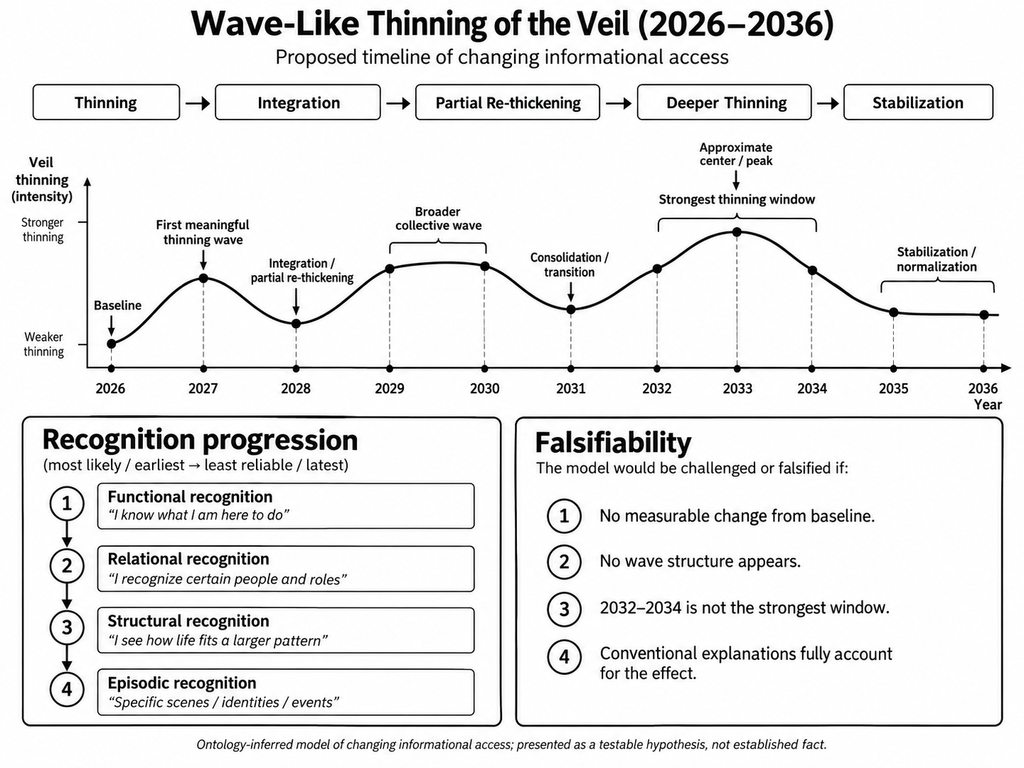
The first layer is functional recognition. This refers to a durable sense of knowing what one is here to do, what kind of role one is meant to fulfill, or why a particular trajectory has persisted across one’s life. Functional recognition does not require any claim of past-life memory or external identity. A person might simply report that a life pattern that previously seemed disconnected suddenly makes coherent sense.
The second layer is relational recognition. Here, the perceived continuity is associated with particular people, roles, or relationships. Someone may feel that a relationship carries an unusual familiarity, obligation, symmetry, or significance that exceeds what they can explain from the present biography alone. Such an experience may ultimately have ordinary psychological explanations, but the category can still be measured without assuming its cause.
The third layer is structural recognition. In this layer, the person perceives an organizing relationship among major events, choices, relationships, disruptions, and recurring themes. The recognition is less about recalling a particular scene than about perceiving a larger architecture connecting experiences that had previously appeared separate.
The fourth layer is episodic recognition: specific scenes, names, places, identities, circumstances, or events experienced as memory-like content outside ordinary autobiographical recall. This is the most dramatic category, but it is also the most vulnerable to contamination by imagination, suggestion, expectation, media exposure, symbolic interpretation, confabulation, and retrospective fitting.
The proposed sequence can therefore be summarized as follows:
| Recognition layer | Proposed expression |
|---|---|
| Functional recognition | “I understand what I am here to do.” |
| Relational recognition | “I recognize the significance or continuity of particular people and roles.” |
| Structural recognition | “I understand how the events of this life connect to a larger pattern.” |
| Episodic recognition | Specific scenes, identities, places, or events interpreted as memory beyond ordinary biography |
The model predicts that functional recognition should become detectable before reliable episodic recognition. This is an important distinction because it gives the hypothesis an internal ordering that can itself be tested. If episodic claims increase dramatically while functional, relational, and structural recognition remain unchanged, the model would not be behaving as predicted. Similarly, if no consistent relationship exists among the categories, the proposed progression would need to be revised.
The timing forecast begins with 2026 as the baseline period. Establishing a baseline before the primary forecast windows is critical because it limits retrospective interpretation. Without a baseline, researchers could wait until after an interesting cultural event, search backward for supporting anecdotes, and redefine the original prediction to fit what happened. That approach can generate compelling narratives but cannot distinguish forecasting from hindsight. A prospective model must establish the categories, timing windows, and expected sequence before the most important period arrives.
The first meaningful increase is predicted around 2027. The character of this opening is expected to be primarily individual rather than institutional. If the model is correct, there should be an increase in reports involving purpose recognition, shifts in personal identity, unusual continuity experiences, relational familiarity, and the perception that previously disconnected life experiences suddenly form a coherent structure. The vocabulary used by participants should not be treated as primary evidence. One person may describe the experience spiritually, another psychologically, another in terms of personal growth, and another simply as clarity. The research question concerns the structure of the experience rather than the interpretive label attached to it.
The year 2028 is expected to behave differently. Rather than producing a larger opening, it should function more strongly as an integration period. If recognition increased during 2027, some of that material should then be processed, questioned, assimilated, or discarded. A temporary plateau or reduction would therefore fit the wave hypothesis better than continuous acceleration. This forecast must be stated in advance because otherwise any decrease could be conveniently explained as “integration” after the fact. The timing matters precisely because the model is claiming that opening and consolidation should alternate.
The second major wave is projected for 2029–2030. Its defining characteristic is expected to be a movement from primarily private recognition toward collective interpretation. The dominant question gradually changes from “What is happening to me?” to “What kind of phenomenon are people experiencing?” This shift could coincide with increasing convergence among discussions of consciousness, artificial intelligence, anomalous experience, identity, spirituality, historical interpretation, UAP or non-human intelligence, and related topics. These subjects should not be treated as evidence merely because they become popular. They are possible correlates. The stronger prediction is that previously separated experience categories begin to be compared and classified within shared interpretive frameworks.
This distinction is especially important because public discussion can change rapidly without any underlying change in consciousness. Social media, entertainment, political events, scientific discoveries, artificial intelligence, influential public figures, or major news stories can introduce new language into a culture. Once that language becomes available, people may begin interpreting ordinary experiences through it. A rise in public discussion about reincarnation, consciousness, synchronicity, UAPs, or extended identity could therefore reflect cultural diffusion rather than a change in informational access.
For the veil hypothesis to survive, something stronger must occur. The measured experiences themselves would need to change, and that change would need to remain significant after exposure and priming are taken into account.
The year 2031 is expected to function as another consolidation and transition period. By this point, competing explanations may become more developed. Psychological interpretations may emphasize unconscious integration, dissociation, memory reconstruction, or meaning-making. Neurological models may focus on changes in memory access, attention, network integration, or altered states. Social explanations may emphasize media amplification and cultural contagion. Spiritual frameworks may interpret the same experiences as remembrance or awakening. Informational-physics models may interpret them as increased accessibility across identity layers.
This competition should be welcomed rather than avoided. A hypothesis becomes scientifically stronger when it survives serious alternatives, not when alternatives are excluded by definition.
The most consequential prediction concerns 2032–2034, with approximately 2033 at the center of the expected highest-intensity interval. This is the period in which the model predicts the largest measurable departure from the 2026 baseline. If the hypothesis is directionally correct, functional, relational, and structural recognition should all be elevated relative to earlier periods. Similar categories of experience should also appear across populations that are not all dependent on the same cultural, religious, or ideological source.
The strongest version of the effect would involve several changes occurring together. More individuals would report stable forms of purpose recognition. Relational experiences of unusual continuity would become more common. Structural reinterpretation of life events would increase. Public interest in questions of consciousness and identity would expand beyond communities already predisposed toward those ideas. Researchers or institutions might begin creating more systematic categories for experiences that had previously been treated primarily as spiritual, psychological, or anomalous.
The model does not require a sudden global revelation. In fact, such a scenario would be less consistent with the proposed architecture than a broad but uneven shift in recognition.
The 2032–2034 interval is also where the hypothesis takes its greatest risk. If this period proves unremarkable compared with the years surrounding it, the central timing prediction should be considered weakened. If another period shows a clearly stronger and more coherent signal while the predicted peak remains absent, the forecast should not simply be moved. A prediction is meaningful only if the original window remains visible after the outcome is known.
The final projected phase, 2035–2036, is expected to involve stabilization and normalization rather than another dramatic increase. If recognition experiences become more common, societies should begin developing greater capacity to process them. Language becomes more standardized, categories become more familiar, research protocols improve, social stigma may decrease in some contexts, and experiences that once seemed extraordinary may become easier to discuss. The phenomenon, if real, would therefore become less disruptive partly because the surrounding interpretive system had changed.
This progression also explains why collective thinning does not imply universal experience. Population-level transitions rarely occur simultaneously across every individual. Some people may report strong recognition years before the predicted collective windows. Others may show little or no change even during the strongest period. Some may have experiences but interpret them entirely within conventional psychological frameworks. Others may never experience anything they would describe as unusual.
The hypothesis concerns distributions, not universality.
That distinction is important because the phrase “collective awakening” often implies that humanity moves as a single unit. The model proposed here makes no such claim. A collective effect would mean that the frequency, intensity, structure, or distribution of particular recognition categories changes across populations. It does not require every person to participate.
Turning this into a genuine research program requires operational measurement. A neutral longitudinal instrument could be developed under a name such as the Extended Identity Recognition Index. A neutral name would be preferable to “Veil Thinning Index” because the latter could prime participants toward the very interpretation being tested. The instrument should measure functional recognition, relational recognition, structural recognition, episodic claims, subjective certainty, emotional intensity, persistence over time, prior exposure to related concepts, media consumption, cultural context, spiritual or religious beliefs, meditation or psychedelic exposure where relevant, and whether the experience arose spontaneously or after prompting.
The strongest study architecture would combine a longitudinal cohort with repeated independent cross-sectional samples. A longitudinal cohort followed from 2026 through 2036 would reveal how the same individuals change over time. Independent annual samples would help determine whether apparent changes are caused by aging, repeated testing, attrition, or conditioning within the original cohort.
Open-ended reports should ideally be coded by researchers who do not know the year in which the responses were collected. The scoring system should remain stable. The primary windows should be preregistered. Statistical thresholds should not be changed after results are visible. Alternative explanations should be measured directly rather than discussed only after the fact.
These controls follow the broader UIPO research discipline. The current ontology specification emphasizes explicit comparison conditions, causal alternatives, null models, controls, uncertainty, out-of-sample testing, and prospective registration where appropriate. Unified_Informational_Physics_R… The accompanying scientific-production protocol similarly distinguishes the presence of a framework or validation artifact from evidence that a test has actually been performed and passed. It requires the object tested, the attack attempted, the result, and the evidence supporting the conclusion.
Applied here, this means that a large collection of unusual personal stories would not by itself validate the hypothesis. Anecdotes can identify categories, generate hypotheses, and reveal patterns worth studying, but they cannot establish the predicted temporal structure on their own.
Competing explanations must therefore remain central throughout the research period. Increased public interest in spirituality could make people more likely to reinterpret ordinary experiences as meaningful. Social media could rapidly transmit language about awakening, synchronicity, reincarnation, or identity. Artificial intelligence could help people identify patterns in their own biographies that they previously failed to notice. Public discussion of UAPs or non-human intelligence could increase the salience of questions concerning human identity. Changes in psychological language could alter how people classify familiar internal experiences. Meditation, therapy, psychedelics, contemplative practice, and changing religious affiliation could also affect the same measures.
Generational change represents another important alternative. Younger populations may simply be more comfortable reporting experiences that older populations would have suppressed, pathologized, or expressed through different cultural language. If that is the explanation, the apparent rise should track cohort replacement rather than the forecast windows.
A serious model must be capable of losing to these alternatives.
The hypothesis should therefore be considered weakened or falsified under several conditions. If recognition measures remain statistically indistinguishable from the 2026 baseline throughout the predicted windows, the central forecast has failed. If recognition increases smoothly without the proposed wave-and-integration structure, the temporal model is weakened. If 2032–2034 does not produce a stronger signal than neighboring years, the central peak prediction has failed. If the apparent effect disappears after controlling for media exposure, demographic shifts, survey conditioning, cultural diffusion, or other ordinary factors, there is no need to invoke a deeper informational mechanism. If the proposed ordering from functional through relational and structural recognition does not appear, the internal architecture of the model must be reconsidered. If similar timing patterns fail to replicate across independent populations, the possibility of local cultural contamination becomes much stronger.
The model should also be considered unsupported if success can be obtained only by changing the definitions after the data are known. If the original 2032–2034 window is later expanded to cover whatever years happen to contain interesting events, the forecast ceases to be meaningful. The same applies to the recognition categories. They should not be widened retrospectively until nearly any experience qualifies.
What, then, would the year 2033 actually look like if the hypothesis is broadly correct? Probably not like a dramatic global awakening. The more plausible expression would be a convergence of quieter but measurable changes. More people would independently report durable forms of purpose recognition. Relational continuity experiences would become more common. Structural reinterpretation of life histories would increase. Questions of consciousness and identity would receive greater attention outside communities already committed to metaphysical interpretations. Researchers or institutions might begin treating some experiences as legitimate objects of classification and study even without agreeing on their cause.
External events could amplify this process. A major scientific discovery, technological development, anomalous observation, or public event that forced reconsideration of consciousness, intelligence, or human identity could interact strongly with the predicted internal recognition wave. However, such an event should not be required for the veil hypothesis to survive. First contact, UAP disclosure, or any other large external development should remain a separate hypothesis with separate falsification criteria. Combining too many speculative dependencies would make the model difficult to evaluate because success or failure could always be reassigned from one component to another.
The value of the veil-thinning hypothesis therefore lies less in the spiritual language than in what happens when that language is disciplined. An idea that is normally expressed as an unfalsifiable expectation can be converted into a prospective research question. If there is a real phenomenon beneath the traditional concept, it should produce observable structure. That structure should emerge in predefined categories, follow a temporal pattern, survive at least some alternative explanations, and replicate beyond populations already expecting it.
The forecast being placed on record is consequently specific. A meaningful opening should begin around 2027, followed by an integration period. A broader collective wave should emerge during 2029–2030. The strongest measurable expression should occur during 2032–2034, with approximately 2033 near the center. The period from 2035 through 2036 should show greater normalization and integration rather than indefinite escalation. Functional recognition should precede reliable episodic claims, and collective change should appear as shifts in population distributions rather than as universal remembrance.
The dates should remain fixed. The recognition categories should remain fixed. The predicted wave structure should remain visible. Misses should be preserved rather than reinterpreted away. Competing explanations should be measured rather than treated as threats to the framework.
If the pattern fails to appear, the model should be revised or rejected.
If the timing fails, the timing claim should be marked as failed.
If conventional mechanisms explain the results adequately, those explanations should take precedence.
If, however, the predicted sequence survives prospective measurement, cross-population comparison, contamination controls, and serious competing explanations, then the ancient language of a thinning veil would have acquired something it has rarely possessed: a measurable empirical counterpart.
The question would no longer be whether people believe that a veil exists. It would be whether human identity and memory access exhibit a reproducible temporal structure that current models do not adequately explain.
That is the standard worth testing.