
Target-Fiber Bounds and Minimal Measurement Refinement
This preprint develops a narrow quantitative result for scientific prediction under incomplete measurement representations. The broad premise—that prediction can fail when measurements omit distinctions relevant to future behavior—is already established across observability theory, functional observability, predictive-state methods, coarse-graining, lumpability, sensor placement, and contemporary predictive-closure research. The manuscript therefore does not claim those concepts as new.
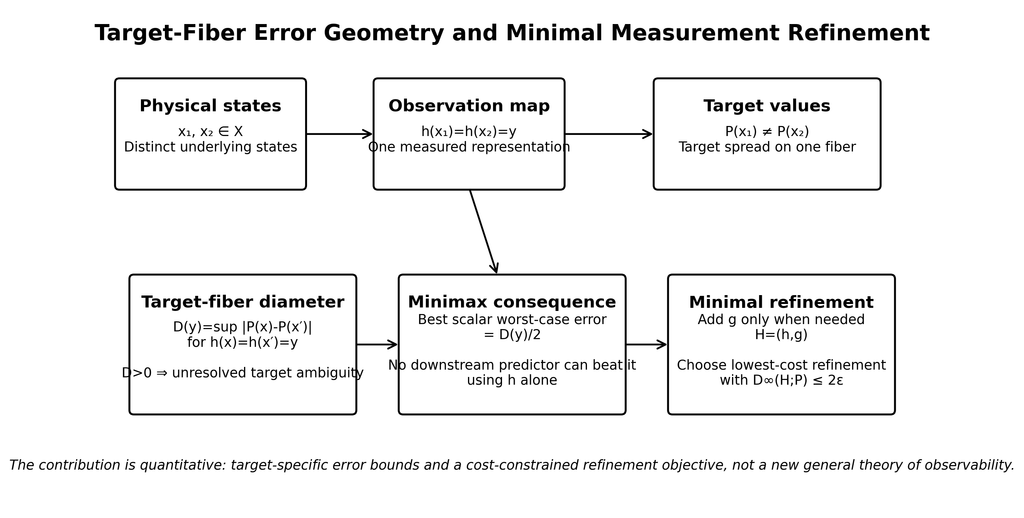
For a fixed observation map h:X→Y and scalar target P:X→R, the paper defines the target-fiber diameter D_P(y) as the maximum target disagreement among states that share the same observed value y. It proves that for every bounded scalar target fiber, the exact deterministic minimax absolute-error floor is D_P(y)/2. Thus a measurement representation supports worst-case error no larger than ε on a fiber if and only if D_P(y)≤2ε. This is an algorithm-independent statement: when two target-divergent states are observationally identical, changing the downstream predictor alone cannot remove the worst-case ambiguity.
The paper extends the construction to normed vector targets. In that setting, the exact minimax quantity is the Chebyshev radius of the target image of the fiber, while one-half of the target-fiber diameter remains a universal lower bound.
A second contribution is Minimal Measurement Refinement (MMR), a cost-constrained measurement-design problem. Given a library of candidate observables, MMR seeks the lowest-cost refinement whose global target-fiber diameter falls below a predeclared tolerance. A refinement-monotonicity proposition proves that splitting observation fibers cannot increase target-fiber diameter.
The framework is tested with an analytically solvable harmonic oscillator. Position-only observation creates a nonzero future-position error floor because momentum remains unresolved. Lowering measurement noise in position does not eliminate that structural ambiguity. Adding momentum collapses the relevant fibers and restores exact noiseless finite-horizon prediction.
The revised manuscript explicitly positions itself against functional observability and Daniel John Murray’s 2026 Predictive Closure preprints. It does not claim priority for fiber-factorization, predictive equivalence, measurement adequacy, constructive refinement, or sensor selection. Its claimed novelty is limited to target-specific error geometry, the scalar D/2 minimax result in the observation-fiber setting, the vector-radius extension, and a cost-constrained refinement objective based on the same error quantity.
The mathematics is self-contained in standard set-theoretic and metric language. UIPO and UIMath are documented as conceptual provenance only and are not required premises. The accompanying reproducibility package contains code, frozen configuration, synthetic data products, figures, checksums, and audit records. No new empirical dataset is reported. The work is a preprint and has not undergone external peer review.