
Darryl Anka’s channeled material attributed to the entity known as Bashar contains a five-part structure Bashar calls the Five Laws of Creation. These are presented not as instructions for making choices, but as fundamental statements about the nature of existence itself.
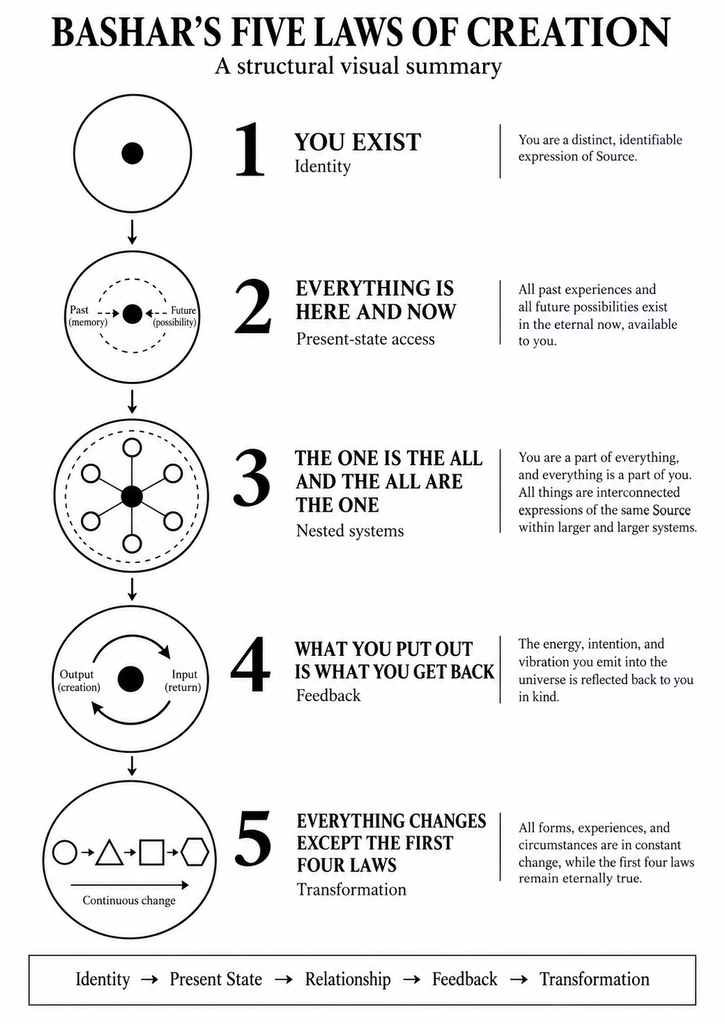
Bashar’s official website currently lists the Five Laws as:
- “You exist,”
- “Everything is here and now,”
- “The One is the All and the All are the One,”
- “What you put out is what you get back,” and
- “Everything changes except the first 4 Laws.”
Bashar’s broader principles place these statements inside a much larger metaphysical framework involving nonphysical consciousness, an eternal present, interconnectedness, belief, attraction, and the claim that consciousness cannot cease to exist.
Those are substantial claims. They should not be treated as scientifically established merely because some of their language can be translated into systems terminology. A more useful question is narrower: when the metaphysical interpretation is temporarily set aside, do the Five Laws correspond to recognizable structural principles within informational physics?
That question produces a surprisingly coherent result.
The Unified Informational Physics Ontology, or UIPO, provides a useful framework for making this comparison because it explicitly separates definitions, mathematical schemas, hypotheses, protocols, applications, and empirical claims. Its purpose is not simply to assign scientific terminology to ideas, but to distinguish what has been defined from what has been proposed, what has been operationalized, and what has actually been demonstrated. Using that same discipline, Bashar’s Five Laws can be translated into a set of structural problems involving identity, present-state information, nested systems, feedback, and transformation.
A useful overview is:
| Bashar’s Five Laws | Informational-physics translation |
|---|---|
| You exist | Identity and persistence |
| Everything is here and now | Present-state informational access |
| The One is the All and the All are the One | Nested systems and relational organization |
| What you put out is what you get back | Feedback and reciprocal coupling |
| Everything changes except the first four Laws | Transformation under persistent constraints |
The important point is not that these phrases are identical. They are not. The value lies in asking whether the same structural problems appear underneath two very different vocabularies.
Law One: You Exist
The first law is the simplest: You exist.
At first glance, it may seem almost too obvious to analyze. If someone is capable of considering the statement, then something capable of thought or experience is already present. Bashar’s broader teaching goes considerably further, describing consciousness as eternal and asserting that although form may change, consciousness itself cannot cease to exist. Informational physics does not need to accept that stronger metaphysical claim to recognize why existence and identity must come first in any description of a changing system.
Before something can transform, there has to be some basis for saying what is transforming. Before something can interact with an environment, there must be some basis for distinguishing the system from that environment. Before information can cross a boundary, there must be enough difference between “inside” and “outside” for a boundary to have meaning.
This turns the statement “you exist” into the deeper problem of identity through change.
A human being provides an obvious example. The body changes continuously over a lifetime. Matter is exchanged with the environment, cells are replaced, memories are gained and lost, beliefs change, relationships change, and physical appearance may become dramatically different. Yet there is enough continuity that a person at age seventy is ordinarily regarded as the same individual who existed at age twenty.
The same problem appears in other systems. A river remains recognizably the same river while different water continually passes through it. A company can change employees, leadership, offices, products, and technology while retaining enough continuity to remain the same organization. A software process can migrate between machines while preserving the organization necessary to remain functionally identifiable.
These examples suggest that identity cannot always be reduced to static material composition. Persistence may instead depend on some combination of organization, history, boundary, relationship, information, and causal continuity.
This is why UIPO treats entities, relations, properties, operators, transformations, dependencies, and revision rules as distinct elements that must be explicitly defined. If we cannot say what counts as the system, what counts as one of its states, or what allows one state to be connected to another, then the statement that the system “changed” becomes ambiguous.
The restrained informational translation of Law One is therefore not “personal consciousness has been scientifically shown to be eternal.” It is simpler:
An identifiable informational organization must exist before state, relationship, feedback, or transformation can meaningfully be assigned to it.
That gives the first law a foundational role. It establishes the node from which all later interaction becomes possible.
Law Two: Everything Is Here and Now
The second law states that everything is here and now. Bashar’s broader teaching interprets this strongly, saying that there is actually only one moment in creation and that the past and future are created from the here and now. That claim enters difficult philosophical and physical questions about the nature of time. Informational physics does not need to adopt that entire interpretation to identify a meaningful structural analogue.
Every functioning system acts from its current state.
A person can remember what happened twenty years ago, but the memory is available as information now. A geologist can reconstruct an ancient environment, but the evidence being examined exists in current rocks, strata, fossils, or measurements. A telescope can detect light that began traveling millions of years ago, but the detection occurs in a detector operating now. Historical documents, genetic sequences, scars, photographs, and archived files all function in the same way: they are present structures carrying information about previous states.
The future operates differently, but the informational principle is similar. A person can plan for retirement, an engineer can calculate a future spacecraft trajectory, a business can invest based on projected demand, and a government can prepare for an anticipated environmental change. None of these systems directly observes the future. Instead, the current state contains a model of a possible later state, and that model influences present action.
This means the present serves as the operational interface through which a system accesses both memory and possibility.
The phrase “everything is here and now” therefore admits a more restrained interpretation: whatever influences a system must become informationally available to the system in its current state.
This does not mean that the past never occurred. It means that the past affects the present because some consequence or informational trace of the past persists. Likewise, it does not mean that the future has already occurred exactly as imagined. It means that present representations of possible futures can alter behavior now.
This becomes especially clear in human psychology. Someone may say that an event from childhood still affects them decades later. The original event is not literally happening again, but information from it may persist through memory, bodily response, learned expectation, belief, or relationship patterns. The previous state remains causally relevant because it left structure behind.
Law Two therefore follows naturally from Law One. Once an identifiable system exists, that system can act only from the state it presently occupies. Information about other times matters only insofar as it becomes available through that current state.
The metaphysical claim that all moments are literally one moment goes beyond what this structural comparison establishes. The informational correspondence is narrower but still significant: the present is where information becomes operational.
Law Three: The One Is the All and the All Are the One
The third law, the One is the All and the All are the One, is probably the most overtly metaphysical statement in the set. Bashar’s broader principles reinforce this view by saying that everything a person experiences is another aspect of oneself. Informational physics cannot simply translate that into the claim that every distinction is unreal. Distinctions are fundamental to information. Without distinguishable states, boundaries, and relationships, there is little basis for information processing at all.
The useful structural correspondence is therefore not undifferentiated oneness. It is nested organization.
Complex systems are arranged in layers. Cells participate in tissues, tissues participate in organs, and organs participate in organisms. Organisms participate in families, populations, ecosystems, economies, cultures, and civilizations. At each scale, the smaller system remains identifiable while simultaneously participating in a larger whole.
The relationship also runs in both directions. A heart contributes to the survival of an organism, but the heart depends on the organism for oxygen, nutrients, regulation, and protection. A person contributes to a language through speech and writing, yet that person can communicate only because the larger language already exists. An employee changes an organization through decisions and behavior, but the organization also determines much of the employee’s available information, incentives, resources, and roles.
The whole depends on the parts, while the parts depend on the whole.
This means unity and individuality do not have to be opposites. A system can contain clearly differentiated components while still functioning as one organized entity. In fact, complex organization often depends on preserving both distinction and relationship.
A sentence illustrates this simply. The words must remain distinguishable or the sentence loses meaning, yet the meaning of the sentence cannot be reduced to one word in isolation. A brain contains individual neurons, yet cognition emerges through relationships among large numbers of them. A market contains individual buyers and sellers, yet prices and larger economic patterns emerge through their interaction.
The informational translation of Law Three is therefore best stated this way:
Distinct nodes can retain their identities while participating in larger systems whose properties emerge from their relationships.
This is different from claiming that boundaries are illusions. Boundaries are often essential. A biological cell survives because its membrane distinguishes inside from outside while permitting controlled exchange. If the membrane became completely impermeable, the cell could not survive. If the membrane disappeared completely, the cell would also cease to function as a coherent cell. Viability depends on both separation and connection.
This provides a more precise bridge between Bashar’s idea of unity and informational physics. The “one” need not erase the “many.” The whole can emerge through the organization of the many.
Law Four: What You Put Out Is What You Get Back
The fourth law states that what you put out is what you get back. In Bashar’s broader framework, beliefs, emotions, actions, attraction, and physical experience are closely connected, and the official principles say that life experiences are attracted through the interaction of strong beliefs, emotions, and actions.
This is also the law most easily overstated.
A strong literal interpretation could imply that every external event is a direct reflection of a person’s internal state. That becomes difficult to reconcile with complex causality, independent agents, environmental processes, historical conditions, chance events, institutions, and physical systems that do not originate inside one individual.
The more defensible informational translation is feedback.
A system produces outputs. Those outputs change some part of the environment. The changed environment then influences what information and conditions become available to the system later. In this sense, what goes “out” can become part of what eventually comes “back,” but the return is not necessarily identical to the original output.
Human interaction makes this easy to see. If someone enters a conversation expecting hostility and therefore behaves defensively, the other person may respond defensively as well. That response becomes new evidence, apparently confirming the original expectation. The first person did not control the other individual, but their output contributed to the conditions that shaped the return.
Organizations exhibit the same pattern. A manager who assumes employees cannot be trusted may impose heavy supervision. Employees respond by taking less initiative. Their reduced initiative then returns as evidence that close supervision was necessary. An expectation helps create a feedback environment that reinforces the expectation.
Constructive loops work similarly. Trust can produce openness, openness can improve information exchange, and better information can increase trust. Scientific inquiry itself is fundamentally a feedback process: a model generates predictions, observation returns evidence, and the difference between prediction and result alters the model.
The important qualification is that feedback is not a perfect mirror. Outputs can be transformed before anything returns. They may be delayed, amplified, weakened, redirected, combined with other causes, or overwhelmed by external conditions. Another person remains an independent causal agent. A hurricane does not appear because one individual expressed the wrong emotional state. A market can move because of thousands or millions of interacting decisions.
The informational translation of Law Four is therefore more precise than the strongest metaphysical interpretation:
A system’s outputs alter the relational environment, and those altered conditions can influence the information and consequences that subsequently return to the system.
This also explains why Law Four follows Law Three. Feedback becomes possible because the node is embedded in a larger relational system. If nothing were connected, outputs could not alter anything beyond the system and nothing could return.
Law Three establishes relational embedding. Law Four describes reciprocal consequence within that relationship.
Law Five: Everything Changes Except the First Four Laws
The fifth law states that everything changes except the first four Laws. Structurally, this is different from the previous four because it introduces the relationship between transformation and invariance. Bashar is not merely saying that change occurs. The law claims that change occurs against a background of principles that themselves do not change.
The specific assertion that the first four laws are literally immutable laws of reality would require independent evidence. But the more general relationship between change and persistence is central to systems thinking.
Change can be recognized only if something remains stable enough to make comparison possible.
If absolutely every property, relationship, measurement rule, and identity changed completely at every instant, there would be no meaningful basis for saying that one thing had transformed into another. There would simply be unrelated configurations. Conversely, if nothing changed, transformation would not exist.
Complex systems occupy the space between these extremes.
A person changes while retaining enough continuity to remain identifiable. A city may replace buildings, businesses, leaders, and residents while preserving enough structure, history, and relationship to remain recognizable as the same city. A whirlpool maintains a pattern even though the water making up the pattern continually changes. A melody can be played on different instruments while remaining the same melody because its informational relationships persist across different physical carriers.
These examples point toward an important principle: what persists need not always be the material itself. Patterns, constraints, relations, histories, boundaries, and organizational structures can remain sufficiently stable while the physical components expressing them change.
Informational physics is naturally concerned with this problem because any theory of transformation must distinguish between variables and invariants. UIPO itself uses explicit definitions, dependencies, status layers, and versioned revision so that the framework can evolve without allowing every term to silently change meaning at the same time.
The informational translation of Law Five is therefore:
Configurations change while sufficiently persistent structures or constraints allow identity, relationship, and transformation to remain coherent.
This does not establish that Bashar’s first four laws are the ultimate invariants of nature. It identifies the more general systems principle beneath the statement: meaningful change requires some form of continuity.
The Five Laws as One Architecture
Once the laws are placed side by side, their sequence becomes more interesting than any one statement taken alone.
| Stage | Structural role |
|---|---|
| 1. Existence | Establishes an identifiable system |
| 2. Here and Now | Establishes the current informational state |
| 3. One and All | Embeds the system in larger relational structures |
| 4. Output and Return | Introduces reciprocal feedback |
| 5. Change | Describes continuing transformation |
The dependency is straightforward. Something must first exist before it can meaningfully occupy a state. A system must occupy some state before it can participate in relationships from that state. Relationship creates the possibility of interaction. Interaction produces feedback. Feedback contributes to transformation.
In informational language, the sequence becomes:
Identity → Present State → Relationship → Feedback → Transformation
This is not merely substituting modern terminology for Bashar’s language. It exposes an underlying systems architecture.
The Five Laws can therefore be read as a movement outward from the existence of the individual node toward an increasingly relational and dynamic picture of reality. The first law establishes being. The second locates experience in a current state. The third situates the individual inside larger systems. The fourth makes those relationships reciprocal. The fifth places everything inside continuing transformation.
That progression is structurally coherent even if the stronger metaphysical interpretations remain unresolved.
Where the Correspondence Stops
A useful comparison must also show where the translation no longer supports the original claim. The main boundaries are:
- Informational identity does not establish eternal individual consciousness.
- Present-state informational access does not establish that all physical moments literally coexist as one moment.
- Nested systems do not prove that all beings are literally manifestations of one consciousness.
- Feedback does not prove that every external event is a direct reflection of personal belief or vibration.
- Transformation under persistent constraints does not prove that Bashar’s first four laws are the final immutable laws of nature.
These distinctions are not weaknesses in the analysis. They prevent a structural analogy from becoming circular validation.
UIPO explicitly states that precision does not equal proof and that hypotheses should connect to observations, comparison models, uncertainty, decision rules, and conditions under which they would fail. That same standard is especially important when scientific and metaphysical language overlap.
Several of the informational translations can be studied directly. Feedback can be manipulated and measured. Nested systems can be modeled. Identity persistence can be operationalized. Information retained from previous states can be quantified. Transformation under constraints can be observed across physical, biological, computational, and social systems.
The stronger metaphysical claims require more. If universal consciousness, timeless existence, or a direct belief-to-reality mechanism are intended as claims about nature rather than philosophical interpretations, they would need predictions that distinguish those ideas from more ordinary explanations.
The role of informational physics is therefore not to automatically validate the metaphysical claim. It is to make the structural claim precise enough to ask what would count as evidence.
From Existence to Transformation
Taken together, Bashar’s Five Laws describe a compact progression. Something exists. That system encounters reality from a present informational state. It participates in larger relational structures. Its outputs affect those structures and influence the conditions that return as feedback. The resulting interactions continually change both the system and its environment while some degree of continuity allows the process to remain intelligible.
Bashar expresses that architecture using metaphysical language. Informational physics approaches much of the same territory using identity, state, boundary, relation, feedback, persistence, and transformation.
The overlap is substantial enough to be worth examining, but not so complete that the two frameworks should be declared identical.
The strongest conclusion is therefore not that informational physics proves Bashar’s Five Laws. The better conclusion is that the laws can be translated into a coherent set of structural questions:
- What allows a system to remain identifiable through change?
- How does information about other states become available in the present?
- How do distinct parts participate in larger wholes?
- How do outputs alter the environment and return as feedback?
- How can reality continually transform while preserving enough structure for identity and relationship to persist?
Those questions belong as much to systems science and informational physics as they do to philosophy or metaphysics.
Bashar calls them laws of creation.
Informational physics treats them more cautiously as structural problems concerning identity, state, relationship, feedback, and transformation.
The correspondence is therefore neither meaningless nor proof. It is a translation between two different ways of describing some of the same underlying architecture.
And that may be the most useful outcome of the comparison. A good translation does not erase the differences between two languages. It makes those differences—and the deeper structures they sometimes share—easier to see.