
How signal, action, openness, coherence, and belief revision form an adaptive informational loop
For decades, Darryl Anka has presented information attributed to the channeled entity known as Bashar. People approach that material from very different perspectives. Some accept Bashar as the nonphysical or extraterrestrial consciousness Anka describes, others regard the material as something emerging from Anka’s own subconscious or intuitive processes, and still others are interested only in whether the ideas themselves are useful. None of those positions needs to be settled before the information can be examined structurally.
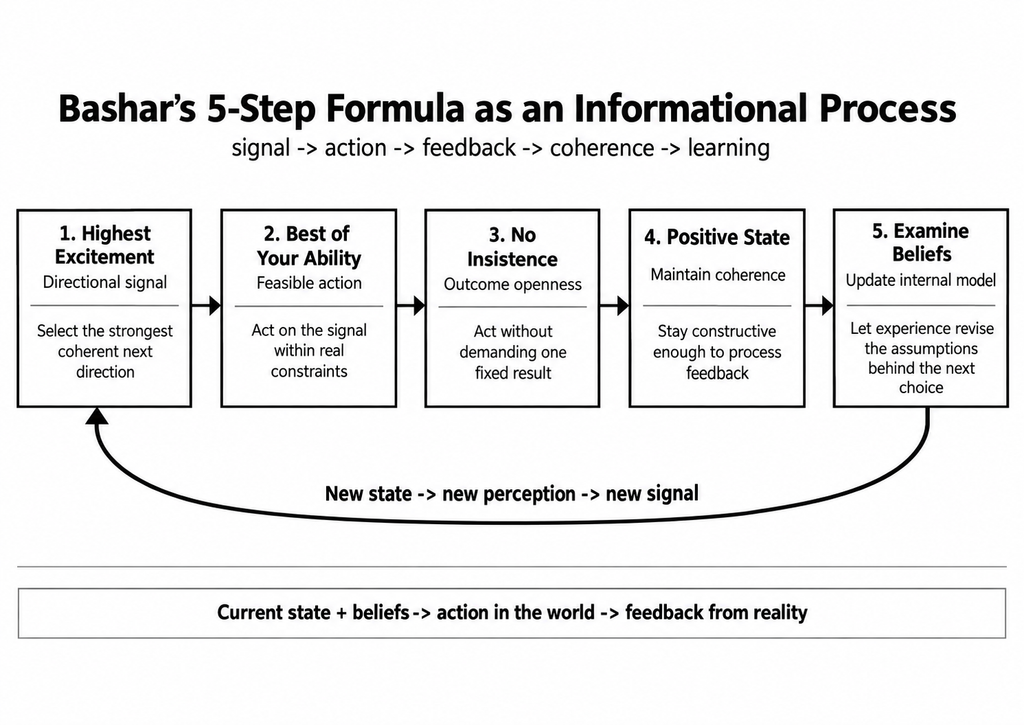
One of the most recognizable teachings associated with Bashar is the “Follow Your Excitement Formula.” In its current official form, the Formula contains five steps: act on what is most exciting or compelling in the moment, do so to the best of your ability, release insistence about what the outcome must be, choose to remain in a positive state regardless of what happens, and continually examine the beliefs through which the experience is being interpreted.
These instructions are usually presented in spiritual language. Excitement is described as a form of alignment. Circumstances provide reflections. Beliefs influence experience. Unexpected outcomes may redirect a person toward something better aligned with who they are. Bashar’s broader teachings place these ideas inside a metaphysical model involving consciousness, vibration, synchronicity, and the relationship between belief and experienced reality.
Informational physics gives us another way of reading the same sequence.
Instead of beginning with the assumption that excitement is literally communication from a higher mind, we can ask what functional role excitement is playing. Instead of beginning with metaphysical claims about manifestation, we can examine what happens when a person acts, encounters an uncertain environment, receives feedback, and revises an internal model. Once translated this way, the Formula begins to look less like a collection of spiritual affirmations and more like a compact protocol for navigating uncertainty.
This is an important distinction. The Unified Informational Physics Ontology, or UIPO, is designed to separate definitions, mathematical structures, hypotheses, protocols, and empirical claims rather than assuming that conceptual coherence automatically establishes physical truth. The same discipline is useful here. The objective is not to claim that informational physics proves Bashar’s metaphysics. The more useful question is whether the five-step Formula contains a recognizable information-processing architecture.
Viewed that way, it does.
The five steps describe a system that selects a direction, tests that direction against real constraints, acts, remains open to information returned by the environment, preserves enough internal coherence to process unexpected results, and then updates the beliefs that will influence the next decision. The process is not really linear, because the fifth step changes how the first step will be experienced the next time around. It is a loop.
That loop is where the informational interpretation becomes interesting.
Step One: Excitement as a Signal
The Formula begins with the instruction to act on whatever carries the greatest excitement, passion, curiosity, or attraction that is available in the present moment. Bashar’s older official explanation says that even if several possible actions are available, the person should begin with whichever contains slightly more excitement than the alternatives. It also warns that anxiety may sometimes be mistaken for excitement, or that genuine excitement may be suppressed because fear causes it to be interpreted as dangerous.
This already tells us something important. The Formula does not actually treat every strong feeling as reliable guidance. It assumes that some discrimination is required.
Informationally, excitement can be understood as a directional signal. A person is continuously surrounded by more possible actions than can actually be pursued. At any moment, one could begin a project, continue an existing one, make a phone call, research an idea, rest, travel, solve a practical problem, spend time with another person, abandon an unproductive strategy, or do nothing at all. The theoretical possibility space is enormous, while attention and action are finite.
A selection process is unavoidable.
The informational interpretation does not require the claim that the strongest internal signal is guaranteed to identify the objectively perfect future. It requires only that the organism needs some way to rank competing possibilities. In Bashar’s Formula, excitement is proposed as that ranking signal.
A minimal mathematical expression captures the idea without requiring us to build a large formal model:
τ* = arg max R(τ)
Here, τ represents a possible transition or action and R represents the strength of the internal resonance associated with it. The expression simply means: among the actions currently perceived as available, identify the one producing the strongest directional signal.
This is a formalization introduced for this comparison, not a pre-existing UIPO equation.
The more important point lies in what the equation does not say. It does not say that the selected action is guaranteed to succeed. It does not say that the feeling proves anything about the external universe. It does not say that every intense desire is trustworthy. It only identifies the role excitement is performing inside the decision process: it reduces a large possibility space to a candidate direction.
Seen this way, the first step is not mystical by necessity. It is informationally necessary. Any adaptive system operating in a complex environment must prioritize some signals over others.
The unusual claim in Bashar’s teaching is the recommendation to use excitement as the primary subjective marker of that prioritization.
That claim can be examined independently of its proposed metaphysical origin.
Step Two: Ability Brings the Signal Into Contact With Reality
If the Formula ended with “follow your excitement,” it would be far less structurally interesting. Strong internal signals can be misleading. Desire can exceed available resources. Impulses can conflict with physical limitations, ethical obligations, legal boundaries, the rights of other people, or simple reality.
The second step introduces exactly this correction.
Bashar instructs the individual to act on the selected excitement to the best of their ability, continuing until the action cannot presently be taken any further. The older official handout explicitly includes physical parameters, laws of society, moral values, and ethical standards among the factors that may determine whether someone genuinely has the ability to proceed.
That converts an internal signal into a constrained action.
Informational physics is fundamentally concerned not only with states, but with which transitions between states are actually available. A system may contain many imaginable future states, but physical reality permits only a subset of them from the current configuration. Resources, boundaries, relationships, information, location, energy, and time all limit what can happen next.
The first two steps can therefore be summarized by a single light formal expression:
τ* = arg max R(τ), subject to τ being feasible
The addition of “subject to” is more important than it may appear. It means that resonance does not override structure.
An individual might feel strong excitement about becoming a concert pianist, starting a company, moving to another country, writing a book, learning a scientific discipline, or building a new technology. The internal signal may be real, but the next available action is unlikely to be the finished outcome. The accessible transition may instead be practicing for an hour, researching a requirement, contacting someone, saving money, writing one section, or running one experiment.
In this sense, the second step prevents the first from becoming fantasy.
It also reveals a deeper feature of action: action produces information.
Before taking a step, a person possesses expectations about what might happen. Those expectations are based on an internal model. The model may say that an opportunity is available, that a particular person will respond positively, that a project is viable, that a certain skill can be developed, or that a particular path will lead somewhere useful.
Once the person acts, the environment responds.
That response contains information unavailable while the person remained purely inside the internal model.
A door that looked open may prove closed. A presumed obstacle may disappear. A project may generate an unexpected opportunity. An idea that seemed compelling in imagination may lose its attraction once work begins. Another direction may become visible only because the first action changed the person’s position.
This means that action is not simply the implementation of a decision. It is also a measurement of reality.
The Formula therefore begins with an internal signal, but it does not remain internal. Step two forces that signal to encounter the world.
Step Three: Non-Insistence Keeps the Model From Becoming the Reality
The third step may be the most important part of the Formula from an informational perspective. Bashar instructs the individual to act with no insistence, assumption, or expectation that a specific result must occur.
At first glance, this sounds like the familiar spiritual principle of detachment. Informationally, however, it addresses a much more specific problem: confusing a prediction with reality.
Every action contains some prediction about what will happen. Even when we are not consciously stating it, we carry an internal model of consequences. We believe that if we take a particular job, speak to a particular person, invest effort in a particular project, move to a particular location, or pursue a particular idea, some family of outcomes will become more likely.
There is nothing inherently problematic about prediction. Prediction is necessary for intelligent action.
The problem occurs when prediction becomes insistence.
Preference and probability are not the same thing. A person can strongly prefer an outcome without possessing enough information to know that it must occur.
A compact expression captures the distinction:
P(o* | A, S) < 1
Here, o* represents the preferred outcome, A the chosen action, and S the current state. The meaning is straightforward: even after choosing an action directed toward a desired result, the probability of that exact result need not equal certainty.
This may sound obvious, but humans routinely behave as though the two were equivalent.
We decide what an action is “supposed” to produce. When something different happens, the unexpected information can be treated as failure rather than evidence. A person may continue forcing an unproductive strategy because abandoning the expected outcome would require revising an assumption. Opportunities that do not resemble the imagined result may be ignored. Contradictory feedback may be rationalized away.
In informational terms, insistence closes the system.
Non-insistence keeps it open.
This does not mean becoming indifferent to outcomes. The Formula does not tell the individual to stop caring about direction. The person still chooses the most compelling available action and pursues it as fully as possible. What changes is the relationship to prediction.
The person acts strongly but predicts softly.
That distinction creates room for information to matter.
Suppose someone begins writing a book because the project contains the strongest excitement. Halfway through, the research reveals an entirely different problem worth solving. Under an outcome-insistent model, the new direction can appear as a distraction from the “real” goal. Under an adaptive model, it can be evaluated as new information generated by the original action.
The original project may have served partly as a pathway into a possibility that could not have been perceived from the original state.
This does not require a metaphysical theory of synchronicity. It follows from a simpler informational fact: action changes the observer’s position inside the possibility space.
Once the position changes, new information becomes available.
Step three tells the person not to reject that information merely because it was not predicted.
Step Four: A Positive State as the Capacity to Continue Processing
The fourth step tells the individual to choose to remain in a positive state regardless of what happens. This is probably the step most vulnerable to misunderstanding because “remain positive” can easily sound like an instruction to suppress negative emotion, deny problems, or pretend that unwanted outcomes are desirable.
That interpretation would actually conflict with the informational logic of the Formula.
If an environment contains genuine danger, error, loss, conflict, or constraint, an adaptive system needs to register that information accurately. Removing or distorting uncomfortable information would make the system less capable of responding.
A more useful interpretation is that “positive state” refers to preserving enough internal coherence to continue processing what has occurred.
Consider what happens when a strongly preferred outcome fails. The event itself contains information, but the individual’s reaction to the event can determine whether that information is incorporated. Anger, disappointment, grief, or frustration are not inherently informational failures. They can be legitimate responses to what happened. The problem arises when the reaction becomes so dominant that the person can no longer distinguish the event from the interpretation placed upon it.
At that point, feedback stops being information and becomes identity.
“I did not get the result I expected” turns into “nothing works.”
“This path closed” becomes “there is no path.”
“This person rejected the proposal” becomes “the idea has no value.”
The informational structure has changed. A local observation has been generalized into a global model.
Step four can be read as an instruction to resist that collapse.
Remaining in a constructive state does not necessarily mean feeling pleasant. It means retaining enough internal order to ask what the event actually revealed, what remains possible, whether the direction still carries the same signal, and what action is now available.
This is why the fourth step belongs after non-insistence. If someone truly releases the requirement that reality produce one predetermined result, unexpected outcomes become easier to process as information rather than as violations of how reality “should” have behaved.
The third and fourth steps therefore work together.
Non-insistence keeps the external possibility space open.
A constructive internal state keeps the observer open enough to perceive it.
Step Five: Belief Examination Turns Experience Into Learning
The fifth step brings the entire sequence together. Bashar instructs the individual to continually examine belief systems, particularly beliefs based in fear or beliefs that do not align with the state the individual prefers to express.
Within informational physics, beliefs can be understood without immediately making any metaphysical claim about whether they directly generate physical reality. A belief is first an internal representation. It influences what information receives attention, how events are interpreted, which outcomes are expected, and which actions are considered possible.
A belief therefore functions as part of the model through which the node navigates its environment.
Suppose a person believes:
“This kind of opportunity is impossible for someone like me.”
That representation affects which transitions are even considered. Opportunities consistent with the belief may receive attention while contradictory evidence is ignored.
Another person might hold the opposite belief:
“If I want something badly enough, it must happen exactly as I imagine it.”
That model produces a different distortion. Signals may be pursued, but contradictory feedback is discounted.
In both cases, the internal representation changes the relationship between information and action.
The fifth step introduces model revision.
We can represent that simply as:
Mₜ₊₁ = U(Mₜ, Fₜ₊₁)
Here, Mₜ is the current internal model, Fₜ₊₁ is the feedback received from experience, and U represents the updating process. The formula says only that tomorrow’s model should be capable of incorporating information that today’s model did not contain.
Again, this is a formalization introduced for this article rather than a canonical UIPO equation.
The important idea is simple: if experience never changes the internal model, then experience does not produce learning.
A person could repeatedly follow excitement, take action, encounter the same obstacle, become destabilized, recover, and then make the identical decision from the identical assumptions. The cycle would repeat without producing adaptation.
Belief examination closes that gap.
This is also where the Formula becomes recursive. Changing the internal model does not merely alter how past events are interpreted. It changes which future possibilities become visible and how strongly they register.
A person who previously believed that only one career could express a particular passion may recognize ten possible expressions after revising the belief. Someone who assumed that one failed relationship meant that connection itself was unavailable may see entirely different relational possibilities after changing the interpretation. Someone who believed that a scientific problem could be approached only through a familiar framework may notice new methods after questioning that assumption.
The internal model changes the perceived possibility space.
The next “highest excitement” is therefore being detected by a different observer.
The Five Steps Are One Process
Once the Formula is viewed as a whole, its structure becomes clearer.
The five steps are not independent pieces of advice. Each one solves a problem introduced by the previous step.
| Step | Informational role | What it prevents |
|---|---|---|
| Highest excitement | Selects a direction | Aimlessness |
| Best of your ability | Grounds the direction in available reality | Fantasy or overreach |
| No insistence | Keeps the result open to feedback | Rigidity |
| Positive state | Preserves capacity to interpret unexpected information | Collapse or overreaction |
| Examine beliefs | Updates the internal model | Repetition of the same error |
This is why “follow your excitement” by itself is an incomplete summary of the teaching.
Excitement gives the system direction, but direction without constraint can become impulsivity. Constraint converts the signal into a real action, but action without openness can become rigid pursuit. Openness allows reality to respond, but unexpected feedback can destabilize the observer. Internal coherence allows the feedback to be processed, but the process remains incomplete unless the information changes the model used for the next decision.
The whole cycle can be summarized very lightly as:
(Sₜ, Mₜ) → Aₜ → Fₜ₊₁ → (Sₜ₊₁, Mₜ₊₁)
The person begins with a current state and an internal model, acts, receives feedback, and ends in a new state with a potentially revised model.
That new configuration then becomes the starting point for the next application of the Formula.
This is why the sequence is better understood as recursive rather than linear.
What Informational Physics Adds—and What It Does Not
Translating Bashar’s Formula into informational language does not prove its metaphysical explanation. It does not demonstrate that excitement is literally transmitted from a higher mind, that physical reality reorganizes itself around personal vibration, or that beliefs directly select external timelines. Bashar’s broader teachings make claims of this kind, but those claims require evidence beyond the structural correspondence explored here.
What informational physics contributes is a way to examine the operational architecture without requiring agreement about those metaphysical premises.
“Excitement” can be examined as a directional signal.
“Best of your ability” can be examined as constraint-bounded action.
“No insistence” can be examined as preservation of uncertainty and responsiveness to feedback.
“Remain positive” can be examined as maintaining sufficient coherence to continue processing information.
“Examine your beliefs” can be examined as revision of the internal model.
The translation is therefore not:
Bashar said this, therefore informational physics proves it.
It is closer to:
Bashar describes a five-stage navigation process, and those five stages correspond to recognizable informational functions.
That difference matters.
A structural match is interesting because it allows the teaching to be evaluated in terms that do not depend entirely on accepting its proposed origin.
One could even test elements of the architecture. People or computational agents could be placed in uncertain environments and assigned different decision strategies. One strategy might simply pursue the most attractive option. Another might use the full sequence: select the strongest signal, check feasibility, act, avoid overcommitting to a predicted result, regulate after unexpected feedback, and deliberately update the internal model.
Researchers could then examine which architecture adapts more effectively when conditions change.
The experiment would not prove Bashar’s identity or metaphysics. It would test whether the structure of the Formula contains practical informational value.
That is a much more manageable question.
A Different Way to Understand “Follow Your Excitement”
The most common shorthand for Bashar’s Formula can create the impression that the teaching is principally about chasing excitement. Once all five steps are considered together, that interpretation becomes difficult to sustain.
Excitement is only the entry signal.
The remainder of the Formula is concerned with what happens after the signal appears.
Can the person translate the signal into an action that is actually possible?
Can the action be taken without demanding that reality follow the imagined script?
Can an unexpected result be received without losing the ability to think clearly?
Can the experience change the assumptions through which the next choice will be made?
Those questions make the Formula much more structurally sophisticated than its popular shorthand suggests.
From an informational-physics perspective, the process is not really:
Feel excitement and reality gives you what you want.
It is closer to:
Use resonance to choose a direction, let constraints determine the next executable step, allow action to generate new information, remain coherent enough to receive that information, revise the internal model, and then choose again from the changed state.
That is not a static formula for arriving at one preferred future. It is a navigation process for moving through a future that cannot be fully known in advance.
The distinction is important because real adaptive systems cannot operate from complete information. They must act before every variable is known. The environment then reveals additional information through the consequences of those actions. Intelligence lies partly in how effectively that new information changes subsequent behavior.
Viewed in that light, Bashar’s Formula can be understood as a recursive relationship between internal signal and external feedback.
The internal signal initiates movement.
Action exposes the signal to reality.
Reality returns information.
The observer processes the information.
The internal model changes.
And because the internal model changes, the next signal is experienced from a different informational state.
The sequence therefore becomes:
Signal → Action → Feedback → Learning → New Signal
with the second, third, and fourth steps serving as the safeguards that keep that cycle grounded, open, and coherent.
Whether the metaphysical explanation Bashar places around this process is ultimately correct is a separate question.
The underlying informational architecture can be examined without settling it.
And that may be the more productive bridge between Bashar’s Formula and informational physics. The interesting correspondence is not that both systems use similar spiritual language; UIPO generally does not. The correspondence lies in the deeper structure of navigation itself.
A system must determine what direction to explore.
It must act within the conditions that actually exist.
It must allow the environment to produce information that contradicts prediction.
It must remain sufficiently organized to process that contradiction.
And it must revise its internal representation if experience shows that the representation was incomplete.
That is how adaptive systems learn.
It is also, when stripped of its metaphysical vocabulary, remarkably close to the architecture contained in Bashar’s five-step Formula.
The phrase “follow your excitement” therefore describes only the opening movement.
The full process is better summarized as:
Follow the strongest coherent signal available to you, act on it within the boundaries of reality, let reality answer without demanding a predetermined response, remain internally coherent enough to hear the answer, and allow what you learn to change the way you see the next choice.
In informational terms, the importance of the Formula is not simply that it tells a person where to go.
It describes how to keep learning while moving.