
How Jesus Taught the Structural Physics of Relationships
Few teachings of Jesus are quoted more often and understood less clearly than the instruction to “turn the other cheek.” For many people, the phrase has come to mean that a good person should simply accept mistreatment, remain quiet, avoid conflict, and let others take advantage of them. In that reading, turning the other cheek becomes almost a command to be passive. But when the verse is read in context, especially alongside the examples that immediately follow it, a different picture begins to appear. Jesus does not seem to be teaching people to become weak. He seems to be teaching them how to stop conflict from controlling their behavior.
In Matthew 5, Jesus gives a series of examples. If someone strikes you on the right cheek, turn the other cheek. If someone tries to take your tunic, give your cloak as well. If someone forces you to go one mile, go two. These examples are often discussed separately, but they make more sense when read together. In each case, one person is trying to control another person through force, status, law, humiliation, or power. Yet Jesus does not tell the weaker person simply to obey, nor does he tell that person to strike back in the same manner. Instead, he introduces an unexpected response that changes the pattern.
That may be the deeper lesson. You do not have to become a mirror of the person attacking you.
This matters because human conflict usually runs on imitation. Someone becomes angry with us, so we become angry with them. Someone insults us, so we search for a sharper insult. Someone attacks our political beliefs, so we attack theirs. Someone questions our religion, intelligence, family, work, or values, and we immediately move into defense. Once that happens, both people begin feeding the same pattern. Each response gives the next response more energy. Very quickly, the original disagreement becomes less important than the conflict itself.
Jesus appears to interrupt that pattern.
To understand why, it helps to look closely at the first example. He specifically refers to being struck on the right cheek. In the culture of the time, many historians and biblical interpreters have noted that a strike to the right cheek could suggest a backhanded slap, an act connected not only with violence but also with insult and social humiliation. The exact social meaning remains debated, so we should not build the entire interpretation on one historical detail. What is clearer is the larger pattern in the passage: Jesus repeatedly takes situations in which another person is trying to set the terms of the interaction and tells the listener to respond in a way the aggressor did not choose.
Turning the other cheek is therefore not the same thing as pretending the first blow did not matter. It may instead be a way of saying, “You can choose what you do, but you do not get to choose what I become because of it.”
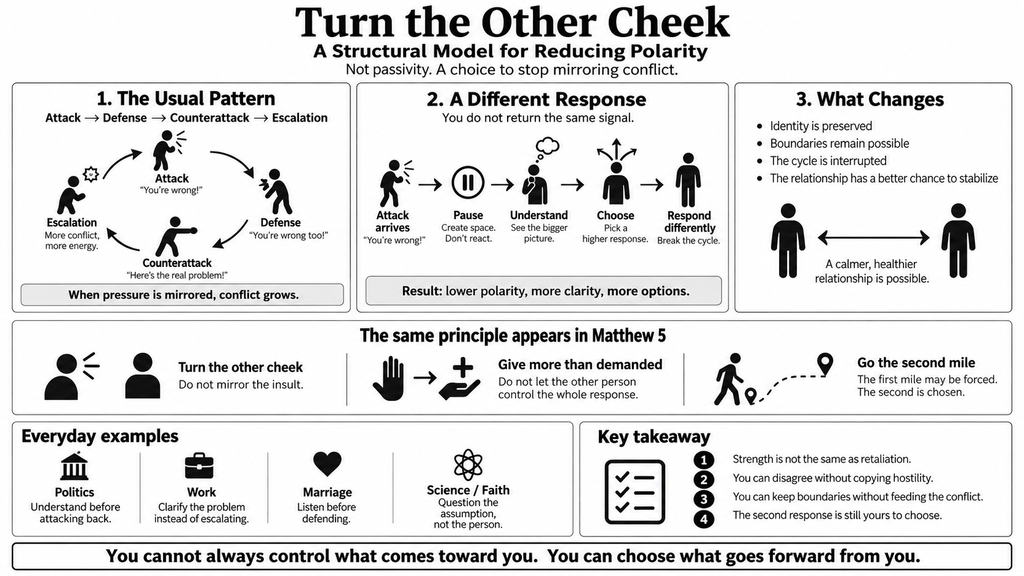
The same principle becomes even clearer in the command to go the second mile. Under Roman rule, soldiers could compel civilians to carry equipment. The first mile, then, represents forced service. The civilian is operating under someone else’s authority. But Jesus tells the person to go farther than required. Whatever else this statement means, one thing changes immediately: the second mile is no longer being forced in the same way as the first. The soldier controls the demand, but the civilian controls the added response.
That is a very different picture from passivity.
The first mile is imposed. The second mile is chosen.
This does not erase the power difference. It does not make Roman occupation just. It does not mean the soldier suddenly becomes good. What changes is the person’s relationship to the pressure being applied. The person is no longer responding only inside the options created by the one with power.
Conflict usually presents us with two choices: fight back or give in. Jesus introduces a third.
That third choice is strength without imitation.
The same pattern appears in the example of the tunic and cloak. Someone is attempting to take something through legal force or economic pressure. Jesus again recommends an unexpected action that goes beyond the demand. The point is not that property rights no longer matter or that people should allow others to strip them of everything. The point is that the response is no longer being completely controlled by the other person.
When the cheek, cloak, and second mile are read together, they begin to look like variations on the same principle. Someone applies pressure. Instead of returning the pressure in the same form or collapsing under it, you change the way the interaction works.
This is where the teaching connects naturally with what might be called the structural physics of relationships.
That phrase does not mean Jesus was secretly teaching modern physics. It means that relationships, like other systems, have patterns. Pressure moves through them. Reactions create further reactions. Repeated behavior forms pathways. Some responses increase tension, while others reduce it or redirect it. The Geometry of Systems describes how load can become concentrated when a system keeps sending pressure through the same narrow pathway, and how flexibility can allow a system to absorb stress without breaking. That same general principle can be seen in human relationships.
Imagine two people in an argument. One attacks. The other immediately attacks back. The first person now feels justified in escalating. The second person escalates again. Both people become more certain that the other is the problem. The argument may have started over politics, money, work, parenting, religion, or a misunderstanding, but soon the structure of the conflict becomes more powerful than the subject itself.
Pressure is being returned as pressure.
In simple form, the pattern looks like this: attack creates defense, defense becomes counterattack, counterattack creates stronger defense, and the cycle continues. Nothing new has entered the system, so the system keeps producing the same result.
Turning the other cheek interrupts that loop.
It does not mean doing nothing. It means refusing to send back the same kind of signal you received.
That distinction is important.
Suppose someone attacks your conservative political views and says, “Conservatives do not care about poor people.” A normal polarized response would be to defend your side by attacking the other side: “Liberals just want government control and handouts.” At that point, both people are no longer discussing poverty. They are defending identities.
A different response might be: “I understand why poverty and access to healthcare matter to you. They matter to me too. I think we disagree more about which policies create good long-term outcomes than about whether people should suffer.”
That response does not require the conservative person to surrender any belief. It does not require agreement with the accusation. What it does is refuse the polarity being offered.
The same should be true in the other direction. Suppose someone says to a liberal, “Liberals do not care about personal responsibility or public safety.” The liberal response does not have to be, “Conservatives are cruel and authoritarian.” It could be, “I understand why responsibility and public safety matter to you. They matter to me too. We may disagree about how to achieve them fairly.”
In both cases, the person has kept an identity while refusing to turn the disagreement into an identity war.
That is not weakness. It is control.
This is where Stephen Covey’s principle, “Seek first to understand, then to be understood,” fits remarkably well. Covey’s point is simple but demanding. Most people do not truly listen during disagreement. They wait for an opening to respond. While the other person is speaking, they are preparing a defense, correction, or counterargument. In effect, both people are transmitting and neither is receiving.
Seeking first to understand changes the order.
You receive before you answer.
That does not mean accepting everything you hear as true. It means understanding what the other person actually believes, fears, values, or sees before trying to change their mind. Once you understand the other person accurately, your own response becomes less reactive and more precise.
That is very close to what turning the other cheek accomplishes in conflict.
Both teachings interrupt automatic reaction.
They create a moment in which you are no longer being controlled by what just came toward you.
From an informational physics perspective, this can be explained in very simple terms. Every person receives information from the world, interprets it, and responds. The response does not have to be an exact copy of the incoming signal. A person can receive anger and return clarity. A person can receive accusation and return a question. A person can receive contempt and return a boundary. A person can receive fear and return reassurance.
The important point is that the system transforms what enters it.
UIPO treats information, identity, boundary, and exchange as distinct parts of system description, while also warning that an interpretive framework should not be confused with empirical proof. Applied carefully here, the framework gives us a useful way to describe the teaching without pretending physics proves biblical interpretation. A person has an identity. A person also has a boundary. Information crosses that boundary through speech, behavior, pressure, criticism, or affection. The person then decides what to do with it.
A weak boundary does not transform much. It simply passes the pressure through.
Someone insults me, so I insult them.
Someone scares me, so I scare someone else.
Someone humiliates me, so I look for another person to humiliate.
The signal keeps moving.
A stronger system can transform what it receives.
This is one of the clearest lessons in The Geometry of Systems. Flexibility is not the same thing as weakness. A flexible system can absorb pressure, adjust, and still preserve its form. A brittle system may look strong until pressure comes, but then it cracks because it has only one way to respond. The same can be true of people.
A person who must answer every criticism with aggression may look strong but is actually very easy to control. All another person has to do is provoke them.
If someone can choose your emotional response, they are controlling more of you than you realize.
This is why the second mile is such a powerful image.
The first mile is about what happens to you.
The second mile is about who you choose to be.
That distinction applies far beyond Roman soldiers.
At work, someone may say, “You completely messed up this project.” The automatic response is easy: “You gave me terrible instructions.” The pressure simply reverses direction.
A different response might be, “I understand why you are frustrated about the deadline. Let me show you where I think the process broke down and what I should have handled differently.”
That does not mean accepting blame for something you did not do. It means refusing to let accusation decide the form of your answer.
In marriage, one person says, “You never listen to me.” The reflex response is, “You never explain anything clearly.”
Again, the same pattern repeats.
A different response is, “Tell me what you feel I’m not hearing.”
The disagreement has not disappeared. But the direction of the conversation has changed.
The same principle applies to religion. Someone says, “Christians are anti-science.” A Christian could attack the person’s intelligence or motives. Or the Christian could say, “I understand why certain religious claims can sound hostile to scientific evidence. I do not think faith requires rejecting careful observation, and I’m willing to talk about where you see the conflict.”
The same is true in science itself. If someone says, “Your theory is nonsense,” the strongest response may not be to defend the theory immediately. It may be to ask, “Which assumption do you think fails first?”
That question does something important. It turns attack into information.
If the critic has found a real flaw, you want to know.
If the critic cannot identify one, the weakness of the criticism becomes visible without your having to become hostile.
This is what strong systems do with pressure. They learn from it when possible, redirect it when necessary, and refuse to amplify it automatically.
None of this means Jesus was teaching people to remain in abusive situations.
That misunderstanding is dangerous and should be rejected clearly.
Turning the other cheek does not require staying in physical danger. It does not mean a victim must remain available to an abuser. It does not mean refusing legal protection. It does not mean that justice is wrong. It does not mean every viewpoint deserves equal respect or that falsehood should be treated as truth.
A person can refuse revenge and still leave.
A person can forgive and still set a boundary.
A person can understand another person and still say no.
A person can remain calm and still call the police.
A person can refuse hatred while still opposing injustice.
Those are not contradictions.
In fact, boundaries are part of strength.
The Geometry of Systems emphasizes that systems preserve identity by regulating what crosses their boundaries, not by allowing unlimited exchange. A healthy relationship works the same way. Compassion without boundaries becomes self-erasure. Boundaries without compassion become isolation. The harder task is to preserve both.
This may be one reason Jesus’ teaching has lasted so long. It does not fit neatly into the categories we usually use.
It is not revenge.
It is not surrender.
It is not passivity.
It is not domination.
It is a different kind of power.
The power is in refusing to let the other person determine the shape of your response.
That also explains why the teaching is so relevant now.
Modern politics rewards polarity. Social media rewards outrage. Cable news rewards conflict. Algorithms often benefit when people become angry enough to keep watching, clicking, and replying. Identity becomes tied to reaction. If the other side says something, our side is expected to say the opposite.
This creates a society full of mirrored hostility.
The more one group attacks, the more the other group hardens. Each side then uses the other side’s reaction as proof that its own aggression was justified. The cycle feeds itself.
Jesus’ teaching offers a very different rule.
Do not let someone else’s hostility choose your behavior for you.
That rule is harder than retaliation because retaliation is automatic. It feels satisfying for a moment. It confirms identity. It signals loyalty to our group. But structurally, it often strengthens the very conflict we say we want to end.
Reducing polarity does not mean reducing conviction.
That is another important distinction.
You can believe something strongly and still understand why another person believes something different. You can defend truth without humiliating people. You can oppose harmful ideas without treating every person who holds them as an enemy.
In fact, understanding the strongest version of an opposing view often makes your own thinking stronger. If your belief can survive only because you refuse to understand the other side, then your belief is probably more fragile than you think.
Strong identity does not require constant defense.
A stable person can listen.
A stable person can question.
A stable person can admit when the other side has a point.
A stable person can disagree without collapsing.
That may be one of the deepest lessons inside “turn the other cheek.”
Someone else can create the first moment.
They can insult you.
They can misrepresent you.
They can pressure you.
They can force the first mile.
But they do not own the second mile.
That belongs to you.
Covey approaches the same insight through communication: seek first to understand, then to be understood.
Systems thinking approaches it through pressure and feedback: if every force is returned in the same form, the system escalates.
Informational physics approaches it through transformation: what enters a system does not have to leave unchanged.
Jesus expresses it with something far simpler.
Turn the other cheek.
Carry the load another mile.
Do not let the person applying pressure decide who you become.
That is not passivity.
It is disciplined freedom.