
And the Structural Problems Behind Them
Businesses rarely fail all at once.
The final moment may be obvious: payroll is missed, a lender refuses additional financing, a major customer leaves, a location closes, or the owner concludes there is no realistic path forward. But the conditions that produced that moment usually developed long before anyone described the business as failing.
That distinction matters because the visible cause of failure is often only the last event in a much longer chain.
A company may officially close because it ran out of cash, but the cash shortage may have begun with weak demand. A business may lose customers because service quality declined, but the service problem may have started when growth exceeded operating capacity. Employees may appear unaccountable, but the real issue may be that authority is concentrated in one overloaded leader who has become the bottleneck for nearly every important decision.
Business failure is therefore better understood as a structural problem than as a single bad event.
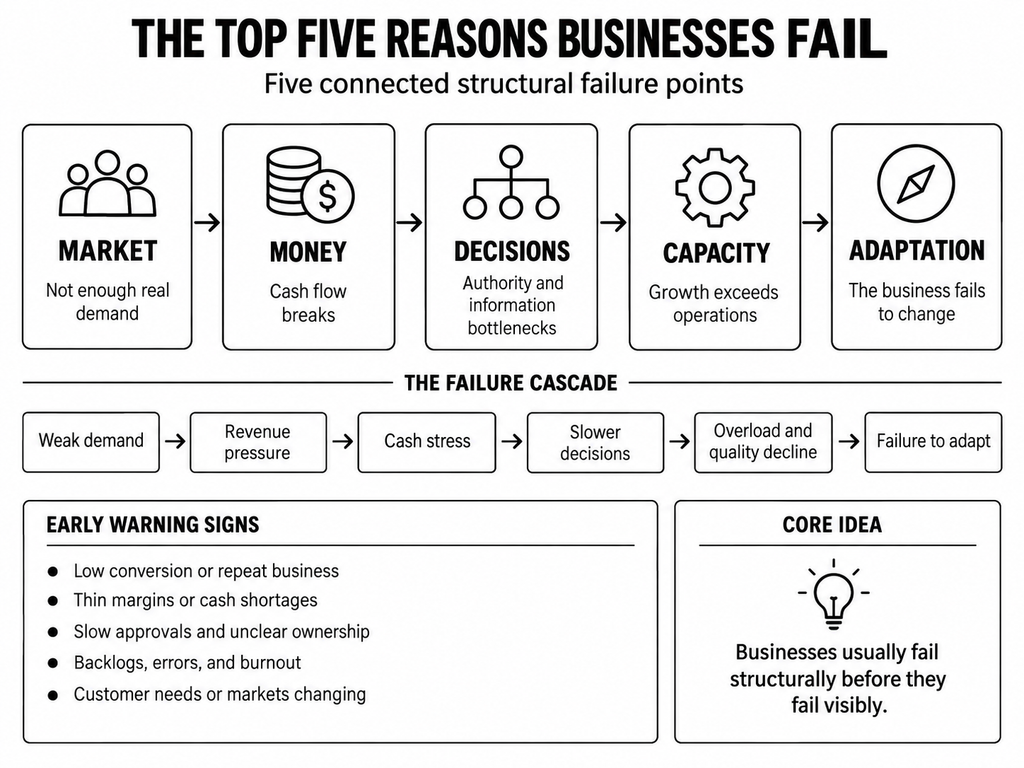
Across industries, company sizes, and business models, five recurring failure points appear again and again:
| Failure Area | Core Question |
|---|---|
| Market | Do enough customers actually want what we sell? |
| Money | Does the business generate enough cash to sustain itself? |
| Decisions | Can information and authority move fast enough? |
| Capacity | Can the operation handle the load being placed on it? |
| Adaptation | Can the business change when its environment changes? |
These five areas are not independent. They form a connected operating system.
Market → Money → Decisions → Capacity → Adaptation
A company must remain aligned across all five. When one begins to break down, pressure frequently spreads into the others.
1. The Market Does Not Want Enough of What the Business Is Selling
The most basic requirement of a business is also the easiest to underestimate: enough people must genuinely want what the company sells.
A founder may have an excellent idea. Customers may say they like it. Friends may be enthusiastic. Early users may praise it. A product may attract attention online. None of those things necessarily prove that a sustainable market exists.
Real demand is demonstrated when enough customers repeatedly choose the product or service at a price that allows the business behind it to survive.
This is the difference between interest and product-market fit.
A customer saying, “That’s a great idea,” is not the same as buying. A first purchase is not the same as repeat behavior. Website traffic is not the same as conversion. Early enthusiasm from a narrow group does not guarantee that a larger market will behave the same way.
The structural problem begins when a company builds an increasingly expensive internal organization around an assumption about external demand that has never been fully validated.
Employees are hired. Inventory is purchased. Offices or facilities are leased. Technology is developed. Marketing spending increases. Debt or investment capital is committed. Each decision assumes that enough demand will eventually arrive to support the structure being created.
If that assumption is wrong, the company is no longer simply selling a weak product. It is carrying a system whose cost is based on demand that does not exist.
This is one reason marketing cannot permanently solve a weak-market problem. Marketing can make customers aware of something they already value. It can improve positioning, explain benefits more clearly, or reduce friction in the purchasing process. What it cannot do indefinitely is force customers to place sufficient value on an offer they do not need enough.
The warning signs usually appear before the financial crisis:
- conversion remains weak even after substantial marketing improvements;
- customers require heavy discounts before buying;
- repeat business or retention is poor;
- salespeople repeatedly encounter the same value objection;
- acquisition costs rise because increasingly more effort is needed to find each new customer;
- customers struggle to explain why the product is meaningfully better than available alternatives.
The danger becomes greater when a company experiences some initial success. Early adopters may create enough demand to make the business look validated. Leadership then assumes that the broader market will respond the same way and expands before that assumption has been demonstrated.
A healthy company continues testing demand even after the first customers arrive.
The useful question is not simply, “Do customers like this?”
It is:
Are enough customers choosing us consistently, at a price and frequency that can support the business we are building?
Until the answer is clearly yes, expansion should remain proportionate to the evidence.
2. The Business Runs Out of Cash
Running out of cash is one of the most visible ways a business dies, but it is often not the original problem.
Cash is the circulation system of a company. It continuously moves outward to pay wages, suppliers, rent, software, inventory, insurance, taxes, debt, marketing, utilities, equipment, and countless other operating expenses. For the system to remain viable, enough cash must eventually return through customers, financing, or other legitimate sources.
When that return flow is consistently smaller or slower than the outgoing flow, the business begins consuming its own ability to continue operating.
The problem can be deceptive because revenue, profit, and cash are not the same thing.
A company may record strong sales and still be unable to pay its bills. Imagine a business that sells $1 million of goods this month but pays suppliers and employees immediately while its customers have 90 days to pay invoices. The income statement may look healthy while the bank account becomes increasingly strained.
A business can also grow while becoming financially weaker. Suppose it spends $130 to acquire and serve a customer who ultimately contributes only $100 of gross economic value. Every new customer increases revenue, but every new customer also deepens the underlying loss.
In that situation, growth does not repair the business. It accelerates the failure.
Several common problems can produce this pattern:
| Financial Pressure | Structural Effect |
|---|---|
| Low margins | Too little cash remains after delivering the product |
| Poor pricing | Revenue does not reflect the true cost of service |
| Long payment cycles | Cash arrives too slowly |
| Excess fixed costs | The company must support too much structure regardless of sales |
| High customer-acquisition cost | Growth consumes cash faster than customers replenish it |
| Too much debt | Future cash flow is already committed |
| Overexpansion | New locations, staff, or inventory consume capacity before returns appear |
| Low reserves | Small disruptions become financial emergencies |
This is why the question “Is the company growing?” is incomplete.
The more useful question is:
Does growth strengthen the financial system, or does it make the company more dependent on additional cash just to keep operating?
Healthy growth should eventually increase the company’s ability to fund itself, absorb shocks, invest, and make decisions from a position of strength.
If every new dollar of revenue produces greater pressure, the economics underneath the business need to be repaired before scale becomes the objective.
Growth cannot rescue economics that do not work.
3. Decisions Become the Bottleneck
A business is ultimately a decision system.
It must decide what to sell, whom to hire, where to allocate capital, what work matters most, which customers to pursue, when to raise prices, when to abandon an idea, and how to respond when reality differs from expectations.
When the decision system becomes slow or unclear, the rest of the organization slows with it.
This is often described as a leadership problem, but that description can obscure the actual structure.
Consider a founder who personally approves nearly every important decision. In a company of five people, that may work extremely well. The founder has the most knowledge, the clearest view of the strategy, and direct visibility into nearly every customer and project.
Then the business grows to twenty employees, then fifty.
The founder may still be excellent at making decisions. The problem is that the number of decisions has increased far faster than one person’s ability to process them.
Employees begin waiting for approval. Customers wait for exceptions. Managers hesitate because they are unsure what authority they actually have. The founder becomes increasingly overwhelmed and concludes that the team is not taking enough responsibility.
From the team’s perspective, taking responsibility may feel dangerous because important decisions are regularly reversed or pulled back upward.
What appears to be an accountability problem may actually be a geometry problem.
Authority, information, and responsibility are concentrated incorrectly.
A similar problem occurs when two executives believe they own the same decision, or when a manager is held responsible for an outcome but does not control the resources that determine it. In other companies, information moves through so many meetings, reports, and approval layers that decisions arrive after the opportunity has already changed.
A healthy decision structure answers three questions clearly:
- Who owns the decision?
- What information do they need to make it?
- At what level does approval actually need to occur?
Not every decision should be decentralized. Strategic, irreversible, regulated, or highly expensive decisions may need senior review.
But routine and reversible decisions should generally be made close to the people who possess the information required to make them.
One particularly useful distinction is between decisions that require permission and decisions that require visibility.
A manager may not need the CEO’s approval to make a routine customer decision, but the CEO may still need visibility into the pattern of those decisions. Separating those two functions can remove an enormous amount of unnecessary friction.
The central diagnostic question is:
Can this company make good decisions at the speed its environment requires?
A business cannot reliably move faster than its decision system.
4. Growth Exceeds Operational Capacity
Growth is usually treated as proof of business health.
Often it is. But growth also creates load.
Every new customer creates additional work. Every employee creates coordination requirements. Every location creates management complexity. Every new product creates inventory, technology, service, accounting, and training demands.
Growth therefore has two sides.
It increases opportunity, but it also increases the pressure placed on the structure that must deliver that opportunity.
The basic relationship is simple:
The problem is that saturation rarely appears immediately.
When demand first exceeds capacity, employees compensate.
They work longer hours. Managers solve exceptions personally. Teams postpone documentation. People create spreadsheets, manual workarounds, and temporary fixes. Founders jump back into daily operations.
For a while, the company appears to be handling the growth.
Internally, however, its margin for error is disappearing.
Eventually, a relatively small disruption causes a large failure. A key employee gets sick. A supplier misses a delivery. A software system crashes. A large customer places an unexpected order. A manager resigns.
That event gets blamed for the problem, but it may only have exposed a system that was already operating without sufficient buffer.
This is why maximum efficiency and resilience are not the same thing.
A company operating at nearly 100% capacity may look highly efficient during normal conditions. But a system with no available slack has very little ability to absorb variation.
Resilient companies intentionally preserve some margin through combinations of cash reserves, spare capacity, backup suppliers, cross-trained employees, realistic deadlines, redundant systems, and available management attention.
The structure also needs to change as the organization grows.
What works at one scale often fails at another.
| Small Company | Larger Company |
|---|---|
| Everyone can talk directly | Information needs structure |
| Founder can approve most decisions | Authority must be distributed |
| Customer exceptions can be handled individually | Repeated patterns need processes |
| Informal knowledge is sufficient | Documentation becomes necessary |
| One person can hold several functions | Roles and dependencies become more specialized |
The mistake is assuming that growth simply means doing more of what already worked.
Often the operating model itself must change.
The better question is not, “How quickly can we grow?”
It is:
How much additional load can our current system absorb before quality, speed, reliability, or employee capacity begins to deteriorate?
Scaling revenue without scaling capacity does not create a larger healthy business.
It creates a larger fragile one.
5. The Business Fails to Adapt
Every company operates from assumptions.
Customers want a certain product. A particular price is acceptable. A distribution channel works. A technology is competitive. A regulatory environment is stable. A certain type of employee can be hired at a predictable cost.
Those assumptions may be completely correct when the business is created.
The problem is that the environment does not agree to keep them correct.
Technology changes. Customer preferences change. Competitors improve. Regulations change. Labor costs rise. Interest rates move. Distribution channels lose effectiveness. New business models appear.
A company can execute yesterday’s strategy perfectly and still become increasingly irrelevant.
Adaptation is therefore not about constantly chasing trends. Businesses that react to every new idea can become just as unstable as companies that refuse to change.
Healthy adaptation means recognizing when evidence shows that an important assumption is no longer true.
Ironically, success can make that harder.
A successful business has employees trained around the existing model, technology designed to support it, customers who associate the brand with it, managers whose incentives depend on it, and investors who expect it to continue.
Changing direction threatens something that has already worked.
That creates a powerful tendency to defend the old structure.
A retailer built around physical stores may underestimate the speed of digital purchasing. A manufacturer may continue perfecting one technology while customers migrate to another. A professional-services firm may resist standardization because customization historically differentiated it, even as customers increasingly value speed and transparent pricing.
The earliest warning signs are often subtle:
- sales cycles become longer;
- customers raise new objections;
- retention begins slipping;
- acquisition costs rise;
- competitors repeatedly win a particular customer segment;
- customers ask for capabilities that the company does not provide;
- pricing becomes harder to defend.
These signals should not automatically trigger a strategic pivot. They should trigger investigation.
Adaptation is the mechanism that prevents the other four structural problems from becoming permanent.
If demand changes, adaptation helps the company reposition the offer. If margins weaken, adaptation changes pricing or cost structure. If decisions become bottlenecked, adaptation changes authority. If operations saturate, adaptation redesigns capacity.
That makes adaptation slightly different from the other four failure modes.
It is both a failure point and the mechanism by which the business corrects the others.
The critical question is:
What assumption are we still operating under that reality may no longer support?
Business Failure Usually Happens as a Cascade
The five reasons are easiest to understand separately, but companies rarely experience them separately.
Consider one common sequence:
Weak demand → weak revenue → cash pressure → defensive decisions → capacity reductions → weaker service → even weaker demand
The failure began in the market, but it eventually appeared everywhere.
Another company may experience the opposite path:
Strong demand → rapid growth → operational overload → quality decline → customer loss → cash pressure
The company did not fail because demand was weak. It failed because its structure could not process the demand it had successfully created.
A third sequence may begin with leadership:
Decision bottleneck → slow response → missed opportunities → weaker market position → revenue pressure → cost cutting → reduced capacity
These examples illustrate a critical distinction between a cause and a trigger.
- The customer leaving may be the trigger.
- The lender refusing another loan may be the trigger.
- The recession may be the trigger.
- The key employee resigning may be the trigger.
But the more important question is:
What condition made that event capable of doing so much damage?
That question moves the analysis away from blame and toward structure.
A Simple Five-Part Business Diagnostic
Companies do not need to wait until failure becomes obvious before looking for structural weakness.
A recurring review of five questions can expose where pressure is beginning to build.
| Area | Diagnostic Question | Useful Signals |
|---|---|---|
| Market | Are enough customers repeatedly choosing us? | Conversion, retention, repeat purchases, pricing power |
| Money | Does growth strengthen our finances? | Cash flow, margins, reserves, acquisition cost, debt load |
| Decisions | Can decisions happen where the relevant information exists? | Approval time, reversals, stalled work, unclear ownership |
| Capacity | Can our systems absorb additional load? | Utilization, backlog, cycle time, errors, rework |
| Adaptation | Which assumption may no longer be true? | Customer behavior, competition, technology, regulation |
The point is not to create another dashboard full of numbers.
The goal is to make structural pressure visible before the business reaches the point where failure is obvious.
Failure Is Usually Structural Before It Is Visible
When a company begins struggling, the instinct is often to push harder.
More sales calls. More advertising. More meetings. More oversight. More hours. More cost cutting.
Sometimes additional effort is exactly what is needed.
But effort cannot permanently repair a structural mismatch.
More sales can make an overloaded operation worse. More growth can accelerate negative cash flow. More approvals can slow an already bottlenecked decision system. More marketing can waste money if the offer does not fit the market. More commitment to an old strategy can make adaptation harder when the environment has already changed.
The better sequence is:
Find the constraint → understand why it exists → change the structure → measure what happens.
Businesses do not need perfect markets, unlimited capital, flawless leaders, endless operating capacity, or constant reinvention.
They need continuing alignment.
The market must support the offer. The economics must support the operation. The decision structure must support execution. Capacity must support the load being placed upon it. And the company must adapt enough to remain aligned as its environment changes.
When those relationships remain healthy, the business becomes resilient.
When they begin drifting apart, failure can start long before anyone sees a crisis.
A business usually does not fail on the day it closes.
It fails gradually as reality changes faster than its structure does.