
A Falsifiable Low-Energy Quantum-Gravity Hypothesis Linking Branch-Resolved Phase to Spacetime Tidal Geometry
Quantum–Classical Curvature Closure (QCCC) presents a falsifiable low-energy quantum-gravity hypothesis that asks whether the nonseparable phase accumulated across quantum gravitational branches closes quantitatively onto the same tidal curvature structure measured in classical gravity.
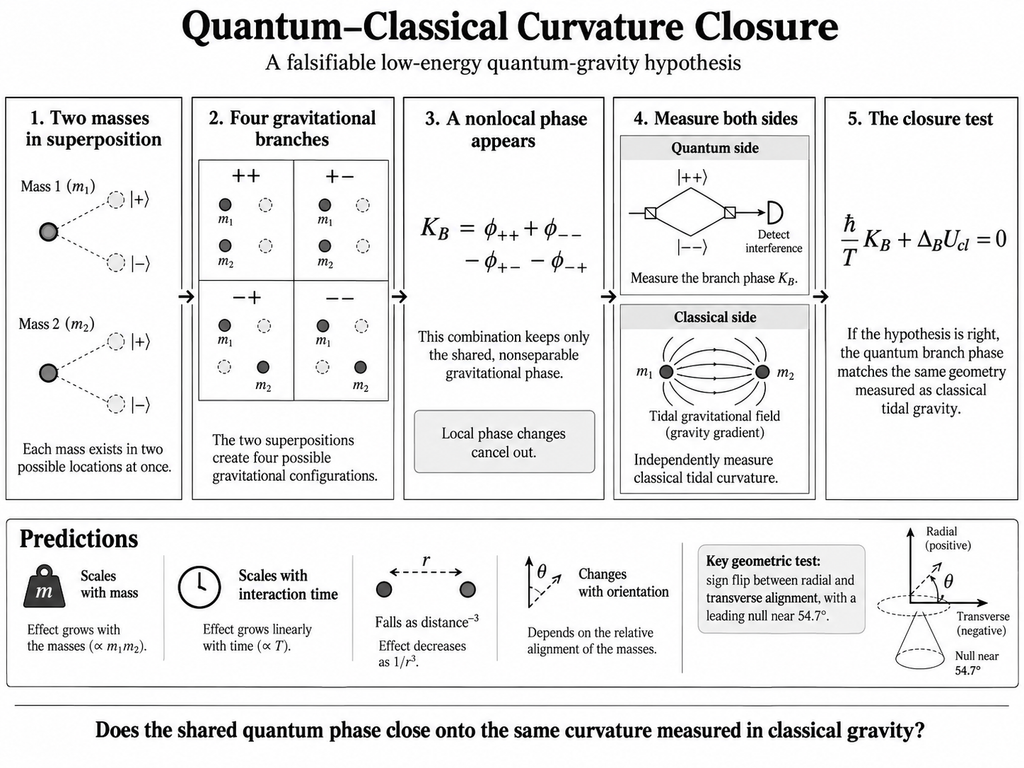
The paper considers two masses, each prepared in a coherent spatial superposition. Their mutual gravitational interaction produces four branch-dependent phases. Most of those phases are locally removable and therefore do not represent genuinely relational two-body information. QCCC isolates the local-phase-invariant mixed finite difference
which vanishes for separable local phase contributions and directly controls the entangling component of the branch state.
For the weak-field Newtonian interaction, the manuscript derives the exact closure relation
where is the mixed finite difference of the classical gravitational interaction energy across the four branches.
In the small-superposition limit, the same branch quantity converges to the classical tidal tensor:
This identifies a direct operational bridge between quantum branch nonseparability and classical geodesic-deviation curvature. The resulting prediction is parameter-free within the stated weak-field regime and yields specific scaling with interaction time, source masses, branch separations, spatial separation, and orientation.
The model predicts the characteristic tidal scaling , a sign reversal between radial and transverse branch geometries, and a leading-order angular null at
The manuscript also derives exact finite-branch corrections, allowing the null and scaling structure to be tested without relying only on a truncated expansion.
QCCC is framed as a model-discrimination experiment rather than a claim that gravity-induced entanglement alone proves quantized gravity. Recent work has shown that classical and hybrid gravity models can produce entanglement under broader assumptions, so the relevant question becomes quantitative: does the measured branch phase follow the independently calibrated classical curvature relation, and does it scale in the way QCCC predicts?
The proposed experimental architecture therefore uses two independently governed channels: a classical gravitational-curvature calibration and a quantum branch-phase measurement. The central falsifier is the closure residual
The hypothesis fails within its declared regime if this residual remains nonzero beyond the full uncertainty budget, if the predicted scaling or angular structure fails, or if competing classical or hybrid models explain held-out measurements better.
This deposit includes the manuscript and a full reproducibility package containing the calculation scripts, symbolic checks, Section 3.1 numerical values, angular and distance-scaling scans, finite-size corrections, rephasing-invariance checks, closure-grid results, diagnostic figures, verification routines, environment specification, and integrity manifest.
QCCC is not presented as a complete ultraviolet theory of quantum gravity. It is a low-energy consistency hypothesis designed to test whether quantum branch geometry and classical spacetime curvature can be connected by one measurable, falsifiable relation.