
A Falsifiable Hypothesis with an In Silico Test in Autocatalytic Chemistry
Abiogenesis as a Dynamically Gated Transition to Endogenous Maintenance presents a falsifiable theoretical and computational framework for examining one of the central unresolved problems in origin-of-life research: how persistent nonliving chemistry could cross into a state in which internal processes actively contribute to maintaining the system’s own continued viability.
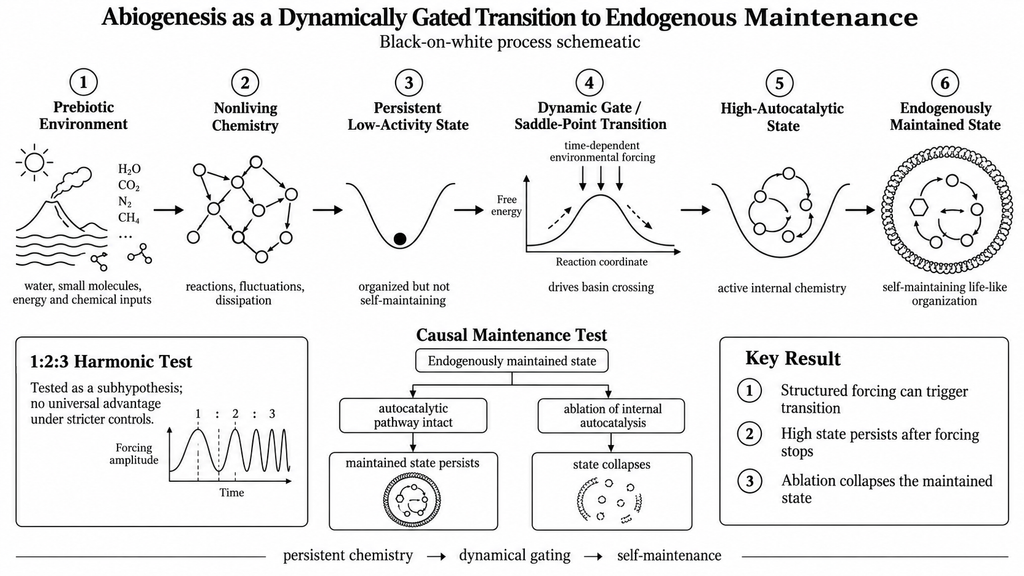
Rather than treating abiogenesis as the random assembly of a modern biological molecule or invoking an undefined organizing force, the paper focuses on a narrower dynamical transition. It distinguishes passive persistence from endogenous maintenance and asks whether time-structured environmental forcing can push a nonlinear prebiotic chemical network across a basin boundary into a self-sustaining active state.
The manuscript develops the Dynamically Gated Endogenous Maintenance (DGEM) hypothesis and tests its dynamical feasibility using an established continuous-flow organic reaction-network model derived from Semenov et al. The model contains bistability, an intermediate saddle, and a stable high-autocatalytic attractor. Numerical integration shows that bounded time-dependent forcing can drive the system from the low-activity basin across the separatrix and into the high-autocatalytic state, where the new state persists after the external drive is removed. A separate causal ablation simulation sets the autocatalytic rate parameter to zero and demonstrates collapse of the high-concentration state, providing an explicit intervention-based test that the maintained state depends on internal autocatalysis rather than residual external forcing.
The paper also directly tests the stronger Triune Harmonic Dynamics subhypothesis that a coherent 1:2:3 forcing architecture should enjoy a privileged transition advantage. Equal-RMS controls initially suggested differences among waveform families, but equal-positive-peak normalization removed the apparent advantage. The manuscript therefore reports the 1:2:3 result as a negative finding rather than preserving it through post hoc reinterpretation. This falsifies universal 1:2:3 privilege within the tested model while leaving the more general DGEM hypothesis intact: near a nonlinear transition, appropriately structured temporal forcing can change the probability of entering a persistent self-maintaining state.
The broader implication is that the origin-of-life problem may be usefully reframed as a sequence of dynamical accessibility problems rather than a single combinatorial accident. Environmental cycling, autocatalysis, compartmentalization, nonlinear feedback, and basin transitions may jointly constrain the state space through which nonliving chemistry can move toward biological autonomy.
The manuscript is accompanied by a complete reproducibility package containing the Python simulation code, pinned dependencies, equilibrium calculations, waveform-comparison data, numerical summaries, figure-generation routines, causal-ablation analysis, verification script, and SHA-256 integrity manifest. The package reproduces the manuscript’s primary computational results from a clean run and is intended to support independent review, replication, extension, and falsification.
This work is presented as a theoretical and computational hypothesis, not as experimental evidence that DGEM caused historical abiogenesis. Its central claims are explicitly testable and include clear failure conditions, conventional alternatives, and an experimental translation pathway toward protocell and RNA-based systems.
Conceptual provenance for the persistence-to-maintenance distinction and the preregistered harmonic-testing discipline is documented in the companion Calista Loop (doi:10.5281/zenodo.22086743) and Unified Informational Physics Ontology (doi:10.5281/zenodo.17623979) publications, while the manuscript’s scientific argument is independently grounded in peer-reviewed work on nonlinear chemical dynamics, autocatalysis, protocells, autonomy, environmental cycling, and origin-of-life chemistry.