
A Microscopic Hypothesis
This paper develops a falsifiable microscopic model in which fermionic exchange behavior and conditional spin-one-half structure emerge from a local bosonic substrate rather than being imposed at the starting level of the theory.
The paper focuses on a specific unresolved question: if a deeper microscopic description is bosonic, what physical mechanism could autonomously select the fermionic branch associated with half-integer-spin matter? Existing approaches have shown that fermionic behavior can emerge from bosonic systems, but the present work targets the antecedent selection mechanism itself.
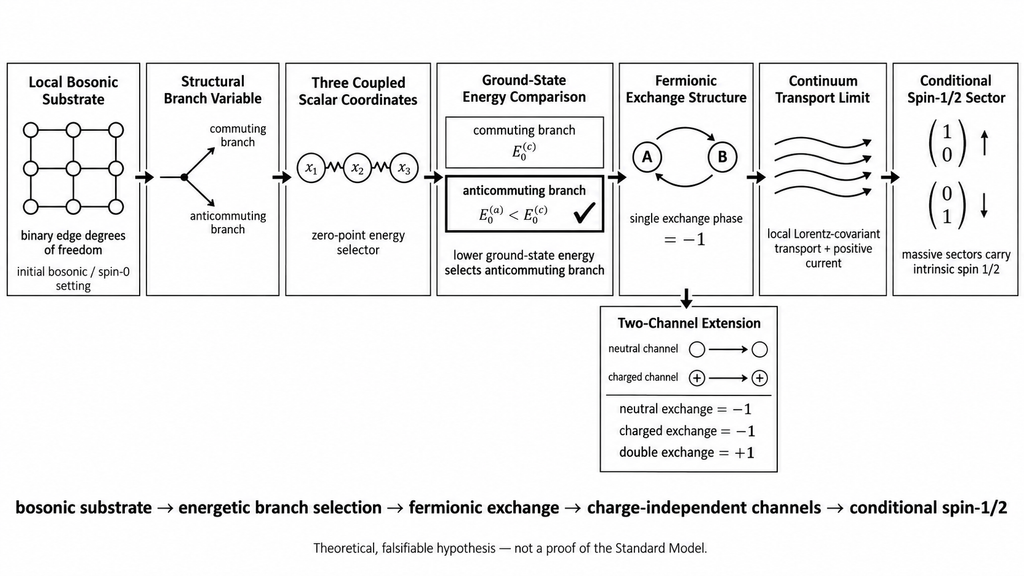
The construction begins with binary edge degrees of freedom on a finite graph and a local structural variable that distinguishes commuting and anticommuting operation-order branches. Three coupled scalar coordinates are then introduced as an autonomous selector. Their zero-point spectra differ between the two branches. A determinant identity proves that, for positive couplings, the anticommuting branch has lower ground-state energy in the specified model. This provides a concrete energetic preference rather than assuming fermionic creation operators as microscopic primitives.
The model next separates electric charge from exchange parity by introducing distinct neutral and charged transport channels that share the same scalar selector. This removes a restriction present in a simpler one-channel construction, where charge and spin parity become too tightly linked. Controlled adiabatic exchange produces a geometric factor of minus one for either individual channel and plus one when both are exchanged. These signs persist under a bounded structural perturbation with an explicit gap certificate.
The same transport framework is then extended into a long-wavelength continuum limit. Under an explicit hypothesis that physical inertial-frame transformations act locally, continuously, and preserve the stated mass bilinear and positive vector current, the resulting massive sectors carry intrinsic spin one-half. The paper carefully distinguishes this conditional spatial-spin result from exchange statistics alone and does not claim that exchange phase by itself determines physical spin.
Several falsifiable consequences are derived. A finite-temperature selector ensemble produces a predicted interference-visibility curve determined by the scalar frequencies. A prescribed exchange protocol tests the expected single-channel and double-channel phase factors. A separate charged-channel mass law yields conditional tree-level magnetic-response relations and partner-mass predictions. These tests have different physical reach and are explicitly separated from claims about the complete elementary-particle spectrum.
The manuscript does not claim to derive all known particles, chiral interactions, non-Abelian gauge structure, or the full interacting vacuum. It also does not claim that a programmable realization would prove that nature uses the same substrate. Instead, it presents a connected conditional hypothesis: an autonomous scalar mechanism selects a fermionic exchange branch, neutral and charged channels inherit that selection independently of electric charge, and the associated transport admits a conditional spin-one-half continuum interpretation.
The central contribution is therefore a mathematically explicit and experimentally vulnerable proposal for how a bosonic microscopic system could select fermionic behavior and support intrinsic spin-one-half structure without assuming fermionic fields at the outset.