Correspondence, Causality, Transformation, Scale, and the Observer Through Modern Systems Science and Informational Physics
Hermeticism occupies an unusual position in the history of ideas. The writings associated with Hermes Trismegistus combine Greek philosophical language with an Egyptian religious setting and explore creation, mind, knowledge, transformation, humanity’s place in the cosmos, and the relationship between visible and invisible order.
The philosophical works now grouped under the Corpus Hermeticum were composed principally in Roman Egypt during the early centuries CE, with most scholarship placing them broadly in the second and third centuries. They were attributed to Hermes Trismegistus, a composite wisdom figure associated with the Greek Hermes and Egyptian Thoth. The surviving Hermetic literature is also broader than the philosophical corpus: texts associated with Hermes included astrology, alchemy, magic, and other technical traditions.
That historical boundary matters because modern popular Hermeticism often begins with the Seven Hermetic Principles popularized by The Kybalion. Those seven principles are not an ancient seven-item doctrine contained in the Corpus Hermeticum. For this paper, the more historically responsible approach is to work from recurring structures within ancient and late-antique Hermetic thought, while treating the Emerald Tablet and later alchemical Hermeticism as related but historically distinct developments.
The famous formulation usually paraphrased as “as above, so below” belongs to the Emerald Tablet tradition rather than the Corpus Hermeticum itself. The earliest surviving Latin forms are medieval, and the text circulated as an alchemical work within a much larger technical Hermetic tradition.
The purpose of translating Hermeticism into physics is therefore not to claim that ancient Hermetic authors secretly knew quantum mechanics, relativity, information theory, or modern cosmology. They did not possess particle accelerators, electronic measurement, differential equations, statistical mechanics, or network science.
What they did possess was the ability to observe recurring structural problems: how multiplicity emerges from unity, how parts interact inside wholes, how knowledge depends on the observer, how transformations preserve or change identity, and whether similar organizational patterns can appear at different scales.
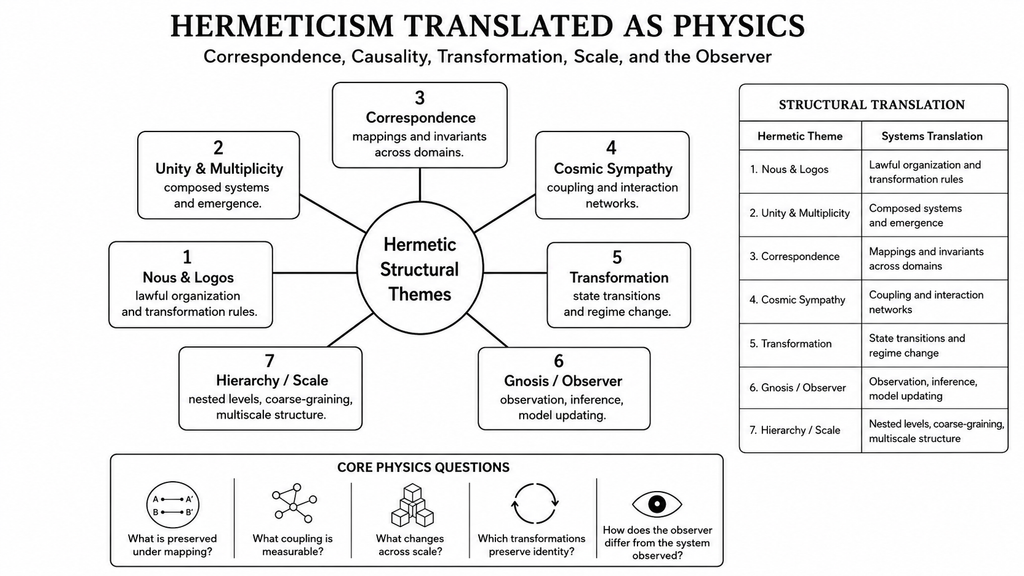
Modern civilization can represent such questions with mathematics.
The central question of this paper is therefore:
When the structural claims of Hermeticism are translated into modern systems language, which relationships remain recognizable without turning analogy into evidence?
That final qualification is essential. Unified Informational Physics Ontology explicitly distinguishes mathematical representation from physical confirmation and requires observation models, typed quantities, alternatives, and testable comparisons before conceptual structure is promoted into an empirical claim.
A Structural Translation of Hermeticism
The main correspondences can be summarized before examining them individually.
| Hermetic theme | Systems-science translation | Mathematical language |
|---|---|---|
| Nous and Logos | lawful organization and mediation | state dynamics and transformation rules |
| Unity and multiplicity | composition of complex systems | product state spaces and interaction terms |
| Correspondence | structure preserved across representations or scales | mappings, invariants, homomorphisms |
| Cosmic sympathy | coupling among system components | interaction matrices and network dynamics |
| Transformation / regeneration | change of dynamical regime | state transitions and attractors |
| Gnosis / knowledge | observer-dependent model formation | observation maps and Bayesian updating |
| Hierarchical cosmos | nested levels of organization | coarse-graining and multiscale models |
| “As above, so below” | possible scale correspondence | dimensionless invariants and scale transformations |
The table deliberately says possible correspondence, not identity. A physical equation can illuminate a structural relation without proving the metaphysical interpretation from which the analogy began.
Nous and Logos: Order Requires Rules of Transformation
One of the recurring themes in the philosophical Hermetica is Nous, often translated as Mind or Intellect, together with Logos, a term that can mean word, reason, discourse, or ordering principle. The Poimandres, the opening and best-known treatise of the Corpus Hermeticum, describes creation through a hierarchy involving divine Mind and Logos. Scholars have long noted that this vocabulary reflects the intellectual environment of late-antique Platonism and related Hellenistic traditions.
A physics translation should not turn Nous into a physical field or Logos into a force. The more defensible parallel is rule-governed organization.
Let a system have state
Its evolution is governed by a dynamical rule
where specifies how the present state and parameters constrain future states.
The important object is not merely the collection of things inside the system. It is also the set of relationships and transformations that determine what those things can do.
Two systems may contain identical components yet behave differently because their interaction rules differ.
A pile of silicon components is not a computer merely because the materials are present. Architecture and transformation rules matter.
A set of neurons is not described completely by listing neurons. Their connectivity matters.
An economy is not merely people and money. Rules governing exchange alter the system.
This provides a restrained Hermetic translation:
Order is not reducible to components. It also resides in the rules connecting and transforming those components.
Hermetic language personifies or metaphysically grounds that intelligibility. Modern systems science represents it through equations, operators, and constraints.
Unity and Multiplicity: How the Many Arise from Composed States
Hermetic cosmology repeatedly explores the relation between a unified source and a differentiated cosmos. Modern physics cannot validate the theological source, but it can formalize the structural problem of how multiplicity emerges through composition.
Suppose a complex system contains subsystems with state spaces
The combined state space can be represented as
A complete state is then
Complexity increases not merely because additional objects exist, but because interactions among them create additional possibilities.
A generic interacting system can be written
where measures coupling and specifies the interaction.
Without the interaction term, the system is merely a collection.
With it, collective behavior can emerge.
This gives a mathematical version of an ancient structural intuition: the many can arise from differentiated relationships inside a larger whole.
Modern complexity science finds such behavior everywhere. Molecules have properties not possessed by isolated atoms. Networks exhibit collective modes. Organisms emerge from interacting biochemical processes. Social systems create institutions that cannot be reduced to any one individual.
That does not establish Hermetic monism. It demonstrates something narrower: composition can generate genuinely new system-level behavior.
Correspondence: When Structure Survives Translation
Hermeticism is strongly associated with correspondence. Later Hermetic traditions made this especially explicit through the Emerald Tablet’s relation between what is above and below. The principle is often interpreted as saying that structures at one level reflect structures at another.
This is where the physics translation requires unusual care.
Superficial resemblance is not structural equivalence.
A spiral galaxy and a hurricane are both spiral-shaped, but that does not mean they are governed by the same physical mechanism. A branching tree and a river network may resemble one another geometrically while differing profoundly in dynamics.
A meaningful correspondence requires something to be preserved under mapping.
Let
map one system representation into another.
Suppose system evolves under transformation , while system evolves under .
A strong structural correspondence would satisfy
This means that transforming first and then mapping produces the same result as mapping first and then transforming.
That is far stronger than visual similarity.
Depending on the claim, one might instead require preservation of:
- topology,
- adjacency,
- symmetry,
- ratios,
- conservation relations,
- dimensionless parameters,
- functional roles.
This provides one of the most useful translations of Hermetic correspondence:
A genuine cross-domain correspondence exists only when a specified relationship remains invariant under a declared mapping.
This distinction also aligns with Informational Physics, which requires cross-domain mappings to state what is preserved and warns against treating geometric or numerical resemblance alone as physical mechanism.
Cosmic Sympathy: Systems Are Coupled
Ancient and Renaissance Hermetic traditions often imagined the cosmos as interconnected, with relationships binding different regions or levels of reality. Later natural philosophy developed ideas of sympathy and antipathy through which parts of the cosmos were thought to influence one another. Renaissance natural philosophy drew heavily on Hermetic and microcosm–macrocosm thinking of this kind.
Modern physics certainly confirms that physical systems interact, but that does not validate historical doctrines of magical sympathy.
The rigorous translation is coupling.
Consider a network of dynamical components:
If
components and are uncoupled in this model.
If
the state of one influences the evolution of the other.
The entire coupling structure can be represented by a matrix
This architecture appears in oscillators, neural systems, ecological networks, power grids, financial systems, and social networks.
Some coupled systems synchronize. Others destabilize. Some form clusters. Some transmit disturbances across great portions of the network.
The modern translation of “everything is connected” must therefore be more precise:
Some variables are connected through identifiable interaction channels whose strengths, directions, and delays can be measured.
Physics does not permit us to infer coupling merely because two things look similar or change together. Correlation does not automatically establish mechanism.
That boundary is important because it transforms Hermetic correspondence from a conclusion into a scientific question.
Transformation: Identity Through Change
Hermetic literature is deeply concerned with transformation, particularly the transformation or regeneration of the human being through knowledge. Technical Hermetic traditions later became closely associated with alchemy, where transformation was represented materially as well as spiritually. The philosophical and technical Hermetica should not be collapsed into one category, but transformation is a clear thread across the broader tradition.
Modern dynamical systems represent transformation as movement through state space.
Let
be a transformation operator.
Then
The system may remain inside the same qualitative regime, or it may cross a threshold into another.
Suppose an order parameter is governed by a potential
Changing the parameter can reorganize the stable states of the system.
The underlying material may remain, while its organization changes qualitatively.
Physics provides many examples: water freezes, magnetic materials change ordering, lasers cross activation thresholds, and biological systems switch regulatory states.
The broader principle is:
Identity does not require the absence of transformation. It may instead require preservation of selected structure through transformation.
This question is central to Informational Physics. What exactly must remain invariant for a changed system to count as the same system?
Material?
Boundary?
Organization?
Memory?
Function?
Causal continuity?
Hermetic transformation becomes scientifically interesting once the problem is stated this way.
Gnosis and the Observer: Knowledge Is Not the State Itself
Hermeticism places unusual emphasis on gnosis—knowledge or direct understanding through which the human relation to reality changes.
Physics does not provide a mathematical equivalent of spiritual gnosis. It does, however, make a crucial distinction between reality and the observer’s representation of reality.
Let the latent state be
The observer receives
where is the observation process and represents measurement noise.
The observer then forms an estimate
Information changes the estimate without necessarily changing the underlying state.
Bayesian updating formalizes the process:
New evidence transforms the observer’s probability distribution over possible states.
This is a powerful modern parallel because it prevents an error that occurs frequently in metaphysical discussions:
a change in the observer’s model is not automatically a change in physical reality.
Conversely, improved observation can reveal structure that was always present.
Informational Physics formalizes this distinction by requiring explicit observation maps and by separating physical-state distinguishability, Shannon information, semantic information, and functional information rather than treating “information” as one interchangeable substance.
The systems translation of Hermetic knowledge is therefore:
An observer participates in knowledge by constructing and updating a representation, but the representation must remain distinguishable from the state represented.
Hierarchy: Different Levels of Description
Hermetic cosmology frequently uses hierarchical structures: divine intellect, cosmos, celestial orders, nature, and humanity are represented at different levels.
Modern physics cannot confirm that metaphysical hierarchy, but multiscale science regularly confronts a related problem: the same system can be described differently at different resolutions.
Let
represent a microscopic state.
A coarse-graining operator
produces
Many distinct microscopic states may map to the same macroscopic state.
For example, temperature describes enormous numbers of molecular configurations without recording the precise position and velocity of every molecule.
This relationship is many-to-one:
even when
That means different descriptive levels contain different information.
The macroscopic level is not “false” because it omits microscopic detail. It is a different representation optimized for different questions.
This offers a useful translation of Hermetic hierarchy:
Reality can support multiple nested levels of description, with each level preserving some relationships while discarding others.
That is a scientific statement.
The further claim that those levels correspond to spiritual planes remains philosophical or metaphysical unless independently operationalized.
“As Above, So Below” and Scale Invariance
The Emerald Tablet provides perhaps the most famous Hermetic phrase associated with correspondence. Historically, however, it belongs to the alchemical Hermetic tradition rather than the ancient philosophical Corpus Hermeticum. Its Latin transmission became important in medieval and later European alchemy.
The strongest modern physical interpretation is not that every scale literally mirrors every other.
It is the question of scale invariance.
Suppose a system transforms under rescaling
A quantity may satisfy
If
then
and the quantity is scale invariant.
Dimensionless quantities are especially important because they permit meaningful comparison across scales.
Using Buckingham’s theorem, dimensional variables can often be combined into dimensionless groups
If two systems share the same governing dimensionless relationships, they can sometimes exhibit dynamically similar behavior despite enormous differences in size.
This is the scientifically useful form of “above and below”:
Ask whether a specified invariant survives a change of scale.
Sometimes it does.
Sometimes it does not.
The answer must be measured rather than assumed.
Alchemy and Conservation: Transformation Is Not Arbitrary
Broader technical Hermetic traditions included alchemical texts, although these should not be confused with the philosophical treatises of the Corpus Hermeticum.
Modern chemistry fundamentally changed the understanding of material transformation by replacing symbolic qualities with quantitative composition, mass balance, stoichiometry, thermodynamics, and atomic theory.
A general conservation equation can be written
where is a local density, a flux, and a source or sink term.
For a closed chemical reaction, atomic species must balance across the reaction.
Transformation does not mean matter can become anything whatsoever.
There are constraints.
Modern science therefore preserves something important from the alchemical fascination with transformation while radically changing the mechanism:
Transformation is real, but allowable transformation is constrained by conservation, energetics, structure, and kinetics.
This is also a central concept in Informational Physics: operators act on states, but not every transformation is admissible.
Informational Physics: Hermeticism as a Structural Translation Problem
Unified Informational Physics Ontology supplies a particularly useful grammar for this comparison because its canonical schema separates state space, state variables, operators, and observation.
Schematically,
where represents the state space, the relevant variables or fields, and the admissible operations. UIPO explicitly states that the schema organizes a model without proving that information is the fundamental substance of reality, and it requires empirical claims to specify observation models, uncertainty, comparison conditions, and falsifiable restrictions.
Through that lens, the Hermetic correspondences become:
| Hermetic language | Informational-physics translation |
|---|---|
| cosmic order | structured state space and lawful operators |
| correspondence | mapping that preserves specified relations |
| sympathy | measurable coupling between domains |
| transformation | admissible state transition |
| gnosis | updated observer representation |
| hierarchy | nested or coarse-grained representations |
| microcosm / macrocosm | cross-scale mapping |
| unity | system-level integration of interacting parts |
This does not validate Hermetic metaphysics. It makes the claims more precise.
Instead of saying “everything corresponds,” we ask: which mapping preserves what?
Instead of saying “everything is connected,” we ask: what coupling mechanism can be measured?
Instead of saying “the microcosm mirrors the macrocosm,” we ask: which dimensionless relationships survive scale transformation?
Instead of saying “knowledge transforms reality,” we distinguish updating the observer model from changing the physical state.
This is exactly the distinction needed to move from symbolic philosophy toward testable structural inquiry.
The Ancient-to-Modern Bridge
The ancient Hermetic writers could think about order without writing dynamical equations. They could contemplate unity and multiplicity without product state spaces, correspondence without homomorphisms, transformation without phase-transition models, and interconnectedness without coupling matrices.
Later Hermetic and alchemical thinkers could imagine relationships between macrocosm and microcosm without renormalization theory or dimensionless scaling analysis.
The absence of modern mathematics does not mean the absence of structural reasoning.
It means the observations and hypotheses were expressed through another language: Nous, Logos, cosmos, sympathy, correspondence, regeneration, ascent, microcosm, and macrocosm.
Modern science translates comparable structural questions into state spaces, operators, networks, transformations, observation models, and scale mappings.
The relationship is strongest when the translation becomes more restrictive, not less.
Modern mathematics should prevent us from declaring every resemblance meaningful.
It should tell us exactly what has to be preserved before a correspondence counts.
Conclusion: From Correspondence to Testable Structure
Hermeticism is sometimes presented today as a collection of universal truths already confirmed by modern science. That framing weakens rather than strengthens the subject.
The more interesting possibility is that Hermeticism preserved an ancient structural intuition: reality is relational, transformations occur within larger orders, observers possess incomplete representations, and patterns may sometimes recur across different levels.
Modern science can examine those ideas without pretending they were originally modern scientific theories.
A disciplined translation produces several clear questions:
- Which relationships remain invariant across scale?
- Which systems are genuinely coupled?
- Which transformations preserve identity?
- Which patterns are only superficial resemblance?
- How does the observer’s information differ from the underlying state?
- When does a higher-level description preserve meaningful structure from the lower level?
Those are legitimate scientific questions.
Hermetic language describes correspondence.
Modern mathematics asks for the mapping.
Hermetic language describes sympathy.
Physics asks for the coupling mechanism.
Hermetic language describes transformation.
Dynamical systems ask for the transition operator.
Hermetic language speaks of the microcosm and macrocosm.
Scale analysis asks which invariants survive the change in resolution.
Informational Physics brings these translations together by asking what state, relation, boundary, transformation, and observation structures must be specified before the correspondence can become more than analogy.
The strongest modern translation of Hermeticism is therefore not:
“As above, so below.”
It is the more demanding scientific question:
When two systems appear to reflect one another across domain or scale, what exactly is preserved under the transformation—and what evidence would show that the correspondence is real rather than merely apparent?
That turns an ancient doctrine from an answer into a research question.