
Truth, Order, Balance, Constraint, and System Stability Through Modern Physics and Informational Physics
For thousands of years, ancient Egyptian religion placed an unusually broad idea at the center of both human conduct and cosmic order: Ma’at.
Ma’at was personified as a goddess, but the concept extended beyond a deity. It represented truth, justice, right order, balance, and harmony. The Metropolitan Museum of Art describes Ma’at as embodying world order, truth, and justice, while the British Museum describes her as associated with truth, justice, balance, order, and harmony.
The best-known visual expression of this principle appears in Egyptian funerary texts. In the judgment scene of the Book of the Dead, the heart of the deceased is weighed against Ma’at or her feather. In the famous Papyrus of Ani, the heart occupies one pan of the balance while a feather representing Ma’at occupies the other. Thoth records the result, and the judgment determines whether the deceased has lived in accordance with proper order.
Modern physics uses very different language. It speaks of state spaces, conservation laws, equilibrium, feedback, information fidelity, boundaries, constraints, stability, entropy production, networks, and measurement.
Yet beneath these different vocabularies lies a surprisingly compatible question:
What conditions must a complex system preserve if it is to remain ordered, trustworthy, stable, and capable of continuing to function?
This paper explores Ma’at through that question.
It does not claim that ancient Egyptians secretly possessed thermodynamics, information theory, matrix algebra, or control engineering. They had no electronic sensors, computers, statistical estimators, network models, or differential equations with which to formalize the behaviors they observed.
What they did possess was long-term observation of natural cycles, political systems, agricultural dependence, interpersonal trust, law, exchange, death, social breakdown, and the consequences of deception and disorder.
Ancient Egypt expressed those observations through religious and ethical language.
Modern civilization can additionally express comparable structural relationships mathematically.
The purpose of this translation is therefore not to prove Egyptian religion through physics. It is to ask what remains when the ancient concepts of truth, order, justice, balance, and proper relationship are translated into the structural language of modern systems science.
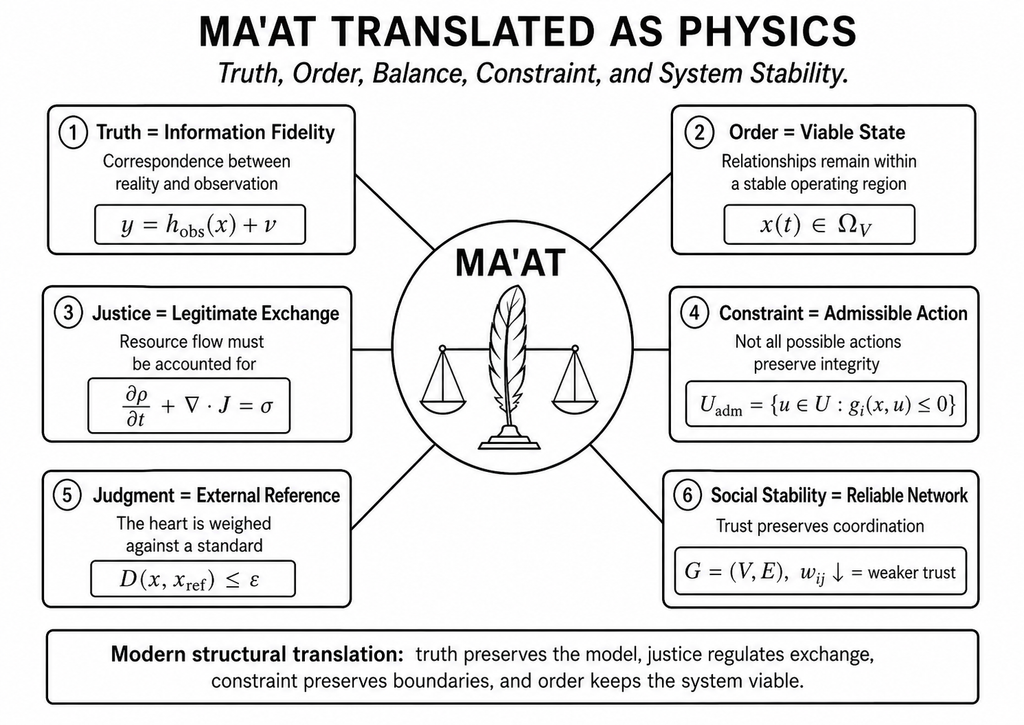
Ma’at Is Better Understood as Order Than as Static Balance
A common visual shorthand for Ma’at is the balance scale, especially because of the weighing of the heart. But interpreting Ma’at simply as “everything being equal” would miss much of the concept.
Physical systems are rarely stable because every variable has the same value.
A healthy body does not contain equal concentrations of every hormone. An ecosystem does not contain equal populations of every species. A functioning economy does not allocate identical resources to every sector. A bridge is not stable because every force is numerically identical.
Balance in systems science is better understood as relationships remaining within a viable configuration.
Let the state of a system be
and let
represent the region within which the system remains viable.
The relevant requirement is
The system can move, adapt, exchange resources, experience disturbances, and still remain within the region that preserves its identity and function.
This gives Ma’at a useful first translation:
Ma’at represents an ordered regime in which the relationships necessary for persistence remain within viable bounds.
Its conceptual opposite, often expressed in Egyptian thought through disorder or isfet, can then be interpreted structurally as movement outside those bounds: corruption of relationships, breakdown of legitimate order, or loss of the constraints that allow the system to remain stable.
This is not static equilibrium.
It is dynamic order.
Truth as Information Fidelity
One of the strongest bridges between Ma’at and modern science concerns truth.
Complex systems depend on information. A court depends on testimony. A government depends on reports. A farmer depends on observations of weather and crops. A scientific institution depends on measurements. A nervous system depends on sensory signals.
If the information entering the system does not correspond sufficiently to reality, even an otherwise competent decision process can fail.
Suppose the underlying state is
The observer receives
where represents the observation process and represents noise or error.
The system then forms an internal estimate
Good regulation requires the estimate to remain sufficiently close to what is actually occurring.
Information theory provides another representation. If is the underlying information and the communicated signal, their mutual information is
A reliable signal reduces uncertainty about the underlying state. A corrupted signal leaves greater uncertainty or, more dangerously, may create false confidence about something that is not true.
Deliberate deception can also be represented as divergence between reality and the model communicated to another person. Using Kullback–Leibler divergence,
where represents an evidence-based distribution and represents the distorted representation induced in the receiver.
As the two distributions diverge, the receiver’s informational model increasingly departs from the source.
This provides a direct structural translation of Ma’at as truth:
Truth preserves correspondence between the state of the world and the information used to regulate behavior within it.
Falsehood is therefore not merely a private moral defect. It is a form of system corruption.
When enough information channels become unreliable, verification costs rise, coordination becomes harder, trust falls, and the system must spend increasing resources determining which signals are genuine.
Truth is infrastructure.
The Declarations of Innocence as a Constraint Architecture
The ethical dimension of Ma’at appears vividly in Chapter 125 of the Book of the Dead. The section commonly called the Negative Confession or Declarations of Innocence contains a series of denials of wrongdoing before divine assessors. UCL’s Digital Egypt project notes that a well-known version contains forty-two declarations before forty-two assessors and dates the surviving written tradition to the New Kingdom.
It is important, however, not to turn this into a historical claim that there was one immutable set of “42 Laws of Ma’at.” That popular modern phrase oversimplifies the manuscript tradition. UCL notes variations in sequence, correspondence between assessors and offenses, and even the number of declarations; one Eighteenth Dynasty example contains thirty-two rather than forty-two.
The more defensible interpretation is that these declarations represent a family of behavioral constraints associated with righteous conduct and successful judgment.
Modern systems science can formalize that structure.
Suppose the full action space is
Each ethical constraint removes a class of prohibited transitions:
The admissible action space becomes
The purpose of a constraint is not to eliminate action. It defines which actions remain compatible with continued system integrity.
The structural parallels can be summarized as follows:
| Ma’at-related behavioral theme | Systems translation |
|---|---|
| Do not murder or cause wrongful harm | preserve autonomous system integrity |
| Do not steal | regulate legitimate resource transfer |
| Do not lie | preserve information fidelity |
| Do not defraud | preserve measurement and exchange integrity |
| Do not abuse power | constrain asymmetric control |
| Do not disrupt legitimate order | preserve viable institutional relationships |
| Do not misuse resources | prevent destructive boundary extraction |
| Maintain proper conduct | remain within the admissible state/action region |
The mathematical point is not that these statements can be derived from physics. Physics alone cannot tell a civilization what is morally right.
The useful correspondence is that persistent systems routinely depend on forbidden transitions.
A computer protocol prohibits malformed operations. A power plant prohibits pressure states beyond safety thresholds. A cell membrane restricts molecular exchange. A legal system restricts some transactions precisely so that legitimate transactions can continue.
Constraint is part of organization.
Justice as Legitimate Exchange
Ma’at also encompassed justice, which creates another useful bridge through conservation and boundary exchange.
Suppose a conserved or accounted resource has density and flux . A continuity equation takes the form
where represents legitimate sources or sinks.
The equation says that changes inside a defined region must be accounted for by flow across the boundary or by specified production and loss terms.
Human resources are not fundamental conserved quantities like electric charge, but social and economic systems nevertheless depend on accounting.
If one person’s resource changes because of a transfer,
in the simplest closed transaction.
The important social question is whether that transfer occurred through an authorized pathway: exchange, compensation, inheritance, gift, taxation under legitimate authority, or another recognized process.
Theft, fraud, and coercive extraction create transfers that may be physically possible but are not institutionally admissible.
This produces a useful translation:
Justice regulates which flows across human boundaries are legitimate.
The point is not that justice equals conservation.
Rather, conservation mathematics demonstrates why boundary exchange must be accounted for if a system is to know its actual state.
Unrecorded extraction corrupts the ledger.
Fraud corrupts the observation.
Unjust exchange corrupts the relationship.
Ma’at joins these issues under the broader demand for right order.
The Weighing of the Heart as an Audit Against a Reference
The weighing of the heart is one of the most powerful images in ancient Egyptian religion because it expresses morality as something evaluated against an external standard.
The British Museum’s description of the Papyrus of Ani identifies the heart on one side of the balance and the feather representing Ma’at on the other, with Thoth present to record the outcome. A related British Museum papyrus describes Ma’at as the principle of order, right, and truth and explains that the heart had to balance correctly against Ma’at for the deceased to be declared justified.
Modern measurement systems use the same general architecture without the religious meaning.
There is:
- an object being evaluated,
- a reference,
- a comparison procedure,
- a decision criterion,
- and a recorded result.
Let a measured state be and a reference condition be . Define deviation
A simple acceptance rule is
where is the allowed tolerance.
The ancient image of the balance can therefore be translated structurally as reference-based evaluation.
This should not be confused with claiming that a human moral life has a physical scalar weight corresponding to righteousness. The physics analogy concerns the architecture of judgment:
A standard exists outside the object being evaluated, and the object cannot validate itself merely by declaring itself acceptable.
This is also an important scientific principle.
A measurement process should not define its own success criterion after seeing the result.
A forecast should not rewrite its target after the event.
An institution should not be its own sole auditor.
External reference reduces circularity.
Ma’at as Feedback and Social Stability
Truth and justice do not merely affect isolated individuals. They alter the topology of social networks.
Let a community be represented as a graph
where contains individuals or institutions and contains relationships among them.
Let
represent the reliability or trust associated with an edge between actors and .
Information moves across the network according to these connections.
If repeated deception, theft, corruption, or arbitrary coercion lowers trust, then
As reliable edges weaken, coordination becomes more expensive. Agreements require more enforcement, communication requires more verification, and cooperative behavior becomes more difficult.
A basic network diffusion model is
where is the graph Laplacian. The dynamics depend on the connectivity of the network.
If relationships disappear or become unreliable, the network’s ability to coordinate changes.
This supplies another physics-like translation of Ma’at:
Social order depends not merely on individual components, but on maintaining reliable relationships among them.
Truth protects informational edges.
Justice protects exchange edges.
Legitimate authority protects coordination pathways.
Restraint protects boundaries.
Ma’at becomes a system-level concept because violations alter the network in which everyone else must operate.
Order Is Not the Same as Low Entropy
Because Ma’at concerns order, it might be tempting to translate the concept simply as low entropy.
That would be scientifically misleading.
Entropy has precise meanings in thermodynamics and information theory. “Order” in ordinary language is not interchangeable with thermodynamic entropy.
Living and social systems are also open systems. They maintain organization through continual exchanges of matter, energy, and information.
For an open thermodynamic system,
with
A living organism can maintain highly organized internal structure while producing entropy and exporting it to the environment.
The appropriate translation of Ma’at is therefore not “entropy decreases.”
It is closer to organized persistence under lawful exchange.
A stable system must preserve enough internal structure to remain recognizable while continuously interacting with its surroundings.
This distinction is important because it prevents symbolic language from replacing actual physics.
Ma’at is philosophically associated with order.
Thermodynamic entropy is a measurable physical quantity.
The two may enter the same model only when the mapping is explicitly defined.
Informational Physics: Ma’at as Boundary-Preserving Order
Informational Physics provides a useful language for combining several of these translations while maintaining the distinction between conceptual correspondence and empirical proof.
UIPO V2.0 represents systems using a state space, state variables or fields, admissible operators, and explicit observation models. It also emphasizes that a mathematically coherent representation does not by itself establish that the representation is physically fundamental or empirically true.
Within that discipline, a Ma’at-inspired system can be represented through several components:
Let the system occupy
Let its viable region be
Let observations be generated through
Let allowable transitions belong to
Then a Ma’at-like condition can be expressed structurally as the requirement that information and transformations remain sufficiently accurate and bounded that
This does not make Ma’at an equation of physics.
It shows how several themes contained in Ma’at can be translated into a common systems grammar:
truth maintains observational integrity;
justice regulates exchange;
restraint constrains action;
balance preserves viable relationships;
accountability compares the system to an external reference;
order preserves the network architecture required for persistence.
UIPO itself requires observation models, uncertainty, declared boundaries, comparison conditions, and separation between mathematical specification and empirical confirmation. That epistemic caution is especially appropriate in a cross-cultural translation like this one.
The Ancient-to-Modern Bridge
Ancient Egyptians could recognize that false testimony damaged communities without calculating mutual information. They could recognize theft and fraud as violations of legitimate exchange without writing continuity equations. They could see that corruption of authority destabilized society without constructing network models.
They understood balance without calculating eigenvalues, social reliability without graph theory, and accountability without numerical hypothesis tests.
They expressed those observations through the technological and cultural language available to them: Ma’at, the feather, the balance, the heart, the judgment hall, and declarations of innocence.
Modern civilization has gained another representational language.
We can now discuss information fidelity, boundary conditions, feedback, conservation, admissible transitions, network stability, and uncertainty.
The absence of those equations in ancient Egypt does not mean the absence of structural observation. It means the observations were compressed into symbols capable of surviving thousands of years.
A feather can communicate balance to someone who has never studied differential equations.
“Do not lie” can communicate information integrity without Shannon entropy.
“Do not steal” can preserve exchange boundaries without a continuity equation.
A judgment against an external standard can communicate accountability without statistical inference.
Ancient language and modern mathematics operate at different resolutions.
The translation becomes useful when the structural relationship survives the change in vocabulary.
Conclusion: Truth as a Structural Requirement
Ma’at is often described as truth, justice, balance, harmony, and order. Those words can sound abstract until they are viewed as components of a functioning system.
Truth preserves the informational model.
Justice regulates exchange.
Boundaries determine which actions are legitimate.
Feedback reveals whether disturbances are correcting or amplifying.
External reference allows accountability.
Reliable relationships allow coordination.
Balance keeps the system within a viable operating region.
None of these principles requires a system to remain static. On the contrary, a persistent system must continually change while preserving enough organization to remain itself.
This gives Ma’at a powerful modern translation:
Order is not the absence of change. Order is change occurring without destroying the informational, relational, and boundary structures required for the system to persist.
Ancient Egyptian religion expressed that architecture through Ma’at.
Modern systems science describes analogous problems through information fidelity, constraints, feedback, networks, conservation, and stability.
Informational Physics asks what information and relationships must remain intact as the system changes.
The deepest structural question beneath all three perspectives is therefore:
How much truth, legitimate exchange, boundary integrity, and relational balance must a complex system preserve before disorder stops being a disturbance and becomes a change in the identity of the system itself?