
Sattva, Rajas, and Tamas Through Dynamical Regimes, Feedback, Stability, and Informational Physics
For more than two thousand years, Indian philosophical traditions have described nature and human behavior through three recurring qualities known as the gunas: sattva, rajas, and tamas. The concept is especially prominent in Sāṃkhya philosophy and the Bhagavad Gita, where the gunas are presented as qualities of prakriti—nature, materiality, or manifested reality.
They are often summarized as follows:
| Guna | Traditional tendency | Systems-science translation |
|---|---|---|
| Tamas | inertia, heaviness, resistance, obscurity | persistence, low activity, resistance to transition |
| Rajas | activity, motion, desire, excitation | forcing, amplification, exploration, transformation |
| Sattva | clarity, balance, harmony, organization | regulated stability, coordination, coherent integration |
These descriptions can easily be misunderstood if they are treated as three substances or as rigid moral categories in which sattva is simply “good,” rajas is “bad,” and tamas is “worse.” Structurally, a more useful interpretation is that they describe different operating regimes within a changing system.
Modern physics and systems science use a very different language. They describe systems in terms of state variables, energy landscapes, forcing, damping, feedback, phase transitions, attractors, metastability, and information flow. Yet the underlying question is surprisingly similar:
How can one system remain persistent, become activated enough to change, and then reorganize into a more stable state?
The purpose of this article is not to claim that the authors of the Bhagavad Gita possessed modern nonlinear dynamics. Ancient Indian civilization did not have phase-space diagrams, differential equations, electronic sensors, control theory, or information science. What ancient observers did have was direct access to human behavior and recurring patterns in nature. They could see that people and systems sometimes became inert, sometimes highly activated, and sometimes clear and well-regulated.
Modern science gives us a new language for describing those differences.
The useful bridge, therefore, is not “ancient scripture predicted physics.” It is that ancient civilizations could identify recurring structural patterns long before modern civilizations developed the equations needed to model analogous behavior.
The Gunas as Dynamical Regimes
The cleanest modern translation begins by treating the gunas as regimes, rather than physical substances.
Let the state of a system be represented by
The same underlying system may occupy qualitatively different regions of behavior:
which we can use as modern labels for tamasic, rajasic, and sattvic regimes.
The system remains the same system. What changes is how it behaves.
A person may move from lethargy into intense activity and later into focused stability. A market may remain stagnant, enter a period of volatility, and eventually settle into a more organized trend. A biological system may move from quiescence into excitation and then into a regulated active regime.
A generic dynamical model can be written as
where represents internal parameters and represents external or internal forcing. Changes in those variables can move the system between qualitatively different patterns of behavior.
This gives us the first structural translation:
The Three Gunas can be understood as three broad dynamical tendencies within the same system: persistence, activation, and organized integration.
That interpretation is more defensible than trying to assign sattva, rajas, and tamas to specific particles, fields, or forms of energy.
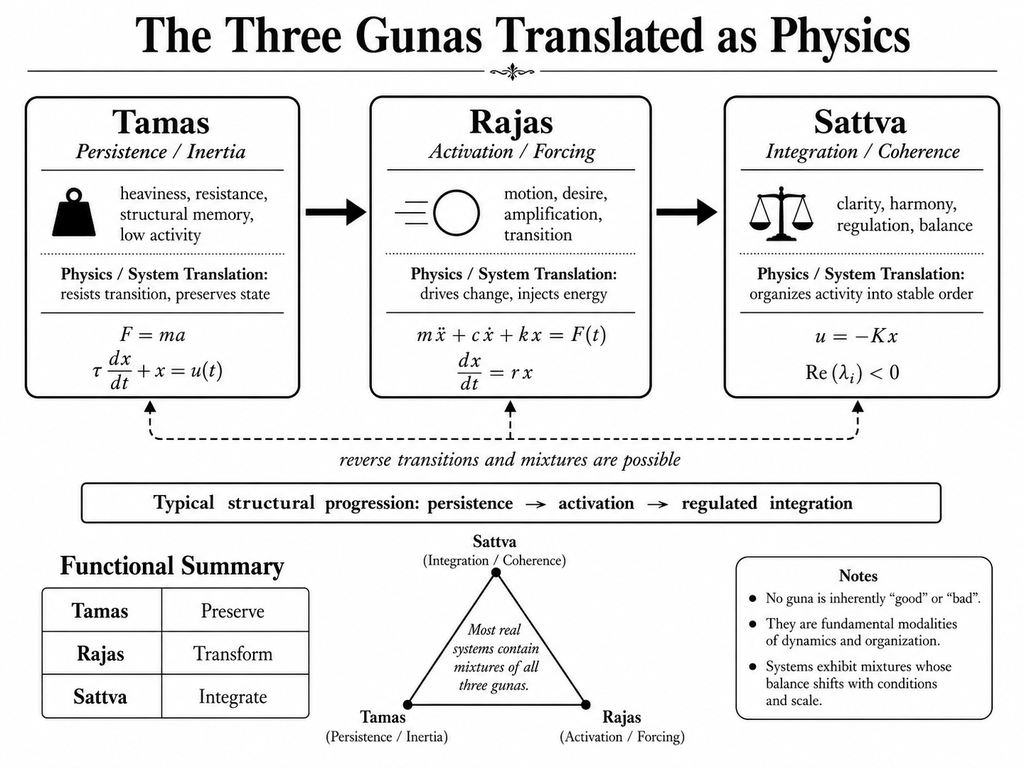
Tamas: Persistence, Inertia, and Resistance to Change
Tamas is associated with heaviness, inertia, resistance, obscurity, and reduced activity. In ordinary discussion, these qualities are often framed only negatively. Physics suggests a more nuanced picture because inertia and persistence are necessary properties of stable systems.
Newtonian mechanics gives the familiar relation
For a fixed force, greater inertia means less acceleration. The system resists changes to its current state.
That resistance is not inherently dysfunctional. A bridge must resist deformation. A memory must persist long enough to remain useful. A biological organism must preserve its internal organization against continuous environmental fluctuations. An institution needs enough continuity that it does not reinvent itself every day.
A simple relaxation model illustrates this idea:
where is a stable reference state. The system tends to remain near or return toward its existing configuration.
The problem appears when persistence becomes excessive. If a system resists change so strongly that new information cannot modify it, stability becomes stagnation.
An energy landscape makes the distinction clearer. Suppose the current state lies in a potential basin and must cross a barrier
to reach another configuration. A transition rate can contain a factor of the form
As the effective barrier rises, the probability of transition falls.
Tamas can therefore be translated structurally as the persistence function of a system when that persistence becomes dominant enough to inhibit necessary transition.
The important distinction is quantitative. Some inertia is memory. Too much becomes rigidity.
Rajas: Activation, Forcing, and Transformation
If tamas resists movement, rajas introduces it. Rajas is associated with motion, activity, desire, ambition, excitation, and continual striving.
Modern dynamics provides a direct analogy through forcing.
Consider the damped driven oscillator:
The forcing term injects energy into the system. When forcing increases, the system is pushed away from its existing state. Under some conditions, particularly near resonance, relatively modest forcing can create large responses.
A simple growth model shows the same amplification principle:
with solution
When , activity increases exponentially unless another mechanism constrains it.
This makes rajas structurally useful rather than simply undesirable. Without activation, nothing changes. Seeds do not grow, organisms do not move, organizations do not innovate, and problems are never acted upon.
The difficulty begins when activation exceeds the system’s regulatory capacity.
A business can move from growth into unsustainable expansion. A market can move from momentum into speculative instability. A nervous system can move from alertness into chronic hyperactivation. A person can move from motivation into compulsive striving.
Rajas can therefore be translated as:
The forcing and amplification required to move a system away from its current state, which becomes destabilizing when activation exceeds the system’s ability to regulate it.
Rajas is the engine of transition. It is not necessarily the endpoint.
Sattva: Regulated Organization and Dynamic Stability
Sattva is associated with clarity, balance, harmony, knowledge, and organization. The simplest modern analogy would be equilibrium, but that translation is incomplete.
Living systems are not static. A healthy organism continually exchanges energy and matter with its environment. A functioning brain is active. A stable economy still changes. A coherent organization still adapts.
Sattva is therefore better understood as regulated dynamic stability.
Let represent a stable operating point and define a small deviation
Near that state,
where is the Jacobian matrix. If the relevant eigenvalues satisfy
small disturbances decay rather than amplify.
This provides a useful physical definition of stability: the system can experience disturbance without losing its operating regime.
Control theory adds another layer. Suppose
and feedback is introduced through
The closed-loop system becomes
The feedback changes the effective dynamics. A system that might otherwise diverge can be stabilized.
Sattva can therefore be translated as a regime in which activity and persistence are sufficiently coordinated that disturbances are integrated without producing either runaway excitation or rigid stagnation.
This is dynamic balance, not stillness.
The Gunas as a Mixture Rather Than Three Separate Boxes
Traditional discussions of the gunas generally treat them as coexisting in different proportions rather than as mutually exclusive categories. That makes a mixture model especially useful.
Let
represent tamasic, rajasic, and sattvic contributions, with
The system can then be represented by
The three pure states occupy the corners of a triangular state space:
Most real states would lie between those extremes.
A possible transition might look like
Structurally, this could describe a system moving from strong inertia, through activation, toward greater regulation.
The value of this representation is that it avoids rigid labeling. A system is not simply “tamasic” or “rajasic.” Its state can shift continuously as different tendencies become dominant.
Transitions Between the Gunas
Once the gunas are viewed as regimes, the next question is how transitions occur.
A simple probabilistic model can be written as
where
contains transition probabilities.
This model allows a useful insight: movement toward greater organization may require an intermediate phase of activation.
A system strongly dominated by tamas may first need rajas before sattva becomes achievable.
An organization stuck in stagnation may require aggressive experimentation before it can discover a stable new structure. A sleeping organism passes through activation before reaching regulated wakefulness. A person caught in inertia may need effort and movement before calm discipline becomes possible.
A useful structural pathway is therefore
although reverse transitions remain possible.
This makes the three gunas more interesting than a simple moral ranking. Rajas can be necessary to escape tamas. Tamasic persistence can help stabilize what activity creates. Sattva organizes the relationship between them.
The Three Gunas as a Feedback System
The gunas can also be represented as mutually interacting processes.
Let
represent their relative strengths. A general nonlinear model can be written
The interesting feature is that the relationships need not be linear.
Moderate activation may improve organization, while excessive activation destroys it. Some inertia preserves memory, while excessive inertia prevents adaptation.
That relationship can be summarized in a table:
| Function | Too little | Functional range | Too much |
|---|---|---|---|
| Tamas / persistence | instability, no memory | continuity, structural retention | stagnation, rigidity |
| Rajas / activation | inactivity | exploration, transformation | agitation, runaway amplification |
| Sattva / integration | fragmentation | coordinated organization | not meaningfully defined as “maximum stillness” |
The same variable can therefore be beneficial at one level and destructive at another.
This is common in complex systems. Some stress promotes adaptation, while excessive stress produces failure. Some damping improves stability, while excessive damping produces poor responsiveness. Some excitation is essential, while excessive excitation destabilizes the system.
The Three Gunas can thus be interpreted as mutually necessary tendencies whose usefulness depends on proportion and interaction.
Tamas as Structural Memory
Tamas becomes especially interesting when persistence is connected to memory.
Consider
The parameter is the system’s time constant. A larger means the state changes more slowly and retains the influence of previous conditions for longer.
This persistence is essential in many systems. An organization that rewrites its identity after every new piece of information becomes incoherent. A biological regulatory system that changes set points instantly after every disturbance cannot maintain homeostasis.
The constructive function of tamas is therefore temporal persistence and resistance to noise.
The difference between memory and stagnation is not categorical. It is a matter of degree.
Rajas as Exploration
Rajas also has a constructive computational interpretation: exploration.
Optimization systems can become trapped if they exploit only their current best state. Some perturbation is required to discover alternatives.
Simulated annealing provides a familiar example:
At higher effective temperature, the system explores more widely. At lower temperature, it settles.
Structurally, rajas raises exploration. Tamas keeps the system in its current basin. Sattva resembles a regime in which exploration and stabilization have reached a productive relationship.
Without rajas, new states may never be discovered.
Sattva as Coherence
Informational Physics provides a useful way to deepen the translation of sattva through coherence.
Coherence should not mean vague “positive energy.” In a model, it can refer to coordinated relationships, reduced contradiction, synchronized dynamics, or preservation of functional organization.
For coupled oscillators, the Kuramoto order parameter is
When phases are dispersed,
When they become strongly coordinated,
The components remain active. They simply interact with greater organization.
That is a better analogy for sattva than inactivity.
The system still changes, but its parts interfere with one another less destructively.
A Functional System Requires All Three
A complete systems translation reveals that none of the gunas is sufficient by itself.
A persistent adaptive system requires:
- enough tamas to preserve continuity,
- enough rajas to permit change,
- enough sattva to integrate that change coherently.
We can represent these three broad requirements as persistence , activity , and coordination :
where is the viable operating region.
The system does not simply maximize one variable.
It regulates their relationship.
This gives us the strongest summary of the translation:
| Guna | System function | Failure when dominant |
|---|---|---|
| Tamas | preserve | rigidity |
| Rajas | transform | instability |
| Sattva | integrate | not inactivity, but coordinated regulation |
The Gunas and Phase Change
The gunas should not be confused with thermodynamic phases, but phase-transition mathematics offers a useful structural analogy.
Consider the Landau potential
Changing can alter the stable configuration of the system. The underlying material remains present, but its organization changes qualitatively.
That is why the regime interpretation works well.
Movement from tamas to rajas or from rajas to sattva does not require replacing the underlying system. The same system reorganizes.
Physics contains many examples of this broader principle. Water can become ice or vapor, magnets can change ordering, lasers cross thresholds, and neural systems move between activity regimes.
The common structural principle is:
Identity can persist while the system’s organization changes.
That question is central to Informational Physics.
Informational Physics: Preserve, Transform, Integrate
The gunas translate particularly well into three informational functions:
| Guna | Informational function |
|---|---|
| Tamas | preserve existing state information |
| Rajas | transform and propagate information |
| Sattva | integrate information into coordinated organization |
This creates a compact functional architecture:
These processes are not truly sequential. They operate together.
A learning system illustrates why.
If nothing is preserved, learning disappears.
If nothing changes, learning never occurs.
If changes are never integrated, the system accumulates noise rather than knowledge.
Memory, update, and integration are jointly necessary.
That is a surprisingly strong structural analogue for tamas, rajas, and sattva.
The Ancient-to-Modern Bridge
Ancient Indian observers could recognize inertia without calculating energy barriers. They could recognize agitation without modeling driven nonlinear systems. They could recognize clarity and balance without calculating eigenvalues or synchronization measures.
They could also observe that these qualities mixed and changed over time, even though they lacked probability simplices, transition matrices, and phase portraits.
Their conceptual language was:
Tamas — Rajas — Sattva.
Modern systems language might say:
Persistence — Activation — Integration.
The language changed because the observational technology changed.
The structural question remained.
Conclusion: Three Functions of a Changing System
The Three Gunas are most interesting when they are treated not as three moral labels, but as three interacting functions of an adaptive system.
Tamas preserves.
Rajas transforms.
Sattva organizes.
Persistence without transformation becomes stagnation. Transformation without regulation becomes instability. Organization without sufficient persistence has nothing durable to organize, while organization without activity has nothing new to integrate.
Modern dynamics describes these relationships through inertia, forcing, feedback, attractors, phase transitions, and stability.
Informational Physics reframes them as the relationship among memory, transformation, and coherent integration.
Ancient Indian philosophy described the same broad problem through the Three Gunas.
The deeper structural question beneath both languages is:
How does a system preserve enough of its previous organization to remain itself, generate enough activity to change, and integrate that change into a coherent next state?
That is the physics translation of tamas, rajas, and sattva.