
Wu Xing Through Coupled Dynamics, Feedback, Cycles, Stability, and Informational Physics
For more than two thousand years, Chinese philosophy has used a five-part framework known as Wu Xing to describe recurring patterns of transformation. The five phases are commonly translated as Wood, Fire, Earth, Metal, and Water, although the familiar English label “Five Elements” can be misleading. Wu Xing is better understood as the Five Phases, Five Movements, or Five Processes, because its emphasis is not primarily on five substances from which reality is constructed. Its deeper concern is with how processes generate, regulate, transform, and renew one another.
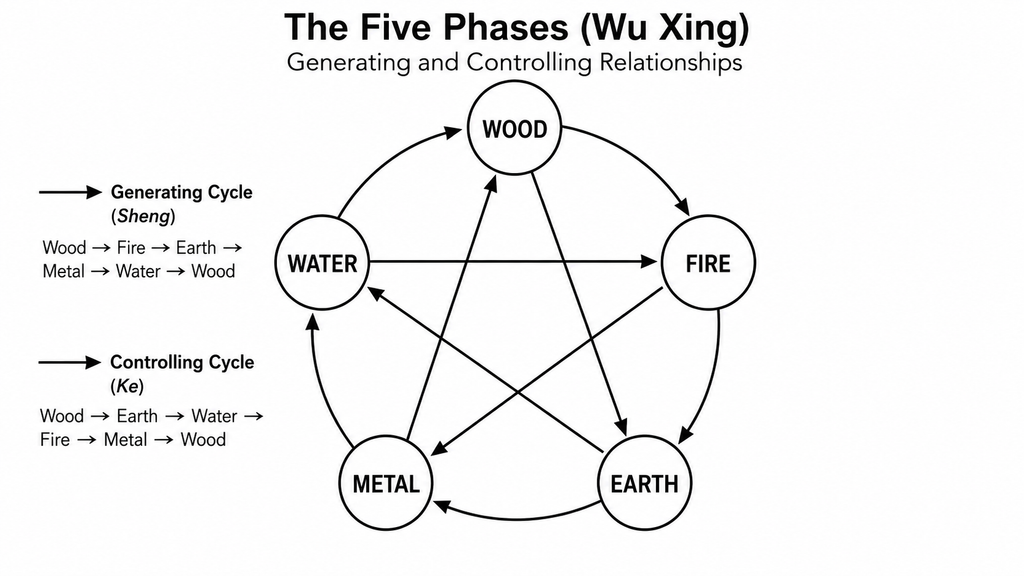
The best-known relationship is the generating cycle: Wood generates Fire, Fire generates Earth, Earth generates Metal, Metal generates Water, and Water returns to Wood. A second relationship, traditionally called the controlling or overcoming cycle, runs through a different sequence: Wood controls Earth, Earth controls Water, Water controls Fire, Fire controls Metal, and Metal controls Wood.
That dual architecture is what makes Wu Xing especially interesting from the perspective of modern systems science. One network promotes change, while another constrains it. In modern language, this resembles a system containing both positive coupling and negative feedback. One set of interactions strengthens downstream processes; another limits excess and prevents uncontrolled amplification.
Modern physics and systems science use a vocabulary that ancient Chinese thinkers did not possess: state variables, coupling matrices, feedback, stability, attractors, damping, resource flows, network topology, phase transitions, and control loops. Ancient observers could nevertheless recognize many of the behaviors those concepts describe. They could observe growth and decay, combustion, seasonal change, agricultural cycles, storage, flow, contraction, expansion, physiological change, and circumstances in which one process either strengthened or restrained another.
The purpose of translating Wu Xing into modern systems language is therefore not to claim that ancient Chinese thinkers secretly possessed differential equations. The stronger and more defensible question is:
What does the Five Phases architecture look like when expressed through modern coupled-system dynamics?
The answer is surprisingly coherent.
1. Wu Xing as a Process Model
A useful starting point is the distinction between a system of objects and a system of processes. A static ontology asks what things exist. A dynamical model asks what processes are occurring, how strongly they are expressed, and how they influence one another.
Wu Xing strongly favors the second perspective.
A modern representation can therefore treat the five phases as components of a state vector:
where the variables represent the current activity of Wood, Fire, Earth, Metal, and Water.
These variables need not represent literal substances. In an applied systems model, they could instead correspond to functional modes:
| Wu Xing phase | Systems translation |
|---|---|
| Wood | expansion, branching, growth |
| Fire | activation, amplification, release |
| Earth | buffering, incorporation, stabilization |
| Metal | contraction, selection, constraint |
| Water | storage, potential, recirculation |
The precise mapping would depend on the system under study. A biological system, an organization, an economy, or an ecological model would each require different observable quantities. The Five Phases should therefore not be imposed on arbitrary data simply because five variables can be found.
The useful translation is more general: the condition of a system may depend on several interacting modes whose relative strengths change over time.
That is already standard practice in modern science. Chemical systems are represented by interacting concentrations, climate models by coupled fields, economies by interacting flows and stocks, and biological networks by multiple regulatory pathways. In each case, the state of the whole is not reducible to one component alone.
2. The Generating Cycle as Positive Coupling
The generating cycle, traditionally called sheng, follows the sequence
Structurally, this is a directed cycle. A modern representation can encode the relationships in a generating adjacency matrix :
If
then describes how activity is transferred around the generating cycle.
A simple dynamical model might be written
where represents the strength of generative coupling and represents dissipation or decay.
This equation is, of course, a modern abstraction rather than a historical Wu Xing formula. Its purpose is to clarify the structural relationship: one process can create conditions that promote another process.
Modern physical and biological systems contain many such chains. Fuel promotes combustion; combustion generates heat; heat drives expansion; expansion changes pressure; pressure alters flow. In biology, gene activation produces proteins, proteins modify signaling pathways, signaling changes metabolism, and metabolism changes the conditions for later regulation.
Positive coupling is not inherently beneficial, however. If amplification becomes too strong, the result can be runaway behavior. That is why the second Wu Xing cycle is so important.
3. The Controlling Cycle as Negative Feedback
The controlling or ke cycle follows a different route:
Traditional imagery explains these relationships through familiar observations: Wood penetrates Earth, Earth contains Water, Water extinguishes Fire, Fire melts Metal, and Metal cuts Wood. The most useful modern translation is not to treat these descriptions as literal scientific mechanisms across every domain, but to recognize their structural role as regulating influences.
If represents the controlling relationships, the two cycles can be combined:
Here:
- represents external input,
- represents generating influence,
- represents controlling influence,
- represents dissipation or loss.
This is immediately recognizable as a feedback architecture.
Positive coupling promotes activity. Negative coupling restrains it. A system with only reinforcement can become unstable, while a system dominated entirely by suppression may become inert. Persistent systems often require both.
Physiology works this way. Blood glucose is regulated by processes that raise and lower it. Neural systems use excitation and inhibition. Ecosystems combine growth with predation and resource limitation. Mechanical systems combine applied force with damping.
The strongest physics-like principle in Wu Xing may therefore be this:
A sustainable system requires not only processes that generate change, but also processes that prevent change from becoming uncontrolled.
4. Wood as Expansion
Wood is traditionally associated with spring, growth, branching, and outward development. A modern systems translation treats Wood as an expansion regime.
Unconstrained growth can be represented by
with solution
Real systems, however, rarely possess unlimited resources. As capacity limits become important, a logistic model is more appropriate:
where represents carrying capacity.
Growth initially proceeds rapidly, but expansion slows as the system approaches its limits.
This pattern appears in populations, markets, organizations, networks, and physical structures. Businesses encounter market saturation, populations encounter resource limits, networks encounter congestion, and branching structures encounter mechanical constraints.
Wood therefore corresponds most usefully to expansion into available possibility until constraint begins to matter.
5. Fire as Activation
Fire converts stored potential into active transformation. In physical combustion, chemical energy becomes heat and radiation. More generally, Fire provides a useful symbol for activation, amplification, and release.
A simple energy balance is
Activation processes may also exhibit threshold behavior. Arrhenius kinetics, for example, describe reaction rate as
where is an activation-energy barrier.
The important systems principle is that a relatively small change in conditions can sometimes move a system into a substantially more active regime.
An idea becomes action. Stored fuel becomes heat. Potential becomes motion. A quiet network becomes highly active.
But activation carries risk. Heat can become overheating, neural excitation can become instability, and economic growth can become speculative excess. Fire therefore cannot represent the endpoint of a stable system. Its output must be absorbed and transformed.
6. Earth as Buffering and Stabilization
Earth occupies a different structural role. Rather than representing continual expansion or activation, it can be understood as buffering, redistribution, and incorporation.
A reservoir provides a simple model:
When inflow exceeds outflow, storage rises. When outflow exceeds inflow, storage falls. The reservoir absorbs differences between processes operating at different rates.
Modern systems rely extensively on such buffers:
- batteries store electrical capacity,
- water reservoirs absorb variability,
- financial reserves absorb shocks,
- inventory absorbs supply-demand mismatch,
- thermal mass moderates temperature fluctuations,
- organizational slack absorbs unexpected workload.
This gives Earth a clear structural translation:
Absorb, redistribute, and stabilize the output generated by more active phases.
A system without buffering transmits disturbances directly through its network, increasing the probability of cascades. Earth therefore represents the process by which activity becomes incorporated into a more stable condition.
7. Metal as Constraint and Selection
Metal is traditionally associated with contraction, autumn, structure, and cutting. Its strongest systems analogue is constraint.
Suppose a system can occupy states
Introducing a constraint reduces the feasible region:
so that
The system now has fewer available states.
Constraint may initially sound like loss, but structure itself depends on constraint. A bridge remains stable because materials constrain motion. Software operates because syntax prohibits invalid instructions. Cell membranes regulate exchange. Organizations require boundaries around authority. Decision-making requires eliminating alternatives.
Metal can therefore be interpreted as selection, contraction, and reduction of degrees of freedom.
In Informational Physics language, this suggests an important principle: coherence may sometimes increase not by adding possibilities, but by removing configurations that no longer support the system’s identity.
8. Water as Storage and Recirculation
Water is traditionally associated with winter, storage, descent, fluidity, and latent potential. Several physical concepts provide useful analogies.
Stored potential energy may be written
Fluid movement responds to gradients:
Conservation can be represented through a continuity equation:
Water therefore combines two important system functions: it preserves potential and facilitates redistribution.
Its structural translation becomes:
Store resources, maintain their capacity to move, and return them to conditions from which new expansion can emerge.
This helps explain why Water returns to Wood in the generating sequence. Storage is not the end of the cycle. It creates the capacity for another beginning.
Reserves enable investment. Memory enables future action. Stored energy permits later work. Winter creates conditions for spring.
The cycle closes through preserved potential.
The Five Phases as One Dynamical System
Taken together, the translations produce a coherent functional cycle:
| Phase | Systems function |
|---|---|
| Wood | Expansion and growth |
| Fire | Activation and release |
| Earth | Buffering and stabilization |
| Metal | Constraint and selection |
| Water | Storage and recirculation |
Water then returns to Wood as stored capacity supports renewed emergence.
This does not mean that every physical system literally contains five stages. The more defensible claim is that many persistent systems contain comparable functions: expansion, activation, stabilization, constraint, and storage.
The complete abstract system can be represented by
At equilibrium,
so
If the relevant inverse exists,
The crucial point is that equilibrium emerges from the relationships among all five processes, rather than from any one phase acting independently.
Balance Is Dynamic Recoverability
A common misunderstanding of balance is that all components should become equal:
Modern dynamical systems provide a more useful definition.
Let be an equilibrium and define a small perturbation
Near equilibrium,
where is the Jacobian matrix.
A locally stable equilibrium generally requires
for the relevant eigenvalues.
In ordinary language, small disturbances decay rather than amplify.
This produces a much stronger translation of Wu Xing balance:
Balance is not equality among processes. It is the capacity of their relationships to restore a viable configuration after disturbance.
A healthy ecosystem does not contain equal numbers of every organism. A human body does not maintain every hormone at the same concentration. A stable economy does not require equal activity in every sector.
The important question is whether deviation can be absorbed and corrected.
Excess and Deficiency as Relational Imbalance
Traditional Wu Xing systems often discuss excess, deficiency, overacting, and insufficient regulation. These ideas can be translated into displacement from a viable operating region.
Let
denote the viable region. The system remains within acceptable operation when
A general deviation metric might be
Large values indicate greater displacement from a reference configuration.
The important observation is relational. Fire is not inherently harmful, Water inherently beneficial, or Metal preferable to Wood. The problem may instead be that one process becomes too strong or too weak relative to the rest of the network.
That is a recognizably modern systems concept:
Function depends on configuration, not merely on the isolated identity of a component.
Wu Xing as a Multiplex Network
The relationship architecture becomes even clearer when expressed as a graph.
Let
with
Wu Xing contains two edge families:
for generating relationships and
for controlling relationships.
The complete system is therefore a multiplex network:
The same five nodes participate in two different networks simultaneously.
That is common in real systems. Two companies may cooperate as suppliers while competing for customers. Species can cooperate in one ecological relationship and compete in another. Neural structures can participate in both excitatory and inhibitory circuits.
This yields one of the strongest modern translations of Wu Xing:
A single system can contain overlapping networks of promotion and restraint, with overall stability determined by their interaction.
Ancient terminology describes generating and controlling cycles.
Network science describes edge types and coupling.
The structural relationship remains recognizable.
Informational Physics — Persistence Through Change
Informational Physics adds a further question: how does a system remain recognizably itself while its internal state continually changes?
A forest changes across seasons. A person changes across decades. A company changes employees. A river continually replaces its water. A living organism exchanges matter with its environment throughout its life.
Persistence therefore cannot require identical material composition.
It requires sufficient continuity of organization.
Applied carefully, the Five Phases can be represented as
with the generating and controlling cycles acting as transformation operators over the state.
Wu Xing fits this perspective particularly well because it never defines stability as stillness. Transformation is built into the architecture.
The system persists through change.
The Ancient-to-Modern Bridge
Ancient Chinese observers could recognize spring-like expansion without writing logistic growth equations. They could observe combustion without knowing reaction kinetics, recognize buffering without reservoir models, identify contraction without constrained state spaces, and understand storage and circulation without continuity equations.
They could also observe that some processes strengthened others while different relationships restrained excess, even though they had no adjacency matrices, Jacobians, or eigenvalues with which to formalize those patterns.
Their representational vocabulary was:
- Wood
- Fire
- Earth
- Metal
- Water
Modern systems science can translate those functional relationships as:
- expansion,
- activation,
- buffering,
- constraint,
- storage,
- generating coupling,
- negative feedback,
- network stability.
The translation does not establish that Wu Xing was ancient physics. It shows that ancient observers could encode meaningful systems relationships in a language appropriate to their civilization, while modern mathematics provides another level of description.
Conclusion — Five Processes, One System
The most scientifically interesting feature of Wu Xing is not simply that it contains five categories. It is that those categories participate in a structured network containing reinforcement, restraint, transformation, excess, deficiency, and return.
Modern systems science recognizes the corresponding questions immediately: How do processes couple? What limits amplification? How does a system absorb disturbance? Which degrees of freedom must be constrained? Where is potential stored? How does the system return to a viable operating regime?
Wu Xing answers those questions through the symbolic architecture of Wood, Fire, Earth, Metal, and Water.
Modern systems science answers them through coupled states, feedback, networks, stability, flow, and constraint.
Informational Physics extends the question further by asking what relationships must remain sufficiently intact for a changing system to preserve its identity while continually reorganizing.
The structural question underneath both languages is therefore:
How can a system continuously generate, activate, absorb, constrain, store, and renew itself without destroying the relationships that allow the cycle to persist?