
64 States of Change Through Information Theory, Dynamical Systems, and Informational Physics
For thousands of years, the I Ching—the Book of Changes—has been used to think about something that modern science also struggles to describe:
How does a system change without ceasing to be the system it was?
The I Ching is unusual among ancient texts because change is not merely one of its subjects. Change is built into its architecture.
Its familiar symbolic system uses two kinds of lines: solid and broken. Three lines form a trigram. Six lines form a hexagram. Eight possible trigrams and 64 possible hexagrams arise from those combinations. The received work became a multilayered text combining these configurations with statements, commentaries, philosophical interpretation, and divinatory practice. Modern scholarship therefore treats the I Ching not as one simple document written at one moment, but as a composite tradition centered on interpreting change, uncertainty, position, and action.
That structure immediately creates an unusual bridge to modern mathematics.
But the bridge requires discipline.
The I Ching did not invent digital computers.
Its yin and yang lines were not electronic bits.
The ancient Chinese did not possess Boolean algebra, information theory, graph theory, dynamical-systems software, or modern statistical mechanics.
What they did possess was the ability to observe.
They could recognize that systems have states.
That states contain relationships.
That one local change can alter the meaning of the whole configuration.
That the same element behaves differently depending on its position.
That timing matters.
That favorable action under one condition may become destructive under another.
And that apparently completed situations continue changing.
Ancient civilization represented those observations through lines, images, names, judgments, and symbolic configurations.
Modern civilization can also represent them through equations.
The question of this article is therefore not:
Did the I Ching secretly contain modern physics?
It is:
If we translate its structural architecture into the language of modern mathematics, what remains recognizable?
That is especially appropriate for Informational Physics. UIPO V2.0 defines an ontology in terms of state spaces, relations, admissible transformations, observation maps, and typed information while explicitly warning that a successful representation is not itself proof that the representation describes fundamental physical reality.
The aim here is structural translation, not retroactive scientific proof.
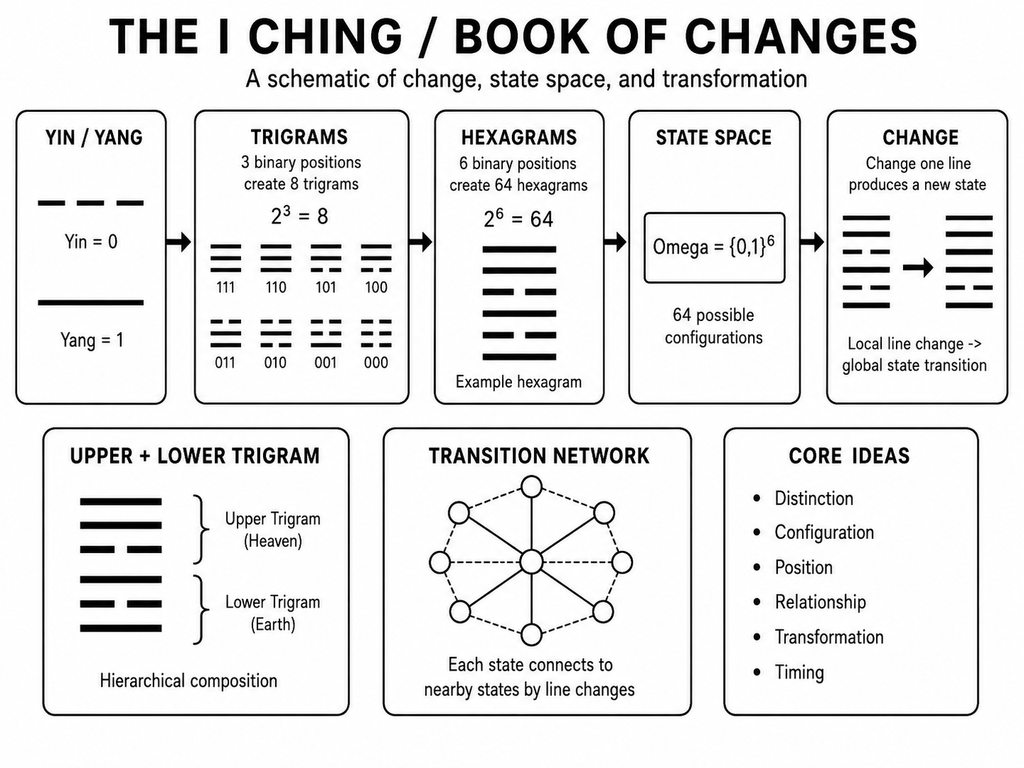
1. Yin and Yang — The Minimal Distinction
At the foundation of the I Ching is a distinction between two line states.
A solid line represents yang.
A broken line represents yin.
For mathematical analysis, we can encode those states as
where, for example,
This encoding is modern. The ancient lines were not “bits” in the computer-science sense.
But mathematically the correspondence is exact at one limited level:
each line has two distinguishable states.
That matters because information begins with distinction.
If a system cannot distinguish one state from another, there is no state information to encode.
A single binary variable has two possible configurations:
Two such variables have
configurations.
Three have
Six have
The deepest modern translation of yin and yang is therefore not “positive and negative energy,” “matter and antimatter,” or any other specific physical pair.
Those analogies would overreach.
The more defensible translation is:
Yin and yang constitute a minimal two-state distinction from which increasingly complex configurations can be constructed.
Physics repeatedly builds complex descriptions from distinctions: spin states, occupied versus unoccupied states, logical states, phases, orientations, and other discrete alternatives.
The I Ching begins with distinction and then asks what happens when distinctions are combined.
2. The Eight Trigrams — Three Distinctions Create a State Vocabulary
Three line positions form a trigram.
With two possibilities at each position, the configuration count is
This is why eight trigrams arise naturally from three two-state positions.
The result can be represented as a three-component state vector:
The possible state space is
with
The I Ching tradition associates these trigrams with natural and relational qualities such as heaven, earth, thunder, water, mountain, wind, fire, and lake. The Xici tradition explicitly describes the eight trigrams as symbolic forms through which patterns of change are represented.
The physics translation is not that those eight natural phenomena literally equal eight binary numbers.
It is more interesting:
Three elementary distinctions generate a finite vocabulary of compound states.
This is a basic principle of combinatorics and information representation.
A small alphabet can generate a much larger vocabulary through composition.
Three binary distinctions already produce eight recognizable states.
Add more positions, and the state space expands rapidly.
This is the first major mathematical lesson encoded by the architecture itself:
complexity can emerge from repeated combination of simple distinctions.
3. The 64 Hexagrams — A Finite Configuration Space
A hexagram contains six line positions.
Represent it as
The full configuration space is therefore
Its size is
This is not metaphor.
Given six positions that can each occupy either of two states, there are exactly 64 possible binary configurations.
The received I Ching contains 64 hexagrams, and modern scholarship describes those hexagrams as a symbolic system for representing different configurations of changing circumstances.
This gives us the strongest mathematical bridge in the entire text.
A modern physicist or systems scientist might call a state space.
Every hexagram is then a point in that state space.
The system does not need an infinite vocabulary to describe change.
It needs:
a finite collection of states,
rules for distinguishing them,
and operations that move from one state to another.
That is remarkably close to the architecture of many modern models.
A cellular automaton has states and transition rules.
A finite-state machine has states and allowed transitions.
Statistical mechanics describes configurations and probabilities.
Computer science represents systems through state vectors.
Control theory asks how actions move systems through state space.
The I Ching does not contain those theories.
But structurally, it organizes thought in a compatible way:
First identify the configuration. Then understand how the configuration can change.
4. Upper and Lower Trigrams — Complex States Can Be Composed Hierarchically
A hexagram can also be separated into two three-line structures:
where
is the lower trigram and
is the upper trigram.
Since each trigram has eight states,
So the same 64-state structure can be represented either as six individual binary positions or as a pair of eight-state subsystems.
The I Ching tradition explicitly interprets hexagrams through relationships between upper and lower trigrams, rather than treating the six lines merely as an undifferentiated string.
Modern systems science calls this hierarchical composition.
A molecule can be studied as atoms or as functional groups.
A computer can be studied as transistors, logic gates, modules, or applications.
An organization can be studied as individuals, departments, or divisions.
The scale changes, but the larger state is built from lower-level configurations.
We can represent this generically as
The larger system is the product of two smaller state spaces.
Informationally, this is significant.
It means the same object can be represented at multiple resolutions.
The I Ching‘s architecture therefore lends itself to a modern principle:
A complex system can preserve structure across levels of description by composing smaller state spaces into larger ones.
That is far more interesting scientifically than simply noticing that eight times eight equals 64.
5. Changing Lines — Change as a Local State Transition
The I Ching is not merely a catalogue of 64 static diagrams.
Its central subject is transformation.
The later Xici explicitly describes strong and yielding lines as changing into one another and presents the six-line figures as expressions of continual movement rather than fixed objects.
Modern mathematics gives this an exact representation.
Suppose a hexagram is
If line changes, then the transformed configuration is
where denotes a binary flip at position .
For example,
might become
Only one local state changed.
Yet the entire six-line configuration is now a different member of the 64-state space.
The distance between two binary states can be measured using Hamming distance:
If one line changes,
If three change,
This gives an unusually clean modern translation:
Change can be represented as movement through configuration space produced by local state transitions.
That principle appears throughout physics and computation.
A local spin flips.
A gene changes expression.
A switch changes state.
A network node fails.
A market variable crosses a threshold.
A single component changes—and the larger configuration becomes something new.
The I Ching makes this relationship between local alteration and global reclassification central to its architecture.
6. The 64 Hexagrams as a Transition Network
Once changing lines are treated as state transitions, something mathematically interesting appears.
Imagine each of the 64 hexagrams as a node in a network.
Connect two nodes whenever they differ by exactly one line:
The result is a six-dimensional hypercube graph.
There are
nodes.
Each node has exactly
single-line neighbors because any one of its six positions can change.
This graph is not historically asserted by the I Ching. It is a modern mathematical construction generated from its two-state, six-position architecture.
But it reveals something important.
The 64 hexagrams do not need to be viewed merely as 64 isolated categories.
They can be viewed as a connected landscape of possible transformations.
From every state, six immediately adjacent states are available under single-line change.
Two-line changes connect more distant configurations.
The number of configurations exactly line changes away is
So from any hexagram there are
states one change away,
states two changes away,
and so forth.
This turns the Book of Changes into something structurally closer to a map of possibilities than a list of predictions.
That distinction also resonates with modern scholarship, which emphasizes that the hexagrams can be understood as symbols for ceaseless change and interconnected factors rather than only as isolated oracles.
7. Position — The Same State Can Mean Something Different Depending on Where It Occurs
A crucial feature of the I Ching is that line identity alone is not enough.
Position matters.
A yang line in one position is not interpreted identically to a yang line somewhere else.
Relationships among positions also matter.
Modern physics knows this principle well.
A variable’s contribution can depend on both its state and its location within the system.
One generic interaction model is
This resembles the mathematical structure used in Ising-type models.
The coefficients represent position-specific contributions.
The coefficients represent interactions between positions.
The important idea is not that the I Ching is an Ising model.
It is:
Instead,
A manager and an employee saying the same sentence may not produce the same organizational effect.
The same mutation in different genomic positions may have different consequences.
The same force applied to different parts of a structure may generate different stress.
Context is part of the state.
This produces another strong translation:
Information is relational and positional, not merely symbolic.
UIPO adopts a similar discipline by requiring states, operators, domains, observation models, and relations to be typed rather than allowing the same symbol to float freely between meanings.
8. Correspondence — Stability Depends on Coupling Between Parts
The I Ching commentarial tradition also pays attention to relationships among lines—especially whether positions correspond appropriately across the hexagram.
The important modern concept here is coupling.
Consider interacting components:
The first term describes the component’s own dynamics.
The second describes the influence of connected components.
The system cannot necessarily be understood by examining each node independently.
Its behavior emerges partly from relationships.
This is fundamental across science.
Oscillators synchronize through coupling.
Neurons influence neighboring neurons.
Species interact within ecosystems.
Markets transmit disturbances through financial connections.
Power grids propagate frequency deviations.
Organizations transmit decisions through authority networks.
A stable system therefore depends not only on which states its components occupy, but on whether those states interact constructively.
The I Ching‘s concern with correspondence can be translated structurally as:
A configuration is partly defined by the compatibility of relationships among its components.
Again, the claim is not that ancient Chinese thinkers possessed network differential equations.
The claim is that they encoded relational configuration as something distinct from isolated component identity.
That remains a central idea in modern systems science.
9. Timing and Judgment — A Good Action Is State-Dependent
Another major theme of the I Ching is that an action cannot be judged entirely apart from circumstances.
Modern scholarship emphasizes that its line statements repeatedly concern what to do, when to advance, when to wait, when circumstances are favorable, and when apparently strong action becomes dangerous.
Modern control theory describes the same structural problem without moral or divinatory language.
Suppose
where
is the current state,
is the chosen action,
and is the surrounding context.
The same action can produce different outcomes depending on and .
A rational policy therefore looks like
The optimal action is conditional.
This offers a disciplined translation of the I Ching‘s language of favorable and unfavorable action.
“Auspicious” need not be translated as a supernatural physical quantity.
It can be understood structurally as:
an action whose consequences are compatible with the present configuration and constraints.
Likewise, “misfortune” can be translated as action that drives the system toward an undesirable or nonviable region.
If
is the set of acceptable states, then a prudent action tends to preserve
The modern lesson is familiar:
There is rarely a universally correct action independent of state.
Timing matters because state matters.
10. After Completion and Before Completion — Change Has No Final Static Ending
One of the most striking features of the received sequence is its ending.
Hexagram 63 is commonly translated as After Completion or Already Fording.
But the book does not end there.
Hexagram 64 is Before Completion, Not Yet Fording, or Ferrying Incomplete.
Stanford’s discussion of the philosophical tradition notes precisely this open-ended implication: the final configuration prevents the sequence from terminating in a permanently completed condition.
Structurally, this is profound.
A system can achieve local stability without change ending.
Modern physics distinguishes equilibrium from broader ongoing dynamics.
Living systems remain alive precisely because exchange continues.
Climate systems fluctuate.
Economies reorganize.
Organisms repair themselves.
Networks adapt.
Even a statistically stationary process can continue changing at the microscopic level.
A simple stochastic system may satisfy
where is a stationary distribution.
The distribution remains stable, yet individual transitions continue.
Equilibrium at one descriptive level can coexist with movement at another.
Likewise, a transition system need not contain a final absorbing state:
for every state .
No configuration means:
nothing can ever change again.
This may be the deepest physics-like insight in the Book of Changes.
Completion is itself a state inside a larger process of change.
A solution creates new conditions.
An integration creates new possibilities.
A stable state becomes the starting condition for the next transition.
The system continues.
Information Theory — How Much Information Is in a Hexagram?
Once the six-line structure is encoded mathematically, another question becomes possible.
How much state information can it contain?
For a random variable over the 64 possible configurations,
Maximum entropy occurs if all 64 configurations are equally probable:
This does not mean that the meaning of a hexagram is only six bits.
The binary configuration contains at most six bits of raw state distinction under this encoding.
Its textual, historical, cultural, relational, and interpretive meaning can be vastly larger.
That distinction is important because UIPO V2.0 explicitly separates different meanings of information: state distinguishability, Shannon information, Fisher information, description length, semantic information, and functional information cannot simply be substituted for one another.
The six-line structure therefore carries at least two different informational layers:
and
Confusing them would be equivalent to claiming that because a digital photograph is stored as bits, the number of bits alone explains what the photograph means.
Structure and meaning are related.
They are not identical.
Informational Physics — The I Ching as a State-and-Transformation Architecture
The strongest connection to Informational Physics appears when the I Ching is viewed not as 64 predictions but as an architecture containing:
states,
distinctions,
positions,
relationships,
transformations,
context,
and possible outcomes.
UIPO V2.0 represents a system schematically as
where is a state space or manifold, contains fields or state variables, and contains admissible operators. It also requires a declared observation model before a representation is promoted into an empirical claim.
A limited modern translation of the I Ching can therefore be written:
The line positions are the state variables.
Changing-line operations become members of an operator set.
For example,
flips line .
More general operations may change several positions:
The important result is not that UIPO proves the I Ching.
It is that both frameworks force us to ask structurally similar questions:
What is the system state?
Which distinctions define it?
Which relationships matter?
Which transformations are possible?
Which transitions preserve viability?
What does the observer actually know?
What changes when one component changes?
And what remains recognizable across transformation?
UIPO’s own scientific governance is particularly relevant here: it explicitly states that conceptual unity is not empirical confirmation and that models must be compared with alternatives rather than treated as true merely because their mathematics is coherent.
That keeps this translation inside the correct boundary.
The Ancient-to-Modern Bridge
An ancient observer could distinguish solid and broken lines.
They could not write
They could combine three lines into eight configurations.
They did not express the result as
They could construct 64 six-line configurations.
They did not describe them as
They could observe one line changing and recognize that the whole figure became another state.
They could not compute Hamming distance.
They could recognize relationships among lines.
They could not write a coupling matrix.
They could recognize that position and timing changed the meaning of action.
They could not formalize state-dependent control policies.
The absence of those equations does not prove that the ancient symbolic system contained the modern theories.
It tells us that the civilization represented structural observations using a different technological language.
Lines instead of bits.
Hexagrams instead of vectors.
Changing lines instead of transition operators.
Judgments instead of viability functions.
Images instead of state-space diagrams.
That is the bridge.
The I Ching can therefore be interesting to modern science without becoming either supernatural proof or a retroactive computer manual.
Conclusion — The Physics of Change
The deepest mathematical feature of the I Ching is not simply that it contains 64 diagrams.
It is the architecture behind them.
Two possible line states produce:
trigrams and
hexagrams.
Those configurations form a finite state space.
Changing a line produces a state transition.
Positions create context.
Relations create coupling.
Timing alters the usefulness of action.
Local changes reorganize global states.
And apparent completion does not terminate transformation.
Modern science describes these ideas through:
state spaces,
combinatorics,
information,
graphs,
coupled systems,
conditional dynamics,
control,
and transition networks.
The I Ching described them through yin and yang, trigrams, hexagrams, changing lines, correspondence, timing, and judgment.
The two descriptions are not identical.
But they operate on a surprisingly similar structural question:
Given a system in one configuration, what transformations are possible—and what happens next?
Ancient China called it the Book of Changes.
Modern mathematics calls it a state space with transition dynamics.
Informational Physics asks what information defines the states, constrains the transformations, and allows identity to persist while change continues.