
Flow, Balance, Non-Forcing, and Return Through Modern Systems Science and Informational Physics
For more than two thousand years, the Tao Te Ching has asked readers to consider a seemingly simple proposition: durable order often emerges not from forcing reality, but from understanding how reality already moves.
Water yields, yet reshapes stone. Emptiness makes a vessel useful. Excess creates reversal. Strength can become weakness. Complex things emerge from simpler conditions. Systems disturbed too aggressively can become less orderly rather than more orderly. And again and again, things are described as returning.
Modern physics uses entirely different language.
It speaks of gradients, equilibrium, feedback, state spaces, attractors, conservation, dissipation, coupling, boundary conditions, entropy, control effort, and information.
The purpose of this article is to place those two languages beside one another.
It is not an argument that Laozi possessed calculus, thermodynamics, information theory, or modern systems science. The historical Laozi is itself a complicated question, and scholarship treats the Daodejing as a text with a long compositional and interpretive history. The received text contains 81 sections, while early manuscript discoveries show that its organization evolved; material corresponding to the text has been recovered from the Guodian manuscripts dating to around 300 BCE.
That historical distance is the bridge rather than the problem.
Ancient observers had no oscilloscopes, particle accelerators, electronic sensors, nonlinear-dynamics software, calculus, or Shannon information theory. They could observe what systems did, but not express those observations using the mathematical instruments available to modern civilization.
They described recurring structure through images:
water,
the valley,
the empty vessel,
the uncarved block,
softness,
return,
yin and yang,
and wu wei—action without coercive forcing.
Modern science gives us another representational layer.
The question is therefore not:
Did the Tao Te Ching secretly contain modern physics?
It is:
When ancient structural observations are translated into modern mathematical language, which relationships remain recognizable?
That distinction matters. UIPO itself separates mathematical definitions, hypotheses, protocols, applications, and empirical evidence and explicitly warns that conceptual correspondence is not empirical confirmation.
The goal here is translation, not retroactive proof.
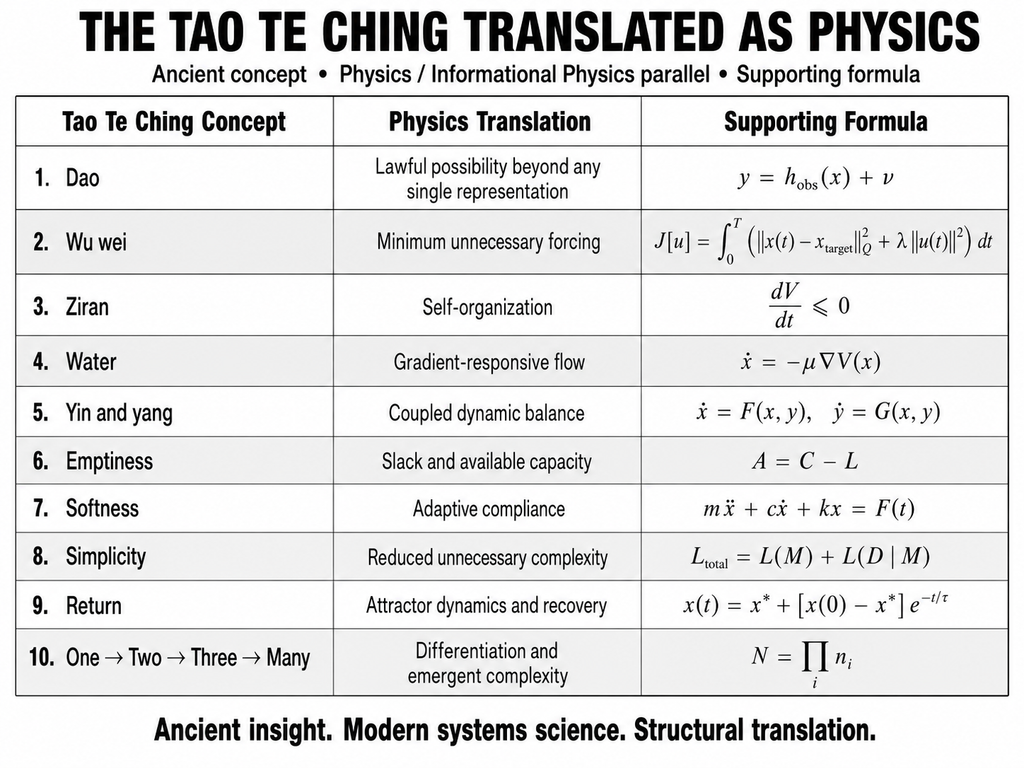
1. The Dao — Reality Has an Underlying Order That Is Larger Than Any Description of It
The Tao Te Ching begins from an unusual epistemic position.
The Dao can guide reality, yet any fixed description of the Dao is incomplete. Modern scholarship similarly emphasizes that the text’s Dao is difficult to capture through language and that ziran—naturalness or “self-so-ness”—and wuwei are central to understanding how the Dao manifests.
Physics begins from a surprisingly compatible methodological limitation.
A physical theory is not reality itself.
It is a representation of reality.
Let the physical state of a system be
An observer does not necessarily access directly. Instead, the observer receives measurements
where is the observation process and represents measurement uncertainty or noise.
Even an excellent measurement is therefore mediated.
Likewise, a scientific model
is a structured description of behavior, not the behavior itself.
This is not mysticism. It is standard scientific discipline.
The model is not the system.
The equation is not the universe.
The observation is not the total state.
Informational Physics makes this distinction explicit. UIPO represents a system using a typed schema involving a state space or manifold, fields or state variables, admissible operators, and an observation model. It specifically states that such a representation does not establish that information is physically fundamental simply because the schema is useful.
A modern structural translation of the Dao therefore begins here:
Reality may possess lawful organization that no single representation completely exhausts.
Ancient language calls that deeper order the Way.
Science calls its partial descriptions theories, models, symmetries, state spaces, and laws.
The correspondence does not make Dao a physical field.
It suggests that both traditions begin by recognizing a difference between reality and our description of reality.
2. Wu Wei — Effective Action with Minimum Unnecessary Forcing
One of the most misunderstood concepts in Daoism is wu wei.
It is often translated as “nonaction,” but scholarly treatments emphasize that it does not simply mean doing nothing. It concerns non-coercive, non-willful, or effortless action—behavior aligned with the conditions of the system rather than imposed against them.
Modern control theory provides an illuminating analogy.
Suppose a system evolves according to
where is the system state and is an external control input.
A crude controller can force the system toward a target by continually increasing .
A more sophisticated controller asks how much intervention is actually necessary.
One possible objective is
The first term penalizes failure to reach the desired state.
The second penalizes excessive control effort.
The objective is therefore not:
Do nothing.
It is:
Achieve the necessary result without applying more force than the system requires.
That is strikingly close to a structural reading of wu wei.
A good intervention works with the system’s existing dynamics.
A poor intervention constantly fights them.
This principle appears everywhere.
An aircraft autopilot makes small corrections rather than violently repositioning the aircraft.
A thermostat allows a temperature band rather than switching infinitely fast.
A skilled athlete stops fighting the mechanics of movement.
A resilient organization distributes decision authority instead of forcing every action through one central node.
The physics does not prove Daoist ethics.
But control theory gives us a precise language for something the Tao Te Ching repeatedly emphasizes:
More intervention is not automatically better control.
Sometimes greater forcing creates greater instability.
3. Ziran — Self-Organization Instead of Continuous External Control
Closely related to wu wei is ziran, commonly translated as naturalness or spontaneity. Stanford’s overview describes it literally as what is “self-so”—the way things arise and operate according to their own nature rather than through imposed construction.
Modern systems science has a direct conceptual category for this:
self-organization.
Consider a system governed by
There is no external control term .
Yet the system can still evolve toward organized behavior.
If there exists a Lyapunov function such that
then trajectories may naturally approach a stable set without an external agent continuously directing every component.
Many physical systems organize this way.
Crystals form ordered structures.
Oscillators synchronize.
Fluids develop coherent vortices.
Biological systems regulate internal variables.
Markets and ecosystems generate macroscopic organization from decentralized interactions, although such organization is not always stable or beneficial.
The important principle is:
Order does not always require centralized instruction.
This offers a modern translation of ziran.
Not “nature is always perfect.”
Not “systems should never be regulated.”
Rather:
Before imposing control, determine what organization the system can generate from its own internal dynamics.
That is a serious engineering principle.
4. Water — Follow the Gradient Rather Than Fight It
Water is among the most memorable natural images in the Tao Te Ching. Scholarship notes its association with yieldingness and deep strength, especially in chapters traditionally numbered 8 and 78.
Why is water such an effective structural metaphor?
Because flow responds to gradients.
A general potential-driven system can be written
meaning the force points in the direction of decreasing potential energy.
A simple gradient-flow model is
where is a mobility parameter.
Instead of selecting a path arbitrarily, the state moves according to the local geometry of the potential.
Fluid conservation adds another principle:
for a conserved fluid without internal source or sink.
Water changes shape continuously while maintaining flow.
It enters available spaces.
It responds to boundaries.
It moves around obstacles when that path requires less resistance.
Yet yielding does not mean ineffectiveness. Repeated flow transports sediment, cuts channels, redistributes energy, and alters landscapes.
The Daoist observation can therefore be translated:
Effective movement often follows the geometry of constraint instead of attacking the constraint directly.
That is a much stronger proposition than the simplistic claim that “water always takes the easiest path.”
Water obeys boundary conditions, forces, viscosity, pressure, and gravity.
Its behavior emerges from the structure of the environment.
The systems lesson is similarly conditional:
Read the field before choosing the force.
5. Yin and Yang — Stability Is Often Dynamic, Not Static
Chapter 42 of the received Daodejing famously describes the progression from Dao to one, one to two, two to three, and then to the “ten thousand things,” while also invoking yin and yang and their harmonization.
The temptation is to declare yin and yang equivalent to positive and negative charge, matter and antimatter, or some other specific physical pair.
That would be too strong.
The more defensible translation is structural.
Physics contains many systems in which apparently opposing variables are coupled rather than independent.
Let
Neither component can necessarily be understood correctly in isolation.
A stable state may occur at
In some systems, the two quantities may also satisfy a constraint such as
Increasing one necessarily changes the other.
Examples occur throughout science:
production and dissipation,
activation and inhibition,
excitation and damping,
inflow and outflow,
positive and negative feedback.
The key point is that equilibrium does not mean both sides disappear.
It means their interaction produces a sustainable regime.
This gives a useful physics translation of yin-yang imagery:
Opposing tendencies can be mutually defining components of one dynamical system.
The Daoist idea of harmony therefore resembles dynamic balance, not frozen equality.
A heartbeat is not stable because nothing changes.
A climate is not stable because temperature never varies.
A healthy organism is not static.
Stability frequently means continuous correction around a viable range.
6. Emptiness — Capacity Depends on What Is Not Occupied
One of the Tao Te Ching‘s most counterintuitive themes is that absence can have function.
The empty part of a vessel makes the vessel useful.
The open space allows occupancy.
Modern engineering gives this observation an unexpectedly practical translation:
capacity requires slack.
Let a system have total capacity and current load .
Define available capacity as
Utilization is
When
available slack approaches zero.
That often makes a system fragile.
A road operating at maximum density cannot absorb a small disturbance.
A server at full utilization cannot absorb a traffic spike.
A hospital with every bed permanently occupied has no surge capacity.
A worker scheduled to 100 percent of theoretical time has no margin for error, interruption, recovery, or learning.
An empty space therefore is not necessarily waste.
It may be optionality.
In information systems, an uncommitted state can preserve future degrees of freedom.
In organizations, slack permits adaptation.
In engineering, reserve capacity absorbs variation.
The translation is powerful:
The unused portion of a system may be part of what makes the system usable.
Ancient imagery calls this emptiness.
Systems engineering calls it margin.
7. Softness and Yielding — Flexibility Can Prevent Structural Failure
The Tao Te Ching repeatedly reverses ordinary assumptions about strength. Softness, weakness, and yielding are presented not simply as deficiencies but as forms of power. Scholarly interpretations emphasize this deliberate reversal of conventional valuation.
Mechanical engineering provides a useful—but limited—parallel.
Stress and strain are related in a simple linear elastic material by
where is Young’s modulus.
A larger means greater stiffness.
But stiffness and resilience are not the same property.
A structure that cannot deform may transmit enormous stresses elsewhere.
Flexible elements can absorb displacement.
Damping systems go further:
where the damping coefficient dissipates oscillatory energy.
A rigid connection transmits disturbance.
A compliant or damped connection may absorb it.
This does not mean softer materials are universally stronger. That would be false.
The real physical correspondence is conditional:
Under variable or impulsive loading, the ability to deform without losing identity can be a form of structural strength.
Trees bend in wind.
Suspension systems absorb shocks.
Expansion joints permit bridges to move.
Flexible organizations can reconfigure when environments change.
The Daoist preference for yielding can therefore be translated not as weakness, but as adaptive compliance.
8. Simplicity — Less Internal Complexity Can Improve Stability
The uncarved block is another recurring Daoist symbol. The received tradition uses it to evoke simplicity, uncontrived integrity, and freedom from unnecessary differentiation.
Modern information science provides a useful structural analogy through description length.
A model can become arbitrarily complicated if every irregularity receives its own parameter.
But more complexity does not automatically mean more understanding.
A simplified minimum-description-length style objective can be represented as
where
is the description length of the model,
and
is the remaining description needed for the data given the model.
An extremely simple model may explain little.
An extremely complex model may merely memorize.
The useful model lies between them.
UIPO V2.0 similarly separates several meanings of information—including Shannon information, Fisher information, semantic information, functional information, and algorithmic description length—and warns against collapsing them into one undefined concept.
The Daoist translation is therefore not:
“Simple is always scientifically superior.”
It is:
Do not introduce complexity unless the additional structure actually carries necessary function.
This is Occam-like reasoning, but also good systems design.
Every extra connection creates another potential failure mode.
Every unnecessary rule consumes cognitive capacity.
Every additional parameter can increase overfitting.
Simplicity preserves maneuverability.
9. Return — Stable Systems Often Move Back Toward Attractors
Return and reversal are among the Tao Te Ching‘s most persistent themes. Scholarly interpretation explicitly identifies the text’s language of returning to Dao, naturalness, and nonaction, together with a broader motif of reversal.
Physics supplies a precise concept:
attractors.
Suppose a system displaced from equilibrium follows
The solution is
As
we obtain
The system returns toward its attractor.
This occurs in thermal relaxation, damped mechanical systems, chemical equilibria, homeostatic biological processes, and control systems.
But “return” need not mean returning to the identical historical state.
Nonlinear systems can approach cycles, manifolds, or new stable configurations.
The deeper translation is:
Disturbance does not necessarily determine the final state. The geometry of the system can pull trajectories back toward a stable regime.
Informational Physics makes a related proposal through Informational Boundary Conditions, which define a model-specific viable region for a system, and through the Coherence Expansion Principle, which proposes a testable tendency for certain self-maintaining systems under specified conditions. UIPO V2.0 is careful to classify CEP as a hypothesis template rather than an established universal law.
That caution is appropriate here as well.
Daoist return is not “proved” by attractor dynamics.
But attractor dynamics demonstrates that return is a genuine mathematical property of many systems.
10. “One Produces Two, Two Produces Three, Three Produces the Many” — Complexity Through Differentiation
Chapter 42 contains perhaps the most tempting numerical passage in the Tao Te Ching: Dao gives rise to one, one to two, two to three, and three to the multiplicity of things.
This should not be treated as a literal modern cosmological equation.
But modern physics does contain an important structural principle that makes the passage interesting:
complexity can emerge through successive differentiation.
Consider the simple bifurcation equation
When
the stable equilibrium is
When
the original symmetry changes and two new stable states appear:
One regime becomes two alternatives.
Once multiple variables interact, the state space expands.
If subsystems possess possible states, then the combined configuration space can contain
possible combinations.
Differentiation plus interaction generates combinatorial richness.
This produces a restrained modern translation of Chapter 42:
Multiplicity can emerge recursively from simpler distinctions and their interactions.
That principle is everywhere in complexity science.
Atoms form molecules.
Cells form tissues.
Nodes form networks.
Binary states form computation.
Simple rules generate complicated patterns.
The ancient sequence is philosophical and cosmological.
The modern mathematical analogue is recursive differentiation followed by coupling.
The resemblance is structural, not proof of identical mechanism.
Informational Physics — The Tao as Constraint-Compatible Flow
When the major translations are placed together, a coherent pattern emerges:
Dao → lawful possibility beyond any single representation
Wu wei → minimum unnecessary forcing
Ziran → self-organization
Water → gradient-responsive flow
Yin and yang → coupled dynamic balance
Emptiness → slack and available capacity
Softness → adaptive compliance
Simplicity → reduced unnecessary complexity
Return → attractor dynamics and recovery
One → Two → Three → Many → differentiation and emergent complexity
Informational Physics provides a useful way to unify these translations without pretending that the ancient text is itself a physics treatise.
UIPO begins from a representational system
where represents the state space, the relevant state variables or fields, and the admissible transformations.
That last word is especially important:
admissible.
A system cannot undergo every conceivable transformation while remaining the same system.
Its boundaries constrain its possibilities.
UIPO expresses that concept through Informational Boundary Conditions, represented schematically by
with empirical implementations requiring additional definitions for observation windows, uncertainty, tolerances, and boundary exchange. The framework explicitly treats these as model-specific structures rather than automatically universal physical edges.
This gives us perhaps the strongest bridge to Daoist thought.
The Taoist ideal does not generally describe overpowering reality.
It describes learning the structure within which effective transformation can occur.
In modern language:
Know the state space.
Recognize the boundary.
Read the gradient.
Minimize unnecessary control.
Preserve slack.
Allow adaptive deformation.
Avoid unnecessary complexity.
Recognize the attractor.
The system then does more of the work itself.
The Ancient-to-Modern Bridge
An ancient Chinese observer could watch water move around stone.
They could not write a continuity equation.
They could see that an overcontrolled population resisted its ruler.
They could not model control cost or network instability.
They could see a tree survive wind by bending.
They could not calculate modulus, damping, or stress concentration.
They could see that overfilled containers lose usefulness.
They could not calculate utilization ratios or reserve capacity.
They could recognize cycles of disturbance and return.
They could not draw a nonlinear phase portrait.
The absence of mathematical machinery does not imply the absence of observation.
It means observation had to be compressed into another representational language.
Water.
Valley.
Emptiness.
Softness.
Return.
Non-forcing.
These images could travel across generations without differential equations.
Modern science gives us the ability to unpack some of those observations at higher resolution.
This does not make ancient metaphor equivalent to modern theory.
It makes the comparison worth examining.
Conclusion — The Way and the Dynamics
The most interesting connection between the Tao Te Ching and physics is not numerical coincidence.
It is a recurring systems principle:
Durable behavior often comes from respecting the structure of the system rather than imposing unlimited force upon it.
Physics tells us that systems follow gradients.
Control theory tells us that excessive intervention has costs.
Dynamical systems tell us that attractors organize trajectories.
Engineering tells us that slack and compliance can preserve stability.
Information theory tells us that representations must remain distinct from what they represent.
Complexity science tells us that large-scale order can emerge from local interactions.
Informational Physics asks how identity, boundaries, permissible transformations, information, and persistence can be described within one structural framework.
The Tao Te Ching expressed related intuitions using the technological language available to its civilization.
Modern science expresses them with equations.
Neither description should be forced into the other.
The more productive possibility is that both are observing the same recurring fact from different resolutions:
Reality has structure.
Once that structure is understood, effective action often requires less force, not more.
Ancient Daoism called that following the Way.
Modern systems science might call it operating within the dynamics.
Informational Physics asks what information about the system makes that alignment possible.