Ancient Moral Constraints Through Thermodynamics, Information Theory, Systems Physics, and Informational Physics
For thousands of years, the Ten Commandments have been understood primarily as moral and religious instructions: rules governing the relationship between human beings, their communities, and God. Physics appears to occupy an entirely different territory. It describes matter, energy, motion, information, fields, boundaries, entropy, and the conditions under which physical systems remain stable or become unstable.
Yet beneath the difference in language is an interesting structural question:
Could some of the same principles expressed morally in the Ten Commandments also describe conditions that help complex systems remain coherent, stable, and viable?
This does not require claiming that Moses was secretly teaching thermodynamics, information theory, or differential equations. Nor does it require claiming that modern physics proves the divine origin of the biblical text.
A more useful bridge concerns the technological and conceptual limits of the ancient world.
The people who first received, preserved, and transmitted these teachings did not possess modern laboratories, electronic sensors, probability theory, calculus, thermodynamics, network science, or information theory. They could observe consequences: communities divided by deception, violence, betrayal, theft, endless labor, competing loyalties, and uncontrolled desire. What they could not do was measure these conditions through entropy production, signal fidelity, coupling matrices, observation functions, or dynamical state equations.
Ancient civilizations therefore expressed durable behavioral observations in the language available to them: narrative, law, metaphor, commandment, ritual, and moral instruction.
Modern civilization has another language available: mathematics.
The purpose of this article is to place those languages beside one another.
The argument is not that moral commandments and physical laws are identical. A physical law describes how a physical system behaves. A moral commandment prescribes how human beings ought to behave. The proposed correspondence exists at another level: constraints.
A complex system does not survive every imaginable state transition. Certain transitions preserve the system; others damage or destroy it.
If the state of a system is
then its viable behavior may be restricted by constraints such as
Not everything that is mathematically possible is dynamically sustainable.
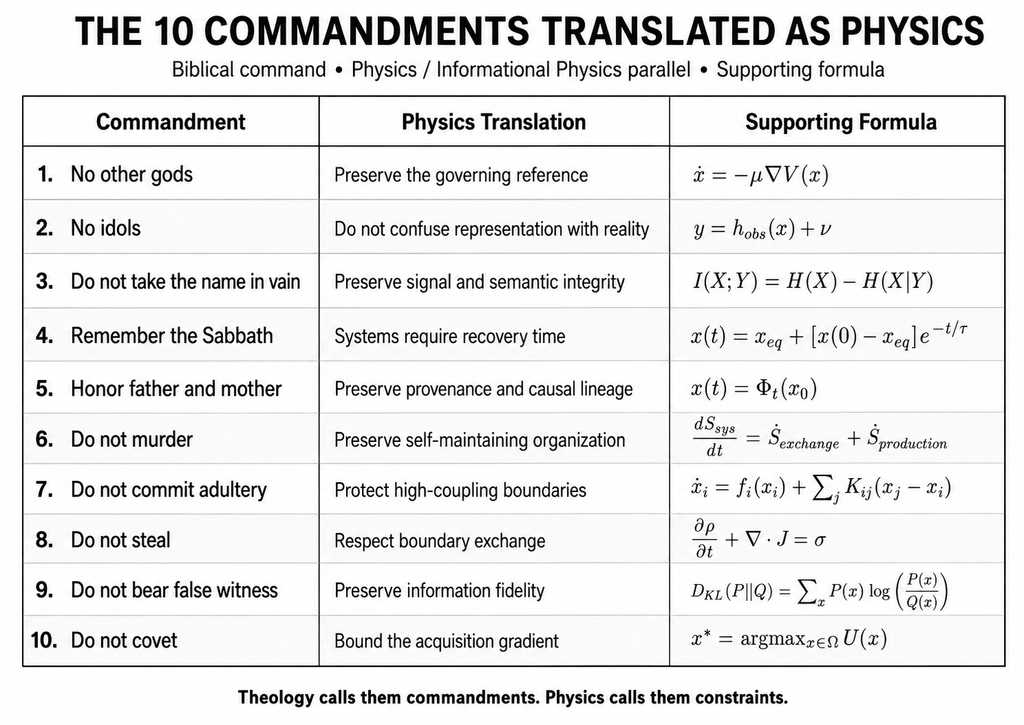
From that perspective, the Ten Commandments can be examined as ten constraints on the informational and relational state space of a human community.
This interpretation also fits the discipline of Unified Informational Physics Ontology, or UIPO, which separates definitions, mathematical proposals, empirical hypotheses, protocols, and established external science rather than treating conceptual similarity as proof. UIPO explicitly states that conceptual unity is not empirical confirmation and that a representation may be useful without establishing that the represented ontology is physically fundamental.
1. “You Shall Have No Other Gods Before Me” — Preserve the Governing Reference
Any organized system must answer a basic question: toward what is it oriented?
In physics and dynamical-systems theory, motion is often represented relative to an objective, potential, or attractor. A simple gradient-flow model is
where is the governing potential and determines the rate at which the system responds.
The system has a direction because the gradient supplies one.
Now imagine that the same system is simultaneously governed by incompatible dominant potentials:
with
The resulting gradients pull the system in conflicting directions.
Human beings obviously operate with many goals simultaneously: family, work, survival, creativity, belonging, security. The physics analogy does not imply that only one goal can exist. The more precise structural issue is whether several incompatible objectives are all permitted to become ultimate governing references.
The first commandment can therefore be translated structurally as:
Preserve a stable highest-order reference against which lower-order priorities are organized.
Informational physics expresses a similar requirement through defined state spaces, operators, objectives, and boundaries. A system becomes difficult to interpret when its governing rules change arbitrarily or when incompatible reference structures compete without hierarchy.
The theological language is loyalty to God.
The systems language is stability of the governing reference.
2. “You Shall Not Make an Idol” — Do Not Confuse the Representation with Reality
This commandment has an unusually direct parallel with one of the central problems of modern science: the distinction between a system and its representation.
Suppose the true physical state is
An observer does not necessarily access directly. Instead, the observer receives
where is the observation process and represents noise or measurement error.
The measurement is not the underlying state.
Likewise:
A map is not the territory.
A model is not the phenomenon.
A symbol is not the thing symbolized.
UIPO formalizes this distinction by requiring an observation map between latent or physical states and measured data. Its representational-neutrality principle specifically allows a schema to represent informational structure without thereby proving that the representation is reality itself.
That produces a compelling structural interpretation of idolatry.
An idol is not merely an object. At a deeper level, it represents a failure of abstraction: the substitution of a finite representation for the reality the representation is intended to reference.
The physics translation becomes:
Do not collapse the distinction between model and source.
Modern science depends on precisely this discipline. Scientific models can be extremely accurate while remaining incomplete. Confusing a model with reality prevents revision when new evidence appears.
What ancient religious language calls idolatry can therefore be compared structurally with what modern science calls reification: treating a representation as though it were the thing itself.
3. “You Shall Not Take the Name of God in Vain” — Preserve Semantic Integrity
A name is an information-bearing symbol.
Its power depends on a stable relationship between signal and referent.
In information theory, the information transmitted between two variables can be represented by mutual information:
Here represents uncertainty about , while represents the uncertainty remaining after observing .
If the signal reliably represents , then uncertainty decreases.
If the signal is corrupted, misleading, or arbitrarily reassigned, then
and the signal becomes less useful.
A name associated with ultimate authority carries unusually high informational weight. Falsely invoking that name—whether to deceive, manipulate, justify personal behavior, or create false authority—corrupts the semantic channel.
UIPO imposes a related rule in technical language: within a defined namespace, a symbol should have one stable meaning unless aliases and revisions are explicitly declared.
The physics translation is therefore:
Preserve the integrity of identity-bearing signals.
The commandment is theological in origin, but the structural principle is familiar to every technical system: identifiers become useless when their meanings are allowed to drift without control.
4. “Remember the Sabbath” — Systems Require Recovery
The Sabbath may contain the clearest everyday systems principle of the ten.
Physical, biological, and organizational systems cannot operate indefinitely at maximum load without consequences.
Consider relaxation toward equilibrium:
where is the characteristic relaxation time.
A displaced system does not return instantly to equilibrium. It requires time.
Energy balance provides another view:
If demand consistently exceeds the system’s ability to dissipate, repair, replenish, or reorganize, accumulated strain increases.
Biological organisms require sleep.
Muscle requires recovery after stress.
Machines require maintenance.
Electrical systems require thermal management.
Organizations require unused capacity.
The physics does not prove that a seven-day cycle is uniquely required. That is a theological and cultural specification outside what the equation establishes.
But the underlying systems principle is strong:
Persistent systems require recovery intervals.
The Sabbath commandment places recovery inside the architecture of life rather than treating rest as something permitted only after all work has been completed.
In modern structural language, rest is not necessarily inactivity.
It is capacity restoration.
5. “Honor Your Father and Mother” — Preserve Provenance
Every physical state has history.
For a deterministic dynamical system,
where is the initial state and describes how that state evolves.
A probabilistic formulation similarly preserves historical dependence:
The current state does not generate itself.
It has provenance.
The same is true informationally. A scientific result has data provenance. Software has dependencies. Species have evolutionary ancestry. Languages have histories. Institutions have founding structures.
Human beings likewise emerge from biological, cultural, historical, and relational lineages.
The commandment to honor father and mother can therefore be translated as a constraint against provenance erasure.
This does not mean that every parental action is correct or that harmful behavior must be tolerated. Healthy systems often require boundaries precisely because inheritance is not synonymous with perfection.
The deeper structural principle is:
The present should not erase the causal pathway from which it emerged.
An informational system that loses its provenance becomes harder to verify because its current state cannot be reconstructed.
Ancient language says: honor your origin.
Modern systems science says: preserve the dependency chain.
6. “You Shall Not Murder” — Preserve Self-Maintaining Organization
A living organism is not merely a collection of matter.
The atoms composing a body are continuously exchanged with the environment. Yet the organism maintains recognizable identity through metabolism, boundary regulation, memory, repair, and organized exchange.
For an open thermodynamic system,
with
Living systems maintain local organization by continuously exchanging energy and matter with their surroundings.
From an informational perspective, life can therefore be viewed operationally as a self-maintaining organization rather than merely a static material object.
Murder does more than relocate matter.
It irreversibly terminates another organism’s autonomous capacity for self-maintenance, regulation, adaptation, experience, and future state generation.
The physics does not generate the moral prohibition. Thermodynamics cannot tell us that murder is morally wrong.
But it clarifies what is physically destroyed:
an extraordinarily organized, self-maintaining system capable of maintaining identity through continuous material change.
The structural translation is therefore:
Do not intentionally terminate another self-maintaining human system.
7. “You Shall Not Commit Adultery” — Protect High-Coupling Boundaries
Human relationships form networks.
Some connections are weak. Others carry high levels of trust, dependency, intimacy, resources, identity, and shared future planning.
A generic coupled-system equation is
where represents the coupling between elements.
Changing a strong coupling changes system dynamics.
Marriage, considered structurally, creates an explicitly declared high-coupling relationship. Expectations about exclusivity, trust, intimacy, resources, and family architecture become part of the system’s boundary conditions.
Adultery constitutes an undeclared modification of those couplings.
The direct physical analogy is limited: physics does not define marriage and cannot determine sexual morality.
The useful structural parallel concerns boundary integrity.
Highly coupled systems depend on accurate information about their important connections. A hidden connection changes the actual system while preserving a false representation of the old one.
That creates informational asymmetry:
The result is instability because participants make decisions from an inaccurate model.
The commandment can therefore be translated structurally as:
Do not secretly alter a high-trust coupling whose stability depends on agreed boundaries.
8. “You Shall Not Steal” — Respect Boundary Exchange
Conservation laws are among the foundations of physics.
For a distributed quantity , a continuity equation has the general form
where is flux through the boundary and represents sources or sinks.
If something enters one region through transfer, its movement must be accounted for somewhere in the system.
Human property is obviously not a fundamental conserved quantity like electric charge. But the accounting principle remains useful.
Ownership systems define legitimate boundaries around resources.
Transfer is allowed through specified operations:
sale,
gift,
exchange,
inheritance,
contract,
consent.
Theft is a transfer that bypasses the authorized exchange rule.
One person’s unexplained increase corresponds to another person’s unexplained decrease:
for the transferred resource, ignoring transaction costs and broader effects.
UIPO’s Informational Boundary Conditions similarly require a system boundary and explicitly include boundary-exchange terms when the schema is physically instantiated. UIPO also warns that such boundaries are model-specific rather than automatically fundamental physical edges.
The translation is therefore:
Stable systems require rules governing legitimate exchange across boundaries.
The biblical term is theft.
The systems term is unauthorized flux.
9. “You Shall Not Bear False Witness” — Preserve Information Fidelity
This commandment has perhaps the strongest relationship to conventional information theory.
A community makes decisions using information.
If testimony faithfully represents underlying events, the receiver’s internal model can become more accurate.
If testimony is deliberately false, the receiver is pushed toward an incorrect state estimate.
Again consider mutual information:
A reliable signal reduces uncertainty about reality.
A deliberately corrupted signal may instead increase uncertainty or produce false certainty.
The difference between two probability models can also be described by Kullback-Leibler divergence:
If represents evidence and represents the belief induced by testimony, systematic deception can drive away from .
Signal quality may also be expressed through
A false witness does something worse than random noise.
It introduces structured misinformation designed to be interpreted as signal.
That distinction matters enormously in courts, science, journalism, finance, government, social media, and artificial intelligence.
A society whose informational channels cannot be trusted incurs enormous verification costs.
The commandment therefore translates cleanly as:
Preserve the fidelity of the shared information environment.
Truth is not only an individual virtue.
It is infrastructure.
10. “You Shall Not Covet” — Bound the Acquisition Gradient
The final commandment differs from many of the others because it addresses internal state rather than external action.
It does not prohibit having goals.
It addresses uncontrolled desire directed toward what belongs to another.
In dynamical terms, uncontrolled positive feedback can produce runaway growth:
with solution
Without saturation or constraint, the system grows without an internal stopping rule.
Stable optimization problems instead operate over admissible domains:
The important term is not merely .
It is
The objective is bounded.
Modern economies depend on ambition, invention, aspiration, and competition. The structural issue is therefore not desire itself.
It is the removal of boundaries from desire.
Coveting occurs when another person’s possession, partner, status, position, or advantage becomes an external gradient capable of reorganizing one’s own behavior.
Instead of the internal system asking,
“What do I value?”
it increasingly asks,
“What does the other system possess that I do not?”
The reference frame moves outside the self.
The commandment can therefore be translated as:
Do not allow acquisition gradients to become unbounded by identity, legitimacy, or sufficiency.
The Ten Commandments as a Constraint Architecture
When the ten translations are placed together, a coherent architecture appears:
- Preserve the governing reference.
- Do not confuse representation with source.
- Preserve semantic integrity.
- Permit recovery.
- Preserve provenance.
- Protect self-maintaining life.
- Protect high-trust coupling boundaries.
- Regulate resource exchange.
- Preserve information fidelity.
- Bound acquisition gradients.
These principles address different parts of a functioning system: objective, representation, identity, recovery, ancestry, persistence, coupling, boundaries, information, and optimization.
A general systems formulation is
The system remains viable while its state stays within an admissible region.
Informational physics expresses a related idea through Informational Boundary Conditions. In UIPO V2.0, the canonical boundary schema includes a system , its boundary , a minimum coherence criterion , and a maximum allowed deviation :
For empirical use, UIPO further requires the boundary definition to be supplemented by an observation window, uncertainty model, tolerances, and boundary-exchange terms. Importantly, UIPO classifies the physical interpretation of this framework as model-specific rather than an automatically established universal law.
That distinction is exactly the appropriate boundary for this article.
The Ten Commandments are not being derived from physics.
Physics is being used as a modern representational language through which their structural consequences can be examined.
From Commandments to Equations
This returns us to the historical bridge.
An ancient Israelite could observe betrayal.
He could not calculate a network coupling coefficient.
An ancient judge could observe the damage caused by false testimony.
He could not calculate mutual information or Kullback-Leibler divergence.
A farmer could understand the necessity of rest.
He could not describe relaxation time, metabolic recovery, fatigue accumulation, or energy balance mathematically.
A community could recognize theft as destabilizing.
It could not express resource transfer through a continuity equation.
Ancient societies therefore encoded complex structural lessons in forms that could survive without laboratories, universities, computers, or universal mathematical literacy.
A commandment is remarkably efficient in that environment.
“You shall not steal” is far easier to preserve across generations than a mathematical discussion of boundary conditions, flux, ownership states, incentive structures, and network instability.
“You shall not bear false witness” can be taught to a child. Information-theoretic channel fidelity cannot.
That does not prove that the ancient authors possessed modern physics.
It suggests something more modest and potentially more interesting:
Different civilizations can describe the same recurring structural problem at different levels of resolution.
Ancient civilization may encode the observable consequence.
Modern science can increasingly model the underlying dynamics.
The two descriptions need not compete.
One can say:
Do not lie.
The other can say:
Preserve signal fidelity.
One can say:
Observe the Sabbath.
The other can say:
A loaded system requires recovery capacity.
One can say:
Do not steal.
The other can say:
Respect authorized boundary exchange.
The ancient formulation answers the human question:
How should we live?
Physics asks a different question:
What happens to systems when certain constraints are violated?
Informational physics adds a third:
What identity, boundary, signal, and relational structures are those constraints preserving?
That may be the most productive way to read the correspondence.
Not as proof that religion is physics.
Not as proof that physics is religion.
But as two languages operating at different resolutions on a recurring problem:
What allows an organized system to persist without destroying the conditions that make its existence possible?
Theology calls them commandments.
Physics calls them constraints.
Informational physics asks what structure those constraints preserve.