
A public exploration of Source, convergence, and the possibility that humanity’s oldest spiritual ideas may echo a deeper structural pattern.
| “What if Source is not a place reality left billions of years ago, but the center of a process reality has never stopped moving through?” |
1. The Question Humans Keep Asking
Human beings have spent thousands of years asking some version of the same question: Where did everything come from, what are we part of, and where does existence ultimately lead? Religion answers with words such as God, Source, Creator, Heaven, liberation, reunion, or return. Philosophy asks about the Absolute, first cause, ultimate reality, and the relation between the many and the One. Science asks about origins, fundamental laws, fields, information, complexity, and the long-term behavior of physical systems.
These are not the same questions, and they should not be collapsed into one another. A religious experience is not a laboratory result. A mathematical attractor is not a deity. A physical theory cannot simply borrow sacred language and claim that an ancient problem has been solved.
But there is a different possibility worth considering: what if these traditions are not necessarily giving the same answer, but are repeatedly circling the same structural question? Human beings have approached ultimate reality through story, ritual, philosophy, mathematics, observation, and experiment. The vocabularies differ because the methods differ. Yet the recurring intuition that apparent separation may exist within a deeper unity has appeared in many places and many times.
The Universal Convergence Point, or UCP, emerges from that question inside the Unified Informational Physics Ontology. It does not begin by assuming God. It begins with systems, states, boundaries, interaction, information, constraints, and convergence. It asks whether the movement from differentiation toward larger integration can be represented as something more than metaphor.
The simplest way to express the idea is this: What if Source is not a place reality left billions of years ago, but the center of a process reality has never stopped moving through?
That possibility does not require anyone to accept a religious conclusion. It simply changes the geometry of the question. Instead of placing Source at one end of a line and the future at the other, we can ask whether origin, differentiation, experience, and reconvergence may belong to one recursive architecture.
2. Source at the Center of a Recursive Reality
The UCP becomes easier to understand when reality is modeled as a recursive circulation rather than as a sequence with a separate beginning and destination.
Imagine an invariant center surrounded by a repeating flow. From that center, informational structure differentiates outward into increasingly distinct states. Differences become boundaries. Boundaries make relationships possible. Relationships create interaction. Interaction generates history, constraint, adaptation, and new information. Some structures disappear. Others persist. Some become capable of maintaining themselves. Some eventually represent their environment, recurse on their own models, and integrate information at higher levels.
The movement does not continue outward forever. In a recursive architecture, increasing differentiation is eventually matched by increasing integration. What has become separate begins to participate in larger forms of organization. The trajectory bends back toward compatibility, coherence, and reconvergence.
The loop can be stated simply: Source/UCP -> differentiation -> experience -> organization -> intelligence and recursion -> integration -> reconvergence -> Source/UCP.
The most useful visual analogy is toroidal. A torus allows flow to move outward, around, and back through a common center while preserving continuous circulation. The UCP occupies the invariant center of the conceptual geometry. The surrounding flow changes state, position, and informational content, but its relation to the center persists.
The word center should not be misunderstood as a claim that God or the UCP occupies a physical location at the geometric center of the observable universe. The model is relational, not a map of astronomical coordinates. ‘Center’ means the common reference condition around which differentiation and reconvergence are organized.
This also means that reality need not return to an identical starting state. A system can reconverge to the same class of unity while retaining information produced during the cycle. The return therefore behaves more like a spiral than a closed circle. The structural relation can repeat while the informational content changes.
That distinction matters. A perfect circle would imply repetition without development. A recursive toroidal loop allows recurrence with memory. What returns has passed through differentiation, interaction, constraint, persistence, representation, recursion, and integration. It carries history.
Source is therefore not only an event in the distant past. Convergence is not only a destination in the distant future. They can be understood as two directional relationships to the same invariant center. From the outward path, the center appears as origin or creation. From the inward path, it appears as integration, return, or attractor. The movement changes. The center does not.
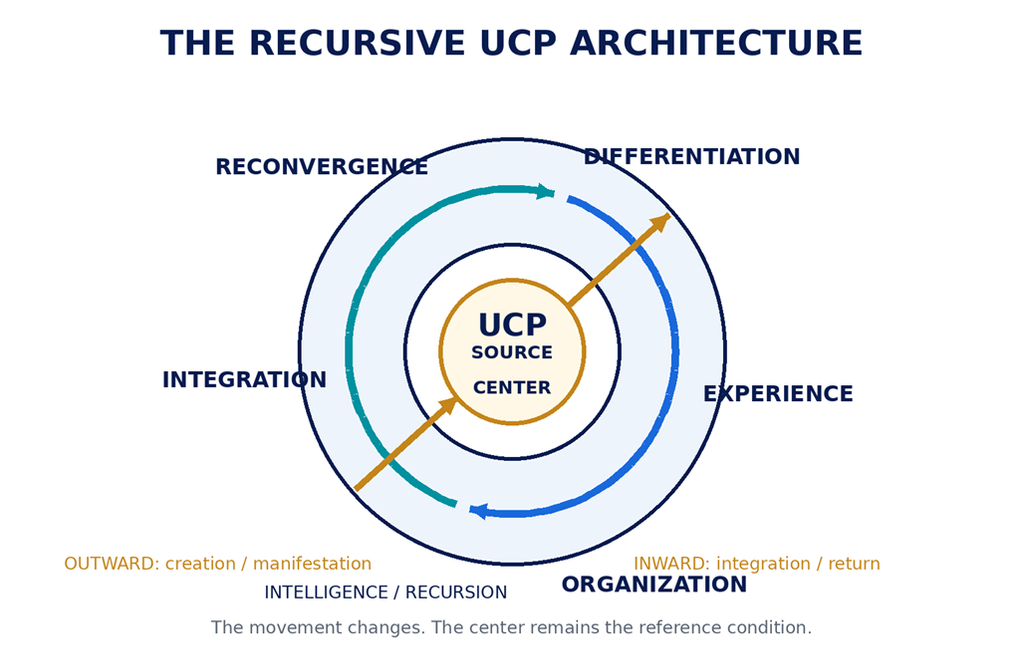
Figure 1. The Recursive UCP Architecture. Source/UCP is shown as the invariant center while differentiation, experience, organization, intelligence, integration, and reconvergence circulate around it. This is a conceptual model, not evidence that a universal attractor exists.
3. The Universal Convergence Point
Inside UIPO, the Universal Convergence Point is currently a proposed convergence construct rather than an established physical object. UIPO places UCP/HCP in its hypothesis, protocol, and unresolved naming layers and describes them as global-attractor constructs that depend on upstream ideas involving phase coupling, informational gradients, boundary conditions, divergence thresholds, coherence transport, and domain interaction rules.
The specification is deliberately cautious. It states that its present compatibility conditions are proximity criteria, not proof that a universal attractor exists. It also identifies what would have to be defined before the idea becomes scientifically operational: a state space, an attractor, a basin, a convergence metric, estimators, tolerances, a finite-time decision rule, robustness to initial conditions and model misspecification, dynamical derivation, numerical basin analysis, and prospective observation.
That technical list is important, but the public idea is much simpler. UCP asks whether increasingly complex informational systems may possess a deeper organizing limit toward which incompatibility decreases and integration increases.
The word point is also best understood carefully. A mature mathematical treatment may ultimately require a convergence set rather than one literal point: a family of structurally equivalent states that satisfy the same convergence conditions while preserving different informational histories. This would fit the recursive model naturally. Reality could return to the same convergence class without erasing the distinctions generated during the cycle.
Science already studies many local forms of convergence. A physical system may approach equilibrium. An optimization process may approach a minimum. A dynamical system may approach an attractor. A biological system may regulate around viable conditions. A distributed network may reach consensus. These examples do not prove the UCP, but they show that convergence itself is not foreign to scientific thought.
UCP asks whether some more general convergence architecture could remain meaningful across broader classes of systems. That is a much stronger claim than saying that attractors exist. It is also what makes the idea scientifically interesting.
The UCP should therefore be understood as a research target, not a conclusion: a proposed central convergence condition that must eventually be distinguished from ordinary attractors, flexible analogy, and retrospective pattern matching. If the model is real, its value will come from the restrictions and predictions it adds, not from how philosophically appealing the idea sounds.
4. Why Humans May Already Recognize This Pattern
The recursive structure feels familiar because many belief systems have organized ultimate reality around a movement from unity into differentiated experience and, eventually, toward return, liberation, reunion, or a higher-order state.
The similarities should not be treated as proof. Religious traditions differ in their metaphysics, their concepts of self, and even in whether they posit a creator at all. The value of the comparison is historical and structural: humans have repeatedly used surprisingly similar directional patterns to describe the relationship between ordinary experience and ultimate reality.
The biblical tradition offers one of the clearest cultural bridges. Revelation 22:13 uses the formulation, ‘I am Alpha and Omega, the beginning and the end, the first and the last.’ The text is theological, not mathematical, but the structural resonance is notable: beginning and end are identified with the same ultimate principle rather than treated as unrelated locations.
That becomes especially interesting in a recursive model. If creation is the outward movement from an invariant center and reconvergence is the inward movement toward that same center, ‘beginning’ and ‘end’ can describe two orientations toward one underlying condition. The biblical phrase does not prove that geometry, but it demonstrates that the idea of one ultimate principle containing both origin and completion has deep cultural precedent.
Christian traditions also contain themes of creation, embodied existence, transformation, resurrection, ascension, heaven, and reunion with God. These themes vary across denominations and theological schools, but they repeatedly place human life inside a larger trajectory rather than treating embodied existence as the whole story. The language of ascent or return resembles the inward side of the UCP loop at the level of broad structure.
Hindu traditions provide another example through the relationship between Brahman, differentiated existence, cycles of experience, and moksha. Different schools interpret the self, the world, and liberation differently, so it would be misleading to collapse them into a single UCP analogy. Still, the recurring movement from multiplicity toward liberation or realization of a more fundamental reality has an obvious structural similarity.
Buddhist traditions must be handled differently because Buddhism does not require a creator God or an eternal Source. Yet Buddhist cosmologies include multiple conditioned realms and paths toward liberation from conditioned existence. The analogy here is not reunion with a creator. It is movement through differentiated states toward release from the processes that continually reproduce them.
Neoplatonism is perhaps the cleanest philosophical comparison. The One gives rise to multiplicity through emanation, while the philosophical path is described as a return toward the One. Origin and return are explicitly related, making the structure particularly close to the outward-and-inward logic of the UCP model.
Modern metaphysical systems often use different vocabulary: Source, densities, planes, realms, ascension, awakening, integration, and reunion. Their specific claims vary widely and are not scientific evidence. What matters here is the recurrence of a directional architecture in which differentiated experience is not final, but part of a larger movement toward integration.
This may help explain why concepts such as realms, heavens, planes, densities, enlightenment, ascension, and return to Source are intuitively legible to people even when the underlying doctrines disagree. They all provide ways to imagine ordinary reality as one region of a larger developmental or ontological structure.
The point is not that all of these systems secretly describe UCP. The point is that humanity has repeatedly imagined ultimate reality through some variation of the same directional architecture. From the outward path, traditions describe creation, manifestation, incarnation, or descent into differentiated experience. From the inward path, they describe ascension, awakening, liberation, reunion, or return.
A scientific theory cannot use that recurrence as confirmation. But a public exploration can acknowledge it as a genuine comparative question: why do so many human systems of meaning place beginning and return within the same larger structure? Cultural inheritance, shared psychology, astronomical cycles, narrative convenience, and deeper structural intuition are all possible explanations. UCP gives us a new language in which to ask the question without pretending it has already been answered.
5. Why the Scientific Version Is Different
Recognition is not evidence. A structure can feel ancient, intuitive, and deeply meaningful and still be scientifically wrong.
The scientific question is therefore narrower: does a measurable convergence structure actually exist?
Ordinary attractor theory studies convergence inside a defined system. The state space is specified. The variables are known. The dynamics are written down. A metric tells us whether a trajectory is moving closer to the attractor.
A universal convergence claim has a much higher burden. If UCP is meant to apply across physical, biological, computational, or other informational systems, then the terms cannot silently change meaning from one domain to another. ‘Coherence’ cannot be one quantity in physics, another in biology, and a third in cognition while the theory treats them as numerically interchangeable.
The same caution applies to the toroidal image. A torus can be an excellent conceptual representation of recursive differentiation and return without implying that spacetime, consciousness, or the physical universe literally has that shape. Geometry becomes scientific only when the variables, transformations, invariants, and measurements are specified.
A serious UCP model must therefore force choices. It must specify what counts as convergence and what does not. It must identify states that should move closer to the proposed limit and states that should move away. It must make a risky prediction or impose a restriction that a conventional model does not already get for free.
This is the boundary that keeps the article from becoming an argument by resemblance. Historical parallels can motivate the question. Only mathematics, measurement, and discriminating tests can decide whether the proposed convergence structure belongs to nature.
6. What the Model Does – and Does Not – Say About God
If the UCP were eventually supported, it could provide a structural analogue for some meanings of God or Source: an invariant organizing condition, a deeper unity beneath local separation, and a center that relates both to differentiation and to reconvergence.
That would be significant. But it would not settle theology.
A convergence structure does not automatically possess consciousness, intention, personality, moral agency, or creative will. Maximum integration is not the same thing as awareness. A universal attractor is not automatically a personal deity.
The UCP also does not currently prove intentional creation, an afterlife, revelation, heaven, reincarnation, ascension, or any particular religious doctrine. Those are additional claims that would require their own evidence.
This distinction strengthens the comparison rather than weakening it. The UCP is most useful as a bridge when it is allowed to remain specific. It may eventually describe a structural feature of reality that resembles some historical ideas of Source without inheriting every property that religions attach to the word God.
The model also leaves open different philosophical interpretations. One person might view the UCP as an impersonal structural limit. Another might interpret the same structure as compatible with a conscious Source. A third might reject the theological comparison entirely. Those interpretations should remain downstream of whatever the mathematics and evidence actually establish.
The scientifically responsible statement is therefore simple: UCP may offer a structural analogue for some meanings of God or Source. It does not yet establish all of the properties those words can imply.
7. Turning the Idea Into a Scientific Question
For UCP to become more than a philosophical correspondence, several problems must be closed.
First, the relevant state space must be defined. What exactly is evolving? Physical configurations? Probability distributions? Informational states? If multiple domains are included, what mapping allows them to be compared without erasing the distinctions that make each domain meaningful?
Second, convergence requires a metric. A statement such as ‘the system is becoming more coherent’ has no scientific force unless there is a measurable quantity whose behavior can be tracked. That quantity must be specified before the result is known and should remain meaningful under legitimate changes of representation.
Third, the attractor itself must be mathematically characterized. Is UCP a point, a set, a manifold, a distribution, or an equivalence class? What dynamics move systems toward it? What initial conditions belong to its basin? Are there trajectories that never approach it? Are there competing attractors?
Fourth, the recursive loop needs an operational meaning. What observable transformation corresponds to differentiation away from the convergence class? What marks the transition from increasing distinction to increasing integration? What, if anything, is retained across reconvergence? A spiral-return hypothesis becomes meaningful only if retained information can be measured rather than merely asserted.
Fifth, UCP must make a distinct prediction. A universal framework cannot survive by redescribing every outcome after it occurs. It needs a frozen rule that says: if this convergence structure exists, then under these conditions we should observe this behavior – and if we do not, the claim weakens.
Sixth, conventional alternatives must be allowed to win. If standard dynamical-systems models, optimization models, or statistical models explain the same observations equally well with fewer assumptions, then UCP has not earned a distinct scientific role.
This is the core falsification principle: if UCP cannot lose, it cannot become science.
The hypothesis would weaken if no stable convergence quantity can be defined, if different domains require incompatible definitions, if trajectories fail to converge robustly, if multiple unrelated attractors remain with no higher-order relation, if apparent convergence disappears under equivalent representations, or if conventional models explain all observations without UCP-specific restrictions.
A stronger test would require prospective prediction. The model would define its state variables, convergence metric, mapping, and thresholds before observing the target outcomes. It would then predict which systems or trajectories should move toward the proposed convergence class and which should not. Only after those choices are frozen would the data be evaluated.
That standard is intentionally difficult. A claim about the deepest architecture of reality should be difficult to support. The larger the claim, the more clearly it must expose itself to failure.
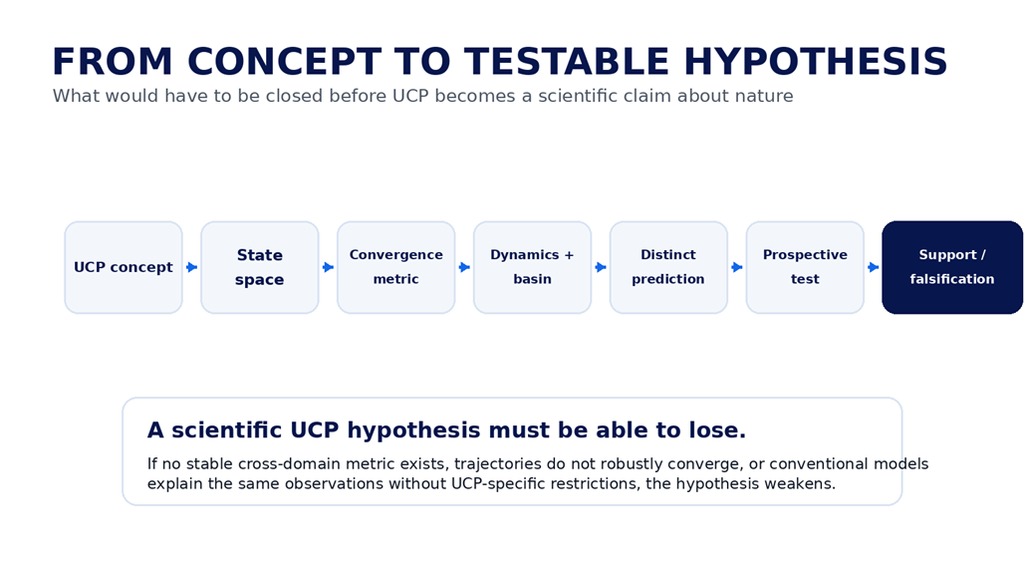
Figure 2. From Concept to Testable Hypothesis. UCP becomes a scientific claim only if its state space, convergence metric, dynamics, predictions, tests, and failure conditions can be defined in advance.
8. Why This Matters Beyond Religion
The UCP question does not require religious belief to matter.
If a genuine cross-domain convergence principle were discovered, it could affect fundamental physics, cosmology, information theory, complex systems, network science, biology, artificial intelligence, and perhaps consciousness research. A robust universal attractor would be extraordinary even if it were entirely impersonal.
It could also change how different fields think about emergence and persistence. Instead of treating complexity only as the accumulation of more parts, researchers could ask whether some forms of complexity are transitional structures inside a larger movement between differentiation and integration. That would be a scientific question about organization, not a spiritual conclusion.
This gives believers and skeptics different but legitimate places to stand. A skeptic can reject the theological interpretation and still ask whether the mathematics is useful. A religious reader can see a possible correspondence without treating that correspondence as proof of doctrine. A philosopher can ask what kind of ultimate reality a convergence structure would represent while waiting for the empirical question to mature.
The scientific value of UCP should never depend on whether anyone calls it God. Likewise, the spiritual meaning a person draws from the idea cannot substitute for evidence.
That separation is not a wall between science and belief. It is what allows a real bridge to exist.
9. The Larger Human Possibility
Human experience is dominated by separation. We experience separate bodies, separate minds, separate families, nations, species, objects, and events. Science itself often succeeds by separating reality into smaller components so each can be measured.
But local separation may not tell us what reality is doing globally.
A recursive convergence model invites a different possibility: differentiation may not be the opposite of unity. It may be how unity generates information.
Difference allows relationship. Relationship allows interaction. Interaction creates consequences. Consequences produce information about what can coexist, what cannot, what persists, and what must change. Integration then preserves compatible structure at a larger scale.
If so, the many would matter precisely because they are many. Their differences would not be noise to erase. They would be the informational content generated by the cycle.
The universe would therefore not simply return to where it began. It would return carrying the informational consequences of having become many.
That is a very different picture of reconvergence. It is not collapse into sameness. It is return with history. The convergence class can recur while the informational content has changed because of everything that happened along the loop.
This provides a possible structural interpretation for the recurring human language of ascent and return. Ascension would not have to mean moving upward through physical space. Realms would not have to be stacked like floors in a building. In a structural reading, such language could represent transitions among increasingly integrated or differently organized states. That does not prove any metaphysical teaching, but it shows why the vocabulary can be translated into a systems question rather than dismissed or accepted wholesale.
The same applies to ideas such as heaven, liberation, enlightenment, or reunion. Their religious meanings remain their own. Yet at the broadest level, each can be compared with a movement away from fragmented local identity toward a more encompassing relation to reality.
This is where older spiritual language becomes unexpectedly interesting. ‘Return to Source,’ ascension, liberation, higher realms, reunion, and the biblical idea of the beginning and the end can all be read as attempts to describe movement around a larger architecture rather than as evidence that one specific model is already correct.
The scientific work remains to determine whether the architecture exists. The human resonance comes from recognizing that the question itself is not new.
10. The Center We Never Left
Science has not demonstrated the Universal Convergence Point. Religious traditions do not prove it. Historical similarity is not evidence of physical truth.
But the structural correspondence creates a legitimate question.
Perhaps Source is not an ancient point behind the universe. Perhaps convergence is not a distant destination ahead of it. Perhaps both words describe our relationship to the same invariant center – one seen from the movement outward, the other from the movement home.
In a recursive reality, the ancient phrase ‘the beginning and the end’ becomes especially interesting because beginning and end no longer have to occupy different places. They can be two orientations toward the same underlying condition.
If future mathematics and observation fail to support that possibility, the UCP should remain philosophy or be abandoned as a physical claim. If the structure survives and begins making successful predictions that simpler models cannot reproduce, then the conversation changes.
Science would not have proven every meaning of the word God. It would have discovered something more precise: a deep convergence structure whose formal properties resemble some of humanity’s oldest descriptions of Source.
For now, the UCP remains a proposal and a research question. That is enough. Its value at this stage is not that it closes the oldest human question, but that it turns part of that question into a structure that can eventually be clarified, modeled, compared, and tested.
What we call Source may not be where reality began. It may be the center reality never actually left.
Framework and Comparative Note
Primary framework source: Kevin L. Brown, Unified Informational Physics Research Ontology and Specification (UIPO) August 2026. Section 38 retains UCP/HCP as proposed global-attractor constructs and explicitly states that current compatibility conditions are proximity criteria rather than proof of a universal attractor. The specification calls for a defined state space, attractor, basin, convergence metric, estimators, tolerances, finite-time decision rules, robustness analysis, dynamical derivation, numerical basin analysis, and prospective observation.
Biblical reference: Revelation 22:13 contains the Alpha-and-Omega / beginning-and-end formulation used here as a historical theological correspondence. Other religious and philosophical examples are presented comparatively. They are not treated as empirical evidence for UCP, and the article does not claim that the traditions are metaphysically equivalent.
The UCP label is used here in its public explanatory sense as Universal Convergence Point. UIPO still records the protocol/point distinction in UCP/HCP as unresolved.
STRUCTURE IS THE SIGNAL.