
A 12-Position Mathematical Architecture of Reality, Life, Intelligence, and Reconvergence
What if the recurring appearance of “twelve” in cosmology, metaphysics, symbolic systems, and ancient traditions is not merely cultural inheritance—but reflects a deeper structural pattern?
The Calista Loop explores that question mathematically.
Rather than beginning with the assumption that reality must contain twelve stages, this work starts from the Unified Informational Physics Ontology (UIPO) and asks a more rigorous question:
What is the smallest nonredundant sequence of informational state classes capable of describing a trajectory from convergence, through differentiation and increasing organization, and back toward convergence?
The resulting architecture contains twelve distinct positions:
Convergent
Differentiated
Bounded
Relational
Dynamical
Persistent
Endogenously Maintained
Representational
Recursive
Integrated
Coherent
Reconvergent
The cycle then closes into renewed convergence.
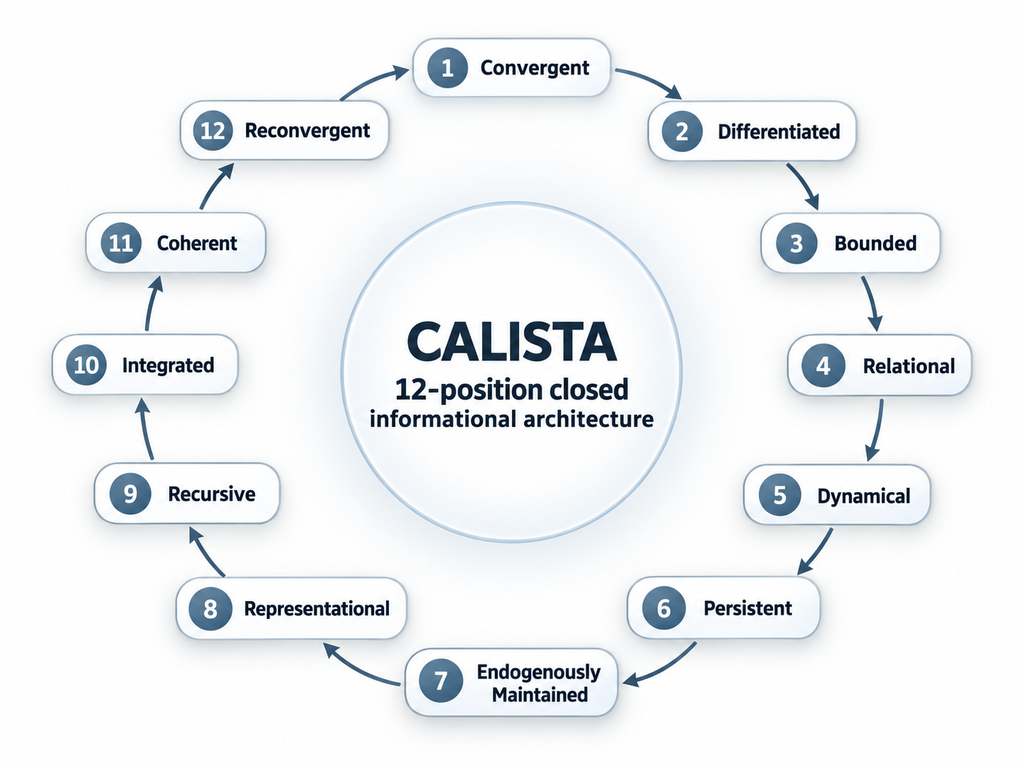
Importantly, these are formal state classes—not metaphysical labels.
Each position survives a compression and irreducibility test because removing or merging it eliminates a meaningful structural distinction.
Examples include:
- Difference is not the same as boundary.
- Boundary is not the same as relationship.
- Dynamics is not the same as persistence.
- Persistence is not the same as self-maintenance.
- Representation is not the same as recursion.
- Integration is not the same as coherence.
- Coherence is not the same as convergence.
This gives the Calista Loop a recognizable developmental interpretation without using those interpretations to define the mathematics.
Possible landmark mappings include:
- Primordial differentiation → Differentiated
- Distinguishable physical systems → Bounded
- Interaction and coupling → Relational
- Big-Bang-era evolving physical dynamics → Dynamical
- Stable matter, stars, planets, and chemistry → Persistent
- Candidate life threshold → Endogenously Maintained
- Perception and internal models → Representational
- Higher intelligence and self-modeling → Recursive
- Integrated cognition → Integrated
- Highly coherent informational organization → Coherent
- Approach toward generalized convergence → Reconvergent
The framework also revisits the Universal Convergence Point concept.
Instead of treating convergence as one literal mathematical point, the paper proposes a Universal Convergence Set: a class of structurally equivalent convergent states.
This allows:
Convergence → Differentiation → Organization → Recursion → Integration → Reconvergence
without requiring the final state to be literally identical to the initial state.
This also creates a stronger “spiral” hypothesis:
a system may return to the same convergence class while retaining information generated through the cycle.
Triune Harmonic Dynamics (THD) has a separate role.
THD is treated as a candidate local transition grammar:
Emergence → Contrast → Integration
while Calista describes the larger global architecture through which those transitions may repeatedly occur.
The paper also examines historical twelvefold structures found across religious, cosmological, philosophical, and metaphysical traditions.
These historical systems are not treated as scientific evidence.
Instead, they raise a legitimate comparative question:
Why does twelve recur so often?
Possible explanations include cultural inheritance, astronomical and calendrical history, the high divisibility of 12, cognitive convenience, or a deeper structural reason.
The Calista Loop attempts to investigate that question independently by deriving its architecture first and only afterward comparing it with historical twelvefold systems.
The paper also includes:
- 10-position and 11-position competing architectures
- compression and ablation tests
- ordering tests
- explicit assumptions
- falsification criteria
- computational test proposals
- biological and artificial-system tests
- cosmological interpretation boundaries
- comparison with modern metaphysical density models
- a distinction between mathematical structure and interpretive analogy
This paper does NOT claim that nature has been proven to contain twelve universal stages.
It does NOT claim that recursion proves consciousness.
It does NOT claim that coherence proves awareness.
It does NOT claim that historical or metaphysical teachings validate the mathematics.
The central hypothesis is narrower and falsifiable:
Twelve non-equivalent informational state classes may form a useful minimal architecture for describing progression from convergence through differentiation, organization, self-maintenance, representation, recursion, integration, coherence, and reconvergence.
Whether that architecture reflects a universal feature of nature, a restricted property of complex informational systems, or simply a useful mathematical taxonomy remains an open empirical question.
Structure is the Signal.