100% FREE AI-Assisted Business Planning & Operating System

Plan and Improve Your Business Smarter. Simpler. Stronger.

A free AI-assisted business planning and operating tool that helps you create, review and improve the plans, processes and working documents used to build and run an organization.

Built around your information
Assumptions made visible
Practical working documents
Launch the Business Operating System AI ↗
100% FREE to use. Start with the plan, document or decision you need.
See how the planning process works
Set the Goal
Share Details
Create Draft
Refine
🎯
Define the Outcome Start with what you want to create or improve
📊
Use Your Information Use real business information when available
⚙️
Build the Deliverable Plans, processes and working documents
Refine and Improve Revise with better data and judgment
A Connected View of the Business

Business functions do not operate in isolation.

A marketing plan should reflect the offer, margins, customer, budget, sales process and delivery capacity. A hiring plan should reflect workload, role clarity, management capacity and cash. A technology plan should reflect the people and processes that have to use it.
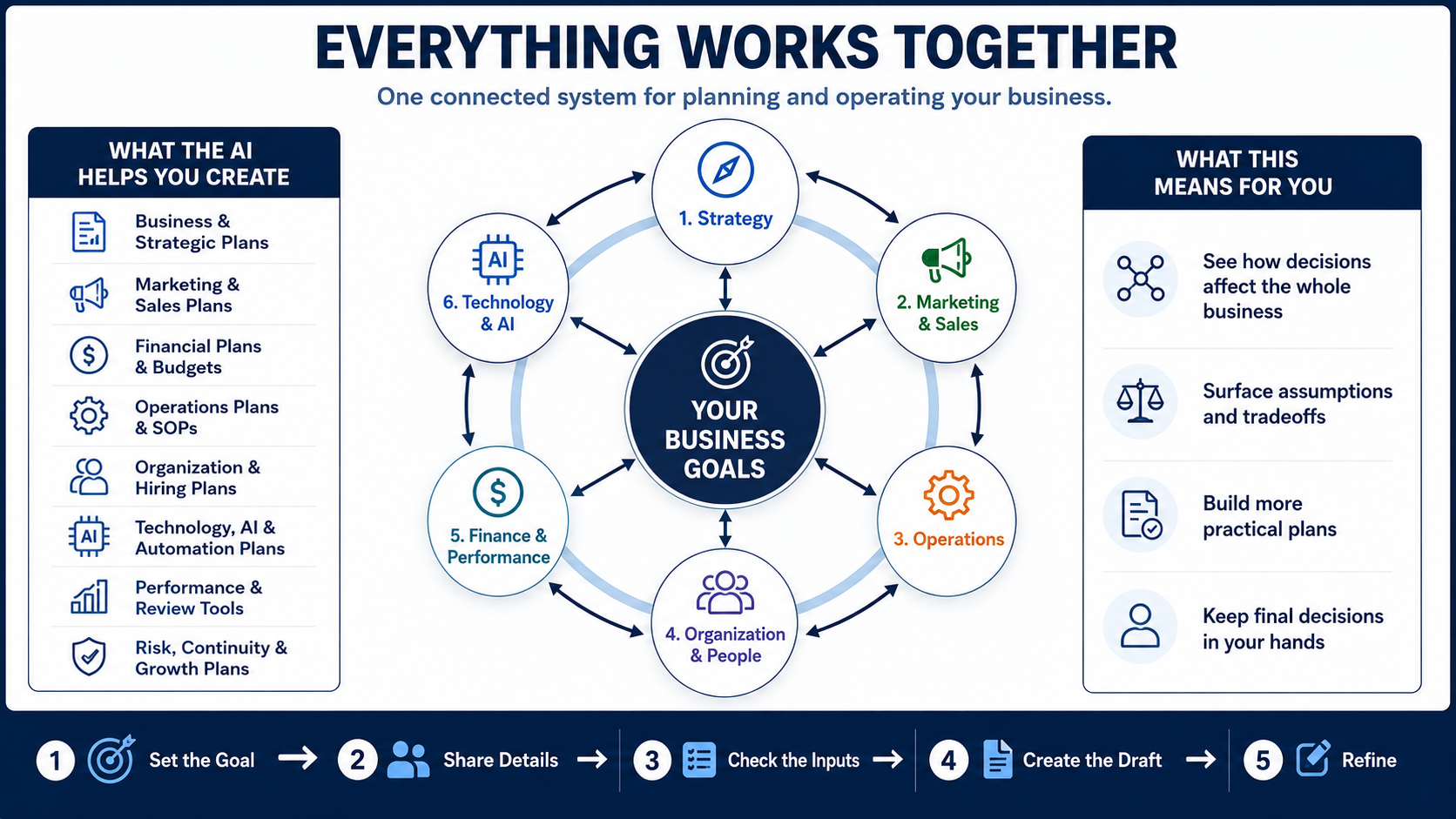
Connected business operating system showing strategy, marketing and sales, operations, people, money and performance, and technology and AI.
Consider Related Functions Surface important relationships between strategy, marketing, sales, operations, people, money and technology.
Surface Tradeoffs Identify assumptions, dependencies and tradeoffs that should be considered before a plan is finalized.
Use Business-Specific Information Use the information you provide to make plans more specific to your organization.
Keep Decisions in Your Hands Use the analysis and drafts as decision support. You decide what is appropriate to implement.
A Practical Planning Process

From desired outcome to practical first draft.

1

Set the Goal

Tell the AI what you want to create, review or improve.

2

Share Details

Provide the information needed to make the plan or document useful for your situation.

3

Check the Inputs

Use the information provided, identify important assumptions, and flag gaps or missing data that could change the result.

4

Create the Draft

Create the plan, analysis, template or operating document while considering related business functions.

5

Refine

Review the draft, correct anything that is incomplete or inaccurate, add better information, and revise until it fits your needs.

Start With What You Need

What do you want to create, review or improve?

Choose a starting point. The AI will ask for the minimum information needed to begin and will identify important assumptions as it works.

📘

Business Planning

Build or improve a business plan, executive summary, operating plan or broader business blueprint using the information available.

Useful prompts to get started Choose a prompt, then add your own business details. Use the copy button to paste it into the Business Operating System AI.
Practical Business Deliverables

Create the plans and working documents your organization needs.

Use the AI to develop a first draft, review an existing document, identify missing assumptions, or improve a plan with better business information.

Business & Strategic Plans Business plans, executive summaries, strategic plans, and 30-, 60- or 90-day action plans.
Marketing & Sales Plans Marketing plans, campaign briefs, sales plans, pipeline structures and follow-up processes.
Financial Planning Budgets, cash-flow structures, scenario models, pricing analysis and planning assumptions.
Operations & Procedures Operations plans, process maps, step-by-step work procedures and process-improvement documents.
Organization & Hiring Organizational structures, role scorecards, job descriptions, hiring plans and onboarding plans.
Technology, AI & Automation Technology plans, AI implementation plans, automation assessments and human-review requirements.
Performance & Management Performance measures, management reviews, decision records and operating-review structures.
Risk & Continuity Risk reviews, continuity plans, scenario planning and operational resilience documents.
Growth, Succession & Exit Growth-readiness plans, succession planning, transferability reviews and exit-planning documents.
See What You Can Create

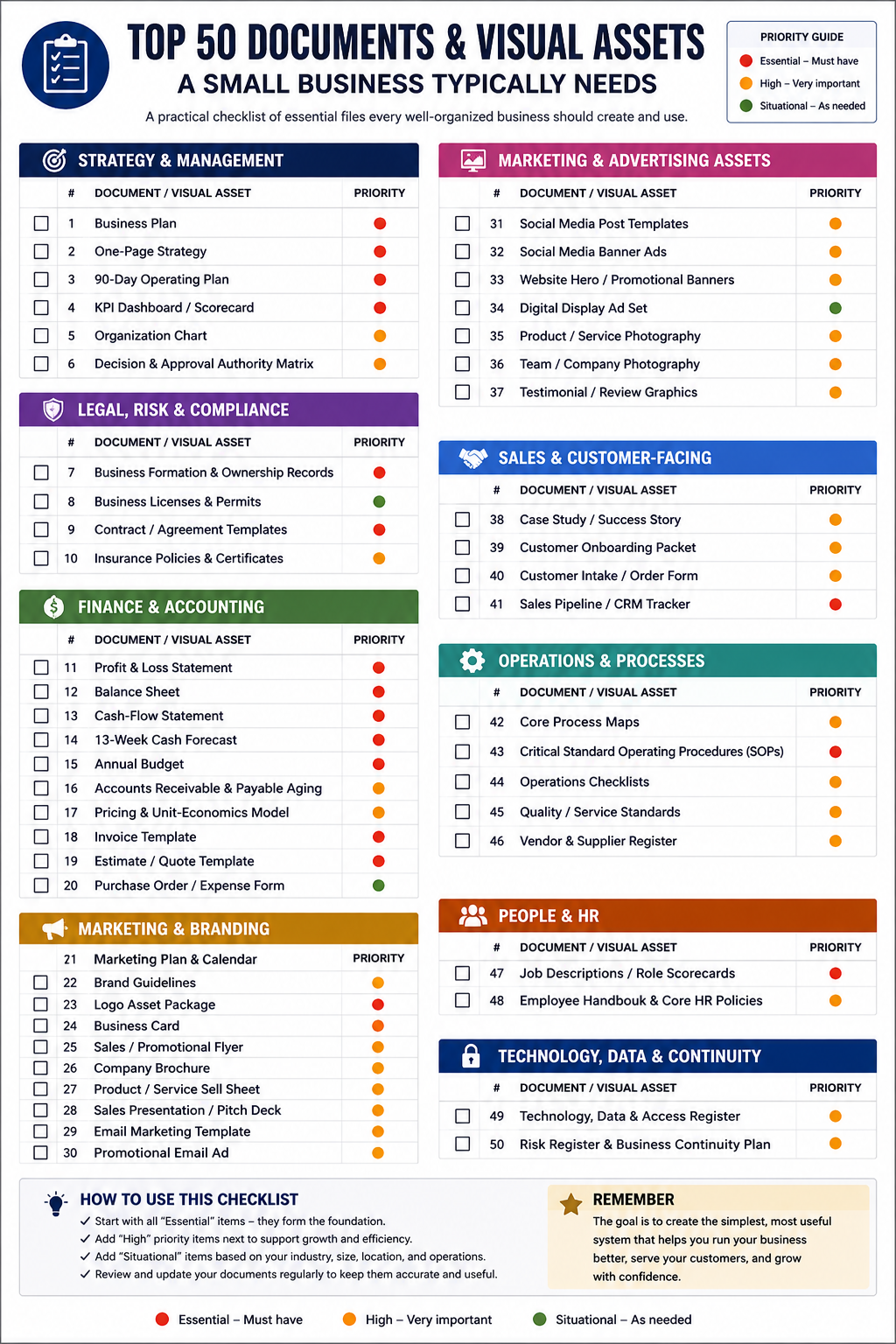
Top 50 Business Tools, Documents & Visual Assets

Explore a practical example of the documents and visual assets that startups, small businesses, nonprofits, departments and business units may use to plan, operate, market, sell, manage and improve their organizations.
Free PDF
Top 50 business tools, documents and visual assets checklist for startups, small businesses and departments.
Example Business Toolkit

50 practical resources a well-organized business may need.

The checklist includes a diverse mix of internal operating documents and customer-facing materials—from strategy, finance and operations to sales collateral, marketing graphics, forms, procedures and business continuity tools.

Strategy & business planning
Financial planning & reporting
Marketing & advertising assets
Sales & customer materials
Operations & procedures
People & HR documents
Legal, risk & compliance
Technology, data & continuity
Every organization is different. This checklist is an example of what can be created with the Business Operating System AI—not a requirement that every organization needs all 50 items. The tool can help customize documents, templates, forms, plans and visual assets for your business, department or organization.
Marketing Plans Grounded in Business Economics

Build marketing plans around the numbers that matter.

When you provide information such as pricing, costs, margins, sales activity, repeat purchases, budget and available capacity, the system can use those inputs to make the marketing plan more specific to your business.

If the inputs are adequate, it can help estimate measures such as the cost to gain a customer, contribution from each sale, conversion rates, payback time and a reasonable acquisition-cost target. These are planning calculations, not guarantees of campaign performance.

Cost to Gain a Customer Estimate how much marketing and selling activity costs for each new customer gained.
Contribution From Each Sale Estimate how much remains from a sale after the variable costs required to deliver it.
Sales Conversion Estimate how many qualified opportunities become paying customers.
Time to Recover Acquisition Cost Estimate how long customer contribution takes to recover the cost of gaining that customer.
Reasonable Acquisition-Cost Target Work backward from contribution, retention, cash constraints and desired profit to estimate what the business may be able to spend.
A Structured Alternative to Fragmented Business Support

Create plans and operating documents with a connected business view.

The system is designed for business planning and decision support. It helps organize information, draft practical materials, surface assumptions and consider related business functions while leaving final decisions and professional review with the user.
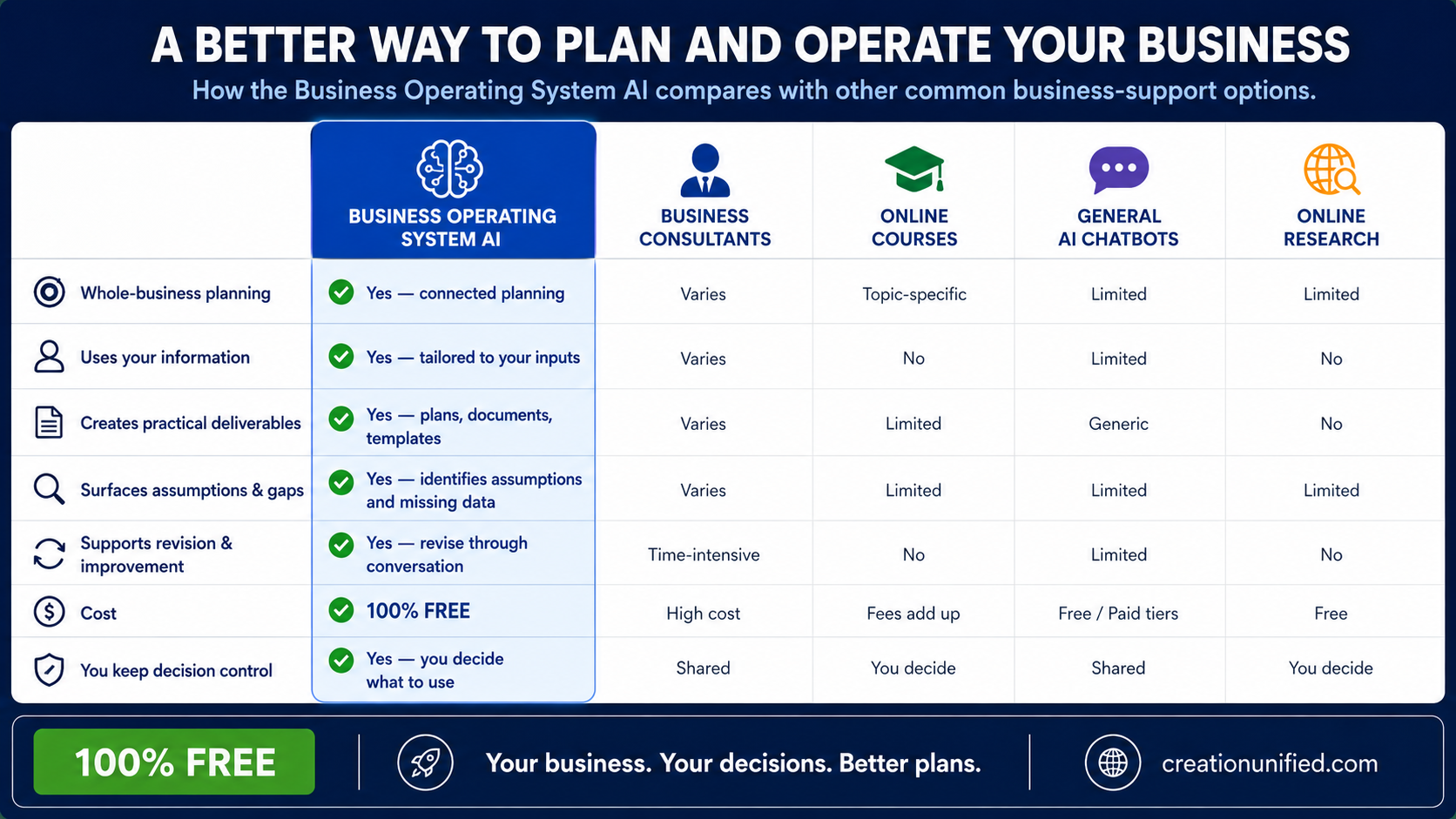
Comparison of Business Operating System AI with business coaches, online training, general AI chatbots and online research.
Comparison illustrates broad differences in approach. Individual providers and services may vary.
100% FREE BUSINESS PLANNING & OPERATING TOOL

Start with the plan or document you need.

Begin with a business plan, marketing plan, sales plan, financial plan, operating process, hiring plan, technology plan or strategic action plan. The AI will ask for the information needed to develop a practical first draft.

Common Questions

What should you expect from the tool?

Yes. Access to the Business Operating System AI itself is free. It is designed to make structured business guidance accessible to owners, entrepreneurs, managers and teams.
It asks for relevant business information when that information could materially change the output. Pricing, costs, staffing, capacity, customer behavior and other inputs can be used to tailor the plan or analysis.
No. It is a planning and decision-support tool. It can identify assumptions, tradeoffs, gaps and possible alternatives, but you remain responsible for deciding what to use and what action to take.
It is primarily designed for small businesses, but it can also support entrepreneurs, startups, nonprofits, managers, teams, departments and business units within larger organizations.
It can help draft or improve business plans, executive summaries, marketing and sales plans, financial plans and budgets, operating procedures, process maps, strategic plans, 30-, 60- or 90-day action plans, organizational structures, job descriptions, hiring plans, technology and AI plans, performance measures, risk reviews, continuity plans, growth plans, succession or exit-planning documents, and other practical business materials.
No. The Top 50 collection is an example of the types of documents, tools and visual assets an organization may find useful. What a business actually needs depends on its industry, size, stage, location, workforce, customers, risks and operating requirements. The examples can be adapted and customized for a specific organization.
No. The Business Operating System AI is a planning and decision-support tool. Legal, tax, accounting, employment, insurance, investment, cybersecurity, safety and other specialized matters may require review by an appropriately qualified professional familiar with your circumstances and jurisdiction.
Important: The Business Operating System AI is a planning and decision-support tool and does not provide or replace legal, tax, accounting, employment, investment, insurance, cybersecurity, safety or other qualified professional advice. Examples, templates and AI-generated materials may not be appropriate for every business, industry or jurisdiction. Users are responsible for reviewing outputs, protecting confidential information, obtaining appropriate professional advice, securing required internal approvals, and determining whether any output is suitable for their circumstances.