Neutrino Boundary-Closure Hypothesis

A Falsifiable Informational-Physics Model of Absolute Neutrino Mass, Majorana Identity, and Cosmic Matter Dominance


Abstract

Three major questions remain unresolved in neutrino physics: the absolute masses of the three neutrino mass eigenstates, whether neutrinos are their own antiparticles, and whether neutrino-sector asymmetry contributed to the cosmic dominance of matter over antimatter. Oscillation experiments establish differences between squared neutrino masses but do not determine the absolute mass baseline. They also cannot, by themselves, determine whether neutrinos are Dirac or Majorana particles. Direct beta-decay experiments currently provide upper limits rather than an exact mass measurement.

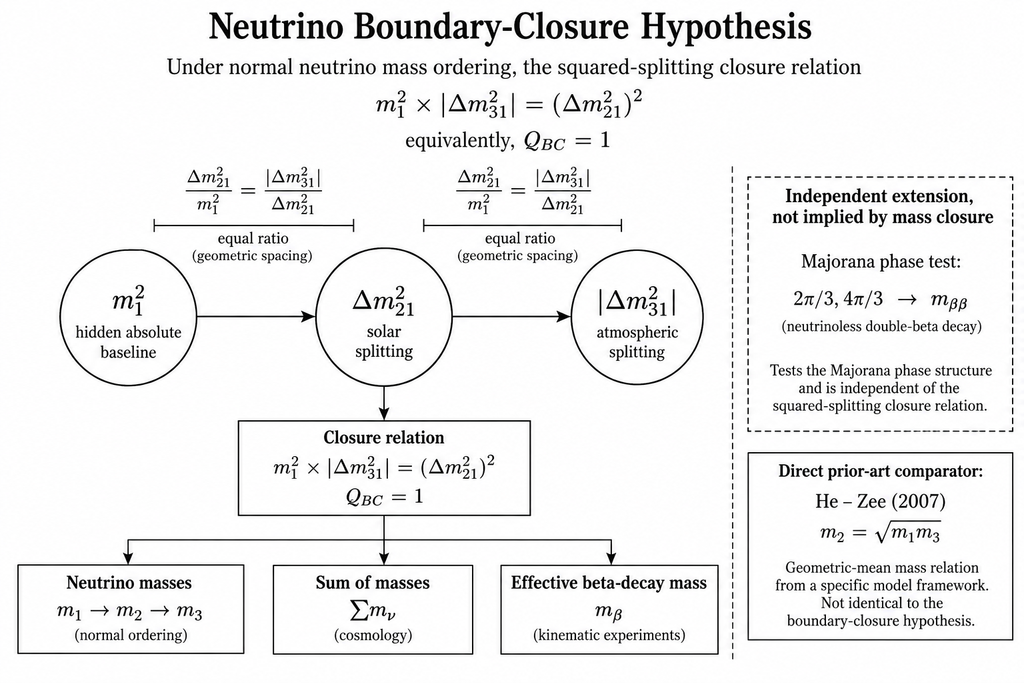
This paper proposes the Neutrino Boundary-Closure Hypothesis, an ontology-grounded but conventionally unestablished model in which neutrino mass eigenstates are stable informational identity modes, flavor states are interaction-dependent process projections, and Majorana self-conjugacy represents closure of the particle–antiparticle identity boundary. The hypothesis introduces a falsifiable geometric closure relation across the three relevant squared-mass scales:m12Δm312=(Δm212)2.m_1^2\,|\Delta m_{31}^{2}|=(\Delta m_{21}^{2})^2.

Under normal mass ordering, this relation fixes the lightest mass rather than leaving it as a free parameter. Using current oscillation central values, the model predicts:m1=1.494±0.038 meV,m_1=1.494\pm0.038\ \text{meV}, m2=8.782±0.115 meV,m_2=8.782\pm0.115\ \text{meV},m3=50.152±0.200 meV,m_3=50.152\pm0.200\ \text{meV},

andmν=60.429±0.246 meV.\sum m_\nu=60.429\pm0.246\ \text{meV}.

The hypothesis further predicts that neutrino mass eigenfields are Majorana fields and that the effective relative phases entering neutrino-less double-beta decay form a triadic phase closure of 2π/32\pi/3 and 4π/34\pi/3. This produces the additional predictions:mβ=8.970±0.103 meV,m_\beta=8.970\pm0.103\ \text{meV},mββ=1.587±0.111 meV.m_{\beta\beta}=1.587\pm0.111\ \text{meV}.

Finally, the model proposes that the same phase orientation responsible for neutrino self-conjugate mass formation was transmitted through heavy self-conjugate neutrino states in the early universe, generating a lepton asymmetry subsequently converted into baryon asymmetry. It predicts a sign correlation:sgn(ηB)=sgn(JCP),\operatorname{sgn}(\eta_B)=-\operatorname{sgn}(J_{CP}),

so the observed matter excess requires JCP<0J_{CP}<0 and a nonzero neutrino CP phase in the interval π<δCP<2π\pi<\delta_{CP}<2\pi, under the phase convention specified in this paper.

The hypothesis is falsified if normal ordering is excluded, if the geometric mass relation fails, if neutrinos are demonstrated to be Dirac particles, if the predicted effective Majorana phase structure is excluded, or if the proposed low-energy and early-universe CP orientations cannot be connected in a viable ultraviolet completion.


Evidence Classification

The Unified Informational Physics Ontology treats reality as an informational architecture composed of fields, operators, boundaries, gradients, identity conditions, and recursive transformations. It defines the Coherence Expansion Principle, Informational Boundary Conditions, an Informational Identity Metric, an Informational Divergence Threshold, and triadic phase coupling.

The ontology also distinguishes pressure that can be converted into orderly reorganization from pressure that exceeds the identity-preserving range of a system and produces transition or breakdown.

The classifications used in this paper are:

ComponentClassification
Measured mass-squared splittings and mixing anglesEmpirical
Current direct mass limits and experimental programsEmpirical
Information, identity, boundary, pressure, and triadic closure conceptsOntology-grounded
Interpretation of mass eigenstates as informational identity modesOntology-inferred
Geometric mass-closure equationNovel falsifiable hypothesis
Majorana phase-lock predictionNovel falsifiable hypothesis
CP-sign connection to baryogenesisSpeculative but falsifiable extension

“Ontology-grounded” does not mean conventionally established. Strong extensions require independent experimental validation.


Hypothesis Statement

The Neutrino Boundary-Closure Hypothesis

System under analysis:
The three-active-neutrino system, its weak-interaction flavor projections, its possible Majorana mass structure, and its early-universe connection to lepton and baryon asymmetry.

Structural model:
Three neutrino mass eigenstates function as persistent informational identity modes. Flavor states are interaction-dependent projections of those modes. The absolute mass baseline is fixed by geometric recurrence across the three squared-mass scales. Self-conjugate identity closure produces Majorana neutrinos, while oriented phase divergence produces a matter-generating lepton asymmetry.

Variables measured:m1,m2,m3,Δm212,Δm312,θ12,θ13,θ23,δCP,JCP,mβ,mββ,mν,ηB.m_1,m_2,m_3,\Delta m_{21}^2,\Delta m_{31}^2, \theta_{12},\theta_{13},\theta_{23}, \delta_{CP},J_{CP},m_\beta,m_{\beta\beta}, \sum m_\nu,\eta_B.


1. Hypothesis Definition

Scientific Claim

The neutrino sector is not composed of three independently arbitrary masses. It is a recursively closed three-state system in which the lowest mass curvature, the solar mass-squared separation, and the atmospheric mass-squared separation occupy equal logarithmic intervals:Δm212m12=Δm312Δm212.\frac{\Delta m_{21}^{2}}{m_1^2} = \frac{|\Delta m_{31}^{2}|}{\Delta m_{21}^{2}}.

Therefore:m12=(Δm212)2Δm312.m_1^2= \frac{(\Delta m_{21}^{2})^2} {|\Delta m_{31}^{2}|}.

This relation fixes the absolute mass baseline from the two measured mass-squared differences.

The hypothesis contains four connected claims:

  1. Normal ordering is the physically realized ordering.
  2. The lightest mass is fixed by the geometric closure equation rather than being freely selected.
  3. Neutrino mass eigenfields are self-conjugate Majorana fields.
  4. The phase orientation associated with Majorana boundary closure also determines the sign of the primordial lepton asymmetry.

In THD terms, the system moves through:

  • differentiation of mass identity,
  • phase contrast between particle and antiparticle channels,
  • integration into a stable three-mass spectrum and a net surviving matter state.

If precise measurements contradict the mass relation, establish Dirac neutrinos, exclude the prescribed phase structure, or invalidate the CP-sign connection, the hypothesis is false.


2. THD Framework → Theoretical Model

Triune Harmonic Dynamics describes transformation through Emergence, Contrast, and Integration. The ontology does not treat a binary opposition as sufficient for stable organization; a third function is needed to regulate, preserve, or integrate the relation.

THD phaseNeutrino-system interpretation
Base Phase — EmergenceA self-conjugate informational field contains the potential for neutrino identity but has not yet differentiated into three stable mass modes.
Pressure Phase — ContrastSymmetry breaking generates mass gradients, flavor–mass misalignment, helicity separation, and CP-oriented differences between lepton and antilepton transition pathways.
Integration Phase — ResolutionThree stable mass eigenstates form, flavor mixing becomes the observable process projection, and a residual lepton asymmetry survives long enough to be converted into baryon asymmetry.

The proposed triadic functions are therefore:

Ontology layerNeutrino expression
IdentityMass eigenstates ν1,ν2,ν3\nu_1,\nu_2,\nu_3ν1​,ν2​,ν3​
ProcessFlavor interactions νe,νμ,ντ\nu_e,\nu_\mu,\nu_\tauνe​,νμ​,ντ​ and oscillation
Harmonic integrationMixing matrix, CP phases, and recursive mass closure

The mass basis preserves identity during propagation. The flavor basis identifies how that persistent state interacts at a particular boundary. Neutrino oscillation is therefore interpreted not as identity destruction but as changing projection of a persistent multi-mode state.


3. System Definition

System Boundaries

The principal low-energy system contains:

  • three active neutrino flavor states;
  • three mass eigenstates;
  • the unitary mixing transformation between them;
  • charged-current and neutral-current weak interactions;
  • possible lepton-number-violating Majorana processes.

The early-universe extension additionally contains one or more heavy self-conjugate neutrino states NiN_iNi​, the Higgs field, charged leptons, and the electroweak processes capable of converting lepton asymmetry into baryon asymmetry.

Variables

VariableMeaning
m1,m2,m3m_1,m_2,m_3Neutrino mass eigenvalues
Δm212\Delta m_{21}^2Solar squared-mass difference
Δm312\Delta m_{31}^2Atmospheric squared-mass difference
UαiU_{\alpha i}Flavor-to-mass mixing matrix
δCP\delta_{CP}Dirac CP-violating phase
α~21,α~31\tilde\alpha_{21},\tilde\alpha_{31}Effective relative Majorana phases entering 0νββ0\nu\beta\beta
JCPJ_{CP}Rephasing-invariant measure of CP violation
mβm_\betaEffective mass measured through beta-decay kinematics
mββm_{\beta\beta}Effective Majorana mass in neutrinoless double-beta decay
ηB\eta_BNet baryon asymmetry
QνQ_\nuGeometric mass-closure ratio

Interactions

  • weak production and detection;
  • coherent neutrino propagation;
  • flavor oscillation;
  • possible Majorana mass insertion;
  • possible lepton-number-violating nuclear decay;
  • CP-asymmetric decay of heavy self-conjugate states;
  • electroweak conversion of lepton asymmetry into baryon asymmetry.

Observables

  • oscillation probabilities;
  • mass-squared differences;
  • mixing angles;
  • neutrino–antineutrino appearance differences;
  • beta-decay endpoint distortion;
  • cosmological neutrino mass sum;
  • neutrinoless double-beta decay rate;
  • baryon-to-antibaryon excess.

Measurement Methods

  • long-baseline and reactor oscillation experiments;
  • tritium beta-decay endpoint spectroscopy;
  • cosmological structure and background-radiation analysis;
  • neutrinoless double-beta decay searches;
  • accelerator measurements of CP-sensitive oscillation probabilities.

Oscillation measurements determine mass-squared differences and mixing but do not determine the absolute mass baseline or independently distinguish Dirac from Majorana neutrinos. Direct beta-decay experiments measure the incoherent electron-flavor-weighted mass mβm_\betamβ​, while neutrinoless double-beta decay would test lepton-number violation and the coherent Majorana quantity mββm_{\beta\beta}mββ​.


4. Prior Evidence → Historical Structural Transitions

Example 1: Solar-Neutrino Anomaly

The observed shortage and flavor transformation of solar neutrinos forced revision of the assumption that neutrinos were massless, independent flavor particles. The system transitioned from a fixed-flavor model to a mixing and oscillation model.

Example 2: Atmospheric-Neutrino Anomaly

Atmospheric observations established a second, much larger squared-mass separation. This produced a three-state hierarchy containing two distinct mass-gradient scales rather than one arbitrary neutrino mass.

Example 3: CP Violation and Matter Asymmetry

CP violation established that particle and antiparticle processes need not be exact mirrors. However, known Standard Model CP violation is insufficient to account for the observed cosmic matter excess, leaving a major explanatory gap.

Current Transition Pressure

Current global fits determine the mass-squared differences with substantial precision, but the ordering is not yet regarded as absolutely settled. NuFIT 6.0 reports normal ordering as the best fit under analyses incorporating certain atmospheric datasets. Its representative normal-ordering values include:Δm212=7.49×10⁵ eV2,\Delta m_{21}^2=7.49\times10^{-5}\ \mathrm{eV}^2,Δm312=2.513×10³ eV2,\Delta m_{31}^2=2.513\times10^{-3}\ \mathrm{eV}^2,sin2θ12=0.308,sin2θ13=0.02215.\sin^2\theta_{12}=0.308, \qquad \sin^2\theta_{13}=0.02215.

The CP-phase best fit lies near 212212^\circ, although the allowed range remains broad enough that this is not a confirmation of the present hypothesis.

KATRIN’s 2025 result placed a direct upper limit of approximately 0.45 eV0.45\ \mathrm{eV} at 90% confidence, still far above the mass scale predicted here.

LEGEND and related experiments are testing whether neutrinoless double-beta decay occurs, which would indicate lepton-number violation and support the Majorana interpretation. DUNE is designed in part to compare neutrino and antineutrino behavior and test whether neutrino CP violation could be connected to cosmic matter dominance.


5. Structural Pressure Measurement

Structural pressure is defined here at two levels.

A. Physical Pressure

Physical pressure is the mismatch that must be resolved when a self-conjugate informational field develops distinguishable mass, flavor, helicity, and CP-oriented pathways while preserving an integrated identity.

Operational proxies include:

  • magnitude and hierarchy of mass-squared gradients;
  • flavor–mass misalignment;
  • neutrino–antineutrino probability differences;
  • lepton-number-violating amplitudes;
  • CP-phase displacement from 000 or π\piπ.

B. Explanatory Pressure

Explanatory pressure is the cumulative unresolved burden placed on the current scientific model by variables it measures indirectly but does not derive.

IndicatorNeutrino-sector definition
Anomaly frequencyNumber of statistically significant results inconsistent with a zero-mass, exact-symmetry, or single-scale model
ClusteringIndependent mass, CP, cosmological, and decay observations converging on a common parameter region
VolatilityChanges in inferred ordering, phase, or mass bounds as datasets and models change
Model divergenceDifference between measured behavior and predictions from an incomplete neutrino model
Instability metricsParameter degeneracies, ordering ambiguity, unresolved phase combinations, and dataset tension

The pressure measure does not prove this hypothesis. It identifies when an explanatory structure has accumulated enough unresolved constraints that a new variable, relationship, or model revision becomes increasingly necessary.


6. Structural Pressure Sources → Independent Variables

Define normalized variables:xm,xM,xCP,xB,xX[0,1].x_m,x_M,x_{CP},x_B,x_X\in[0,1].

Where:xm:unresolved absolute-mass pressure,x_m: \text{unresolved absolute-mass pressure},xM:unresolved Dirac-versus-Majorana identity pressure,x_M: \text{unresolved Dirac-versus-Majorana identity pressure},xCP:uncertainty in neutrino CP orientation,x_{CP}: \text{uncertainty in neutrino CP orientation},xB:unresolved baryogenesis pressure,x_B: \text{unresolved baryogenesis pressure},xX:cross-observable inconsistency.x_X: \text{cross-observable inconsistency}.

More explicitly:

VariableMeasurement concept
xmx_mWidth of the experimentally permitted absolute-mass interval relative to a preregistered target interval
xMx_MRemaining uncertainty over lepton-number conservation and Majorana identity
xCPx_{CP}Normalized uncertainty in δCP\delta_{CP}​ and JCPJ_{CP}
xBx_BResidual inability of the tested theory to produce the observed sign and magnitude of baryon asymmetry
xXx_XDisagreement among oscillation, kinematic, cosmological, and decay-derived quantities

7. Structural Pressure Index → Structural Equation

A provisional neutrino explanatory-pressure index is:Pν=0.25xm+0.20xM+0.20xCP+0.25xB+0.10xX.P_\nu= 0.25x_m+ 0.20x_M+ 0.20x_{CP}+ 0.25x_B+ 0.10x_X.

Where:

  • PνP_\nuPν​ is total structural pressure;
  • xix_ixi​ are normalized unresolved variables;
  • wiw_iwi​ are weighting coefficients;
  • wi=1\sum w_i=1∑wi​=1.

A provisional transition threshold is:Pc=0.75.P_c=0.75.

Thus:Pν>Pcdiscovery, revision, or structural reorganization required.P_\nu>P_c \Rightarrow \text{discovery, revision, or structural reorganization required}.

The value Pc=0.75P_c=0.75 is an operational research threshold, not a claimed universal constant. It must be preregistered and retrospectively calibrated against prior scientific model transitions.

Core Physical Closure Equation

The principal falsifiable equation is:Qνm12Δm312(Δm212)2=1.Q_\nu\equiv \frac{m_1^2|\Delta m_{31}^2|} {(\Delta m_{21}^2)^2}=1.

Therefore:m1=Δm212Δm312.m_1= \frac{\Delta m_{21}^{2}} {\sqrt{|\Delta m_{31}^{2}|}}.

The remaining masses are:m2=m12+Δm212,m_2=\sqrt{m_1^2+\Delta m_{21}^2},m3=m12+Δm312.m_3=\sqrt{m_1^2+\Delta m_{31}^2}.

The three quantitiesm12,Δm212,Δm312m_1^2,\quad\Delta m_{21}^2,\quad|\Delta m_{31}^2|

therefore form a geometric progression in squared-mass space. The solar separation is the geometric mean between the absolute identity baseline and the atmospheric integration scale.

This equation is a new ansatz derived from the ontology’s geometric recurrence and triadic closure logic. It is not contained as an established neutrino equation in the ontology or in conventional particle physics.

Self-Conjugate Identity Condition

Define a charge-conjugation identity overlap:IC(νi)=νiCνiνiCνi.I_C(\nu_i)= \frac{ |\langle\nu_i|C\nu_i\rangle| }{ \|\nu_i\|\,\|C\nu_i\| }.

The hypothesis predicts:IC(νi)=1I_C(\nu_i)=1

for each mass eigenfield. At the field level:νi=νic.\nu_i=\nu_i^c.

This does not mean that experimentally produced neutrinos and antineutrinos behave identically in weak interactions. Their experimentally distinct behavior can remain encoded through helicity, chirality, and interaction boundary conditions while the underlying massive field is self-conjugate.

Triadic Majorana Phase Closure

The effective relative phases entering the neutrinoless double-beta decay amplitude are predicted to be:α~21=2π3,α~31=4π3,\tilde\alpha_{21}=\frac{2\pi}{3}, \qquad \tilde\alpha_{31}=\frac{4\pi}{3},

up to complex conjugation and physically equivalent permutations.

The low-energy effective Majorana mass matrix may therefore be written phenomenologically as:Mν=Udiag(m1,m2ei2π/3,m3ei4π/3)U.M_\nu= U^* \operatorname{diag} \left( m_1,\, m_2e^{i2\pi/3},\, m_3e^{i4\pi/3} \right) U^\dagger.


8. Model Incompleteness — Verification Gap

What Current Models Do Not Yet Explain

Current neutrino physics does not yet provide an experimentally verified answer to:

  • the absolute value of the lightest neutrino mass;
  • the origin of the mass hierarchy;
  • whether the hierarchy is normal or inverted with final certainty;
  • whether neutrinos are Dirac or Majorana fields;
  • the values of the Majorana phases;
  • whether neutrino CP violation generated the primordial matter excess;
  • why the universe retained matter rather than equal surviving matter and antimatter.

Where Divergence Appears

Divergence appears because:

  1. oscillations reveal differences but not the absolute baseline;
  2. weak interactions reveal flavor but not the persistent mass identity directly;
  3. beta-decay measures an incoherent effective mass rather than each eigenvalue;
  4. neutrinoless double-beta decay depends on coherent phase addition;
  5. cosmology measures a model-dependent total mass effect;
  6. baryogenesis requires physics beyond the currently sufficient Standard Model CP source.

Variables Potentially Missing

The present hypothesis proposes that the missing variables are:

  • a geometric closure condition fixing the absolute mass baseline;
  • self-conjugate identity at the mass-eigenstate level;
  • a discrete triadic Majorana phase relationship;
  • a heavy self-conjugate neutrino sector;
  • a common CP orientation connecting low-energy neutrino behavior to early-universe lepton asymmetry.

9. Signal Divergence → Residual Error Model

For each measured observable:Dj=OjMj,D_j=|O_j-M_j|,

where:

  • ​ is the observed value;
  • MjM_j is the hypothesis prediction.

A normalized joint residual is:Dν(N)=j(OjMjσj)2.D_\nu^{(N)} = \sqrt{ \sum_j \left( \frac{O_j-M_j}{\sigma_j} \right)^2 }.

The prediction vector is:Mν=(m1,m2,m3,mν,mβ,mββ,sgnJCP,ordering,Majorana status).\mathbf{M}_\nu= \left( m_1,m_2,m_3, \sum m_\nu, m_\beta, m_{\beta\beta}, \operatorname{sgn}J_{CP}, \text{ordering}, \text{Majorana status} \right).

A statistically significant joint divergence cannot be dismissed by adjusting one observable independently because the hypothesis is defined by correlated predictions. It succeeds or fails as a constrained structure.


10. Pre-Transition Indicators

Observable signals expected before full verification include:

  1. Increasing preference for normal ordering.
  2. Cosmological mass determinations converging near 0.0604 eV
  3. Direct kinematic measurements moving toward mβ≈0.0090 eV.
  4. A nonzero CP phase in the lower half of the phase circle: π<δCP<2π.\pi<\delta_{CP}<2\pi.
  5. A negative Jarlskog invariant in the convention used here.
  6. No convincing neutrino-less double-beta signal at effective-mass sensitivities substantially above 1.6 meV.
  7. Eventual cross-isotope evidence for lepton-number violation once sensitivity reaches the predicted effective-mass region.
  8. Increasing consistency among oscillation, beta-decay, cosmological, and nuclear-decay measurements.

The current NuFIT best-fit CP phase lies in the predicted half-plane, but its uncertainty remains too broad for confirmation.


11. Structural Failure Location Hypothesis

Weakest Constraint

The weakest constraint is the boundary between flavor identity and mass identity. Flavor is what the weak interaction detects; mass is what propagates. Treating these as interchangeable obscures the absolute identity baseline.

Highest Stress Concentration

The highest explanatory stress occurs at the unmeasured lightest mass m1m_1​. Once m1m_1​ is fixed, the remaining masses, mass sum, beta-decay mass, and Majorana decay amplitude become much more constrained.

Bottlenecks

The principal experimental bottlenecks are:

  • endpoint energy resolution;
  • source and detector background;
  • nuclear matrix-element uncertainty;
  • cosmological model dependence;
  • CP-phase degeneracies;
  • mass-ordering degeneracies;
  • insufficient sensitivity to the predicted mββm_{\beta\beta}​ scale.

Resonance Points

The highest-value verification points are simultaneous agreement among:

  • oscillation-derived mass splittings;
  • direct beta-decay mass;
  • cosmological mass sum;
  • normal ordering;
  • CP-phase sign;
  • neutrinoless double-beta decay;
  • a viable heavy-neutrino leptogenesis completion.

No individual result is sufficient. The model predicts a correlated convergence.


12. Predicted Structural Outcomes

Using the current representative normal-ordering inputs, the hypothesis predicts:

ObservablePrediction
Mass orderingNormal
m1m_11.494±0.038 meV1.494\pm0.038\ \mathrm{meV}
m2m_28.782±0.115 meV8.782\pm0.115\ \mathrm{meV}
m3m_350.152±0.200 meV50.152\pm0.200\ \mathrm{meV}
mν\sum m_\nu60.429±0.246 meV60.429\pm0.246\ \mathrm{meV}
mβm_\beta8.970±0.103 meV8.970\pm0.103\ \mathrm{meV}
mββm_{\beta\beta}1.587±0.111 meV1.587\pm0.111\ \mathrm{meV}
Neutrino identityMajorana
Effective Majorana phases2π/3, 4π/32\pi/3,\ 4\pi/3
CP requirementNonzero
CP half-planeπ<δCP<2π\pi<\delta_{CP}<2\pi
Jarlskog signJCP<0J_{CP}<0
Baryon-asymmetry relationsgnηB=sgnJCP\operatorname{sgn}\eta_B=-\operatorname{sgn}J_{CP}

The uncertainties shown are propagated from current quoted oscillation-parameter uncertainties. They do not represent uncertainty in the proposed closure law itself and do not include unknown model-systematic error.

Effective Beta-Decay Mass

mβ=iUei2mi2.m_\beta= \sqrt{ \sum_i|U_{ei}|^2m_i^2 }.

Using current representative mixing values:mβ8.970 meV.m_\beta\approx8.970\ \mathrm{meV}..

Effective Majorana Mass

mββ=c122c132m1+s122c132m2ei2π/3+s132m3ei4π/3.m_{\beta\beta} = \left| c_{12}^2c_{13}^2m_1 + s_{12}^2c_{13}^2m_2e^{i2\pi/3} + s_{13}^2m_3e^{i4\pi/3} \right|..

This gives:mββ1.587 meV.m_{\beta\beta}\approx1.587\ \mathrm{meV}.

The small value results from structured phase cancellation, not from the absence of Majorana identity.


13. Transition Likelihood Model

The general THD transition relation is:P(TransitionPν)asPν.P(\text{Transition}\mid P_\nu) \uparrow \quad\text{as}\quad P_\nu\uparrow..

A provisional logistic representation is:P(TransitionPν)=11+exp[k(PνPc)],P(\text{Transition}\mid P_\nu) = \frac{1} {1+\exp[-k(P_\nu-P_c)]},

where:

  • kk controls transition steepness;
  • PcP_c​ is the preregistered pressure threshold;
  • “transition” means discovery, exclusion, or material model revision.

This probability model concerns the research system’s movement toward resolution. It does not claim that institutions must accept this particular hypothesis. High pressure may instead cause the hypothesis to be rejected in favor of a better model.


14. Observable Confirmation Signals

The hypothesis gains support only through correlated confirmation.

Mass-Sector Confirmation

Qν=m12Δm312(Δm212)21.Q_\nu= \frac{m_1^2|\Delta m_{31}^2|} {(\Delta m_{21}^2)^2} \approx1.

A direct or combined measurement should yield:m11.49 meV,m_1\approx1.49\ \mathrm{meV},mν60.43 meV,\sum m_\nu\approx60.43\ \mathrm{meV},mβ8.97 meV.m_\beta\approx8.97\ \mathrm{meV}.

Identity Confirmation

At least two independent isotopes should eventually show a lepton-number-violating decay signature compatible with a common effective mass near:mββ1.59 meV,m_{\beta\beta}\approx1.59\ \mathrm{meV},

after nuclear matrix-element and detector uncertainties are incorporated.

LEGEND-1000’s stated target sensitivity is approximately 9919 meV19\ \mathrm{meV}, still above the central prediction made here. A null result at that sensitivity would therefore not falsify the hypothesis.

CP Confirmation

The long-baseline oscillation program should establish:JCP<0,J_{CP}<0,

with:π<δCP<2π,\pi<\delta_{CP}<2\pi,

and exclude CP-conserving values 00 and π\pi.

Baryogenesis Connection

Introduce a heavy self-conjugate state NNN with decay asymmetry:ϵN=Γ(NH)Γ(NˉH)Γtotal.\epsilon_N= \frac{ \Gamma(N\rightarrow\ell H) – \Gamma(N\rightarrow\bar{\ell}H^\dagger) }{ \Gamma_{\mathrm{total}} }.

The hypothesis predicts:sgn(ϵN)=sgn(JCP).\operatorname{sgn}(\epsilon_N) = -\operatorname{sgn}(J_{CP}).

A minimal phenomenological source relation is:Aν=JCP(Δm212Δm312),A_\nu= -J_{CP} \left( \frac{\Delta m_{21}^{2}} {|\Delta m_{31}^{2}|} \right),

followed by:ηB=κAν,\eta_B=\kappa A_\nu,

where κ>0\kappa>0 represents heavy-state abundance, electroweak conversion efficiency, and washout.

The sign is predicted. The magnitude is not yet fully predicted because κ\kappa, the heavy-neutrino spectrum, and the relevant couplings have not been derived.


15. Falsification Criteria

The unified hypothesis is false if one or more core predictions are decisively contradicted.

Primary Falsifiers

  1. Inverted ordering is conclusively established.
  2. The lightest mass is measured and fails the closure relation: Qν1Q_\nu\neq1by a preregistered significance threshold, such as more than 5σ5\sigma, after experimental and theoretical errors are included.
  3. A model-robust mass sum is established outside the predicted region: mν60.43 meV.\sum m_\nu\not\approx60.43\ \mathrm{meV}.
  4. A direct kinematic measurement establishes: mβ8.97 meV.m_\beta\not\approx8.97\ \mathrm{meV}.
  5. Neutrinos are demonstrated to be Dirac particles or exact lepton-number conservation is established.
  6. Neutrinoless double-beta decay is measured with an inferred effective mass incompatible with: mββ1.59 meV,m_{\beta\beta}\approx1.59\ \mathrm{meV}, after nuclear and experimental uncertainty is properly included.
  7. The effective Majorana phase closure 2π/3,4π/3 is excluded through combined observables.
  8. CP conservation is conclusively established in the neutrino sector.
  9. The measured CP orientation gives JCP≥0 while the hypothesis retains its proposed common low-energy and early-universe phase orientation.
  10. No viable ultraviolet completion can produce the observed baryon asymmetry while preserving the low-energy mass, phase, and CP predictions.

Important Non-Falsifiers

The following would not by themselves falsify the hypothesis:

  • failure of KATRIN to detect a mass near its current sensitivity;
  • absence of neutrino-less double-beta decay at mββm_{\beta\beta}​ sensitivities well above ;
  • temporary disagreement among cosmological analyses that depend strongly on different background models;
  • a current CP interval that still includes both conserving and violating values.

Pressure-Index Falsifier

The structural-pressure model is separately false if repeated historical and prospective tests show that:Pν>PcP_\nu>P_c

has no greater ability than chance or simpler models to identify periods of discovery, exclusion, or major theory revision.


16. Final Hypothesis Test Statement

The neutrino system contains measurable structural gradients expressed through mass splitting, flavor–mass divergence, self-conjugate identity uncertainty, CP orientation, and cosmic matter asymmetry.

When these variables are modeled as a closed triadic system, the absolute mass baseline must satisfy:m12Δm312=(Δm212)2.m_1^2|\Delta m_{31}^2| = (\Delta m_{21}^2)^2.

The system must consequently produce normal ordering, the specified three-mass spectrum, Majorana identity, triadic effective Majorana phases, and a negative low-energy CP invariant correlated with positive cosmic matter excess.

Therefore:Pν>Pcdiscovery, transition, or model revision.P_\nu>P_c \Rightarrow \text{discovery, transition, or model revision}.

And:Pν>Pcwith sustained contradictory evidence and no predicted transitionHypothesis False.P_\nu>P_c \quad\text{with sustained contradictory evidence and no predicted transition} \Rightarrow \text{Hypothesis False}.

More directly:Qν1or Dirac identity establishedor the CP correlation excludedNeutrino Boundary-Closure Hypothesis False.Q_\nu\neq1 \quad\text{or Dirac identity established} \quad\text{or the CP correlation excluded} \Rightarrow \text{Neutrino Boundary-Closure Hypothesis False}.


17. Real-World Implications

A. Domain-Level Impact

Validation would replace the assumption that the lightest neutrino mass is an unconstrained free parameter with a geometric relation derived from the two measurable mass-squared separations.

It would also connect three currently separate questions:

  • absolute mass;
  • Majorana identity;
  • matter–antimatter asymmetry.

The neutrino would no longer be treated as merely a weakly interacting particle with unexplained parameters. It would become an example of a closed informational identity system in which mass, phase, and asymmetry arise from the same boundary conditions.

B. Predictive Capability

The model allows the following predictions before direct measurement:

  • normal ordering;
  • each of the three absolute masses;
  • the total mass;
  • beta-decay effective mass;
  • neutrinoless double-beta decay effective mass;
  • Majorana identity;
  • effective Majorana phase relations;
  • CP-phase half-plane;
  • sign of the low-energy CP invariant;
  • sign relationship between neutrino CP orientation and baryon asymmetry.

This replaces unconstrained parameter selection with cross-observable prediction.

C. Measurement and Instrumentation

A validation program would require:

  • sub-10-meV beta-decay sensitivity;
  • model-robust cosmological mass-sum analysis;
  • normal-ordering determination;
  • high-precision long-baseline CP measurement;
  • multi-isotope neutrinoless double-beta searches approaching the 1-meV range;
  • improved nuclear matrix-element calculations;
  • searches for heavy self-conjugate neutrinos or other ultraviolet leptogenesis signatures.

A combined Neutrino Closure Test should be developed around the residual vector:Dν=OνMν.\mathbf{D}_\nu= \mathbf{O}_\nu-\mathbf{M}_\nu.

D. Engineering and Application Layer

The hypothesis would influence detector design by shifting attention from independent one-variable searches toward coordinated precision targets.

For example:

  • beta-decay instrumentation would require approximately 9 meV9\ \mathrm{meV}9 meV sensitivity;
  • neutrino-less double-beta decay programs would require sensitivity beyond the planned 1010-meV class;
  • cosmological surveys would need systematic control sufficient to discriminate a mass sum near 60 meV60\ \mathrm{meV};
  • accelerator programs would prioritize definitive determination of the CP-phase sign and exclusion of CP conservation.

E. Cross-Domain Transferability

The same structural procedure may be tested in other systems that contain:

  1. a hidden identity baseline;
  2. an observable intermediate gradient;
  3. a larger integration scale.

The relevant recurrence is:X22=X1X3.X_2^2=X_1X_3.

However, finding a geometric progression elsewhere would not independently prove the neutrino hypothesis. Cross-domain recurrence may motivate tests, but each domain requires its own measurements and falsification criteria.

F. Decision-Making and Policy Impact

Research institutions could use the hypothesis to prioritize complementary rather than isolated experiments.

A direct mass result alone cannot determine Majorana phases. A neutrinoless decay result alone cannot determine all individual masses. A CP result alone cannot establish baryogenesis. The hypothesis requires coordinated investment in:

  • oscillation physics;
  • direct mass measurement;
  • cosmological observation;
  • lepton-number-violation searches;
  • early-universe model development.

G. Discovery Implications

High divergence combined with high explanatory pressure indicates that the missing element is unlikely to be another isolated neutrino parameter. It points instead toward a missing relationship among existing parameters.

Under this model, the candidate discoveries are:

  • geometric mass closure;
  • self-conjugate neutrino identity;
  • discrete Majorana phase locking;
  • a heavy self-conjugate boundary state;
  • common CP orientation across low- and high-energy neutrino sectors.

H. Limitations and Boundary Conditions

This paper has several important limits.

First, the geometric closure equation is phenomenological. It has not yet been derived from a complete gauge-invariant quantum field theory.

Second, the Majorana phase values are ontology-inferred rather than experimentally established.

Third, the model predicts the sign relationship of the baryon asymmetry but does not yet derive its absolute magnitude. A complete theory must specify:

  • heavy-neutrino masses;
  • Yukawa couplings;
  • decay rates;
  • thermal history;
  • washout effects;
  • electroweak conversion efficiency.

Fourth, cosmological mass inference remains dependent on the assumed cosmological model.

Fifth, neutrinoless double-beta interpretation depends on nuclear matrix elements and possible mechanisms beyond light-neutrino exchange.

Sixth, the model assumes three dominant active neutrino states and approximate unitarity of the standard mixing matrix. Discovery of additional light sterile states or substantial non-unitarity would require structural revision.

Seventh, the ontology provides the generating logic for the hypothesis but is not itself independent empirical proof of the neutrino equations.


Final One-Sentence Hypothesis

The three-active-neutrino system accumulates measurable structural pressure through mass splitting, flavor–mass divergence, particle–antiparticle boundary uncertainty, and CP asymmetry; when that pressure is resolved through triadic geometric closure, it must produce normal ordering, a lightest mass satisfying m12​∣Δm312​∣=(Δm212​)2, Majorana self-conjugacy, discrete effective phases of 2π/3 and 4π/3, and a negative neutrino CP invariant correlated with positive cosmic matter excess—otherwise the hypothesis is falsified.