
Earth–Human Boundary Regulation Hypothesis
Abbreviation: EHBRH
System type/domain: Human physiology, bioelectricity, sleep science, autonomic regulation, inflammation
System under analysis: The human body electrically connected to the Earth through direct conductive contact
Structural model: Earth contact reduces electrical potential difference between the body and the ground, which may alter measurable physiological regulation
Experimental status: Proposed confirmatory hypothesis
Evidence classification: Ontology-grounded mechanism with limited preliminary empirical support
Scientific positioning
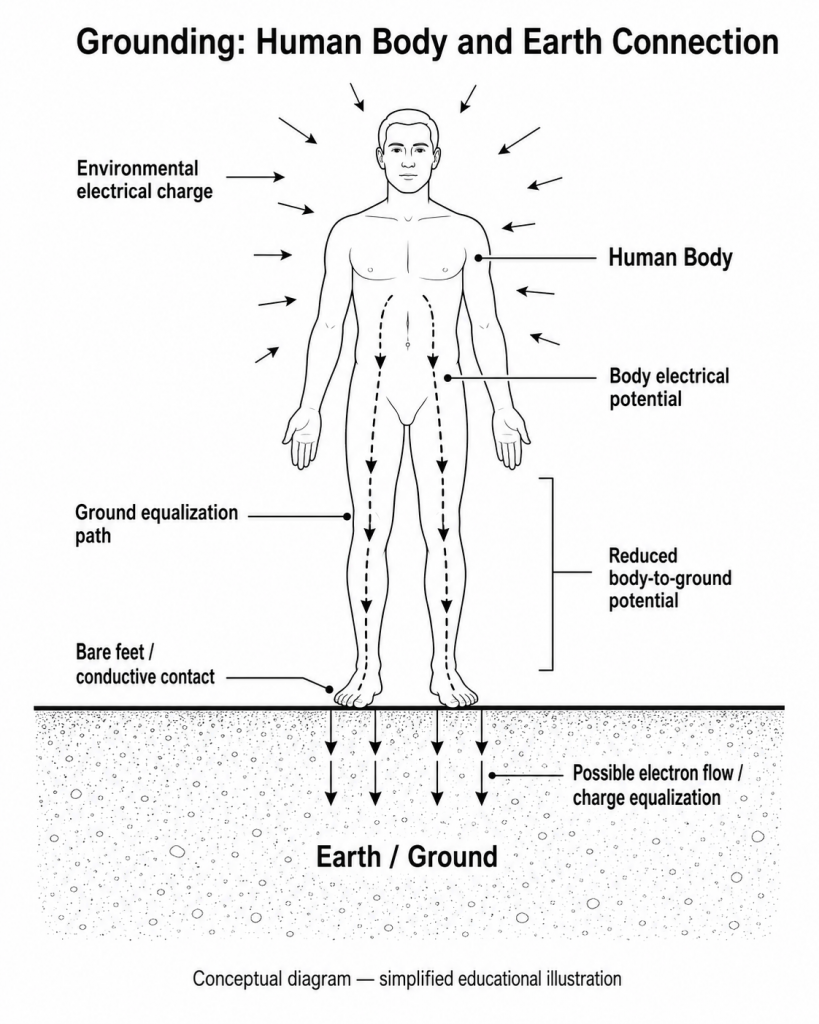
“Grounding” or “earthing” means placing bare skin in conductive contact with the ground or connecting the body to a properly verified Earth-ground reference.
The physical claim that grounding changes the body’s electrical potential is straightforward and measurable. A published experiment reported that grounding greatly reduced alternating voltage induced on the body by nearby electrical sources.
The broader health claims are much less certain. Small studies have reported changes in sleep, cortisol, pain, blood-cell aggregation, and recovery after exercise, but the research base remains limited, often uses small samples, and does not yet establish broad clinical benefit. Examples include a sleep study, a 32-person exercise-recovery experiment, and a 10-person blood-viscosity study.
The hypothesis below is designed to distinguish a real physiological effect from expectation, relaxation, outdoor exposure, temperature, movement, and placebo effects.
Hypothesis statement
Earth–Human Boundary Regulation Hypothesis
The human body functions as an electrically conductive biological system whose voltage relative to the Earth varies with environmental electric fields, insulating materials, bodily movement, and local electrical conditions.
Direct conductive contact with the Earth reduces the body-to-Earth potential difference and associated induced electrical noise. If this electrical normalization is biologically relevant, sustained grounding should produce reproducible changes in autonomic regulation, sleep architecture, stress-hormone timing, inflammatory recovery, and subjective well-being when compared with an indistinguishable sham-grounded condition.
The effect should:
- begin after measurable electrical coupling occurs;
- increase with contact duration up to a saturation point;
- weaken or disappear when conductive contact is interrupted;
- correlate with the measured reduction in body-to-ground voltage;
- remain detectable after controlling for expectation, environment, movement, light, temperature, and outdoor exposure.
If grounding reliably changes body voltage but produces no corresponding physiological benefit in adequately powered, blinded studies, the proposed health mechanism is falsified.
1. Hypothesis definition
Primary scientific claim
Grounding changes the electrical boundary condition of the human body:
Where:
- is the body’s measured electrical potential;
- is local Earth potential;
- is the body-to-Earth potential difference.
The physiological hypothesis is:
Where:
- is environmentally induced electrical noise measured on the body;
- is physiological regulatory stability.
Regulatory stability is not treated as a vague wellness state. It must be measured through predefined variables such as:
- heart-rate variability;
- sleep efficiency;
- cortisol timing;
- inflammatory markers;
- pain following standardized exertion;
- recovery rate;
- electrodermal activity.
Null hypothesis
Grounding may reduce measured body voltage while having no meaningful biological consequence.
Alternative hypothesis
2. Informational Physics and THD framework
According to the Informational Physics Ontology, a viable organism maintains identity through regulated exchange across a boundary. The body is not isolated from its environment; it continuously exchanges matter, heat, energy, mechanical force, electromagnetic influence, and information.
Grounding changes one boundary condition: the body’s electrical reference relative to the Earth.
THD phase structure
| THD phase | Physiological expression |
|---|---|
| Emergence / Base Phase | The body maintains its current electrical, autonomic, hormonal, and inflammatory state while insulated from Earth. |
| Contrast / Pressure Phase | Environmental fields, stress, activity, sleep disruption, and metabolic demands introduce regulatory variation and electrical noise. |
| Integration Phase | Conductive Earth contact reduces electrical potential difference; the body either shows measurable regulatory improvement or no biological response. |
The core ontology-grounded proposal is:
A biological system may regulate more efficiently when unnecessary boundary gradients are reduced.
This is not yet an established medical fact. It is the causal proposition being tested.
3. System definition
System boundaries
The test system includes:
- the participant;
- the skin–ground contact interface;
- local soil or verified grounding electrode;
- ambient electric and magnetic fields;
- indoor or outdoor environmental conditions;
- autonomic, endocrine, circulatory, inflammatory, and sleep responses.
Independent variable
Grounding condition:
- verified conductive Earth connection;
- visually identical sham connection;
- optional insulated barefoot-contact control;
- optional outdoor grounded versus outdoor insulated comparison.
Primary dependent variables
- body-to-ground voltage;
- induced 50/60 Hz body voltage;
- heart-rate variability;
- resting heart rate;
- sleep efficiency;
- sleep onset latency;
- wake after sleep onset;
- salivary cortisol awakening response;
- overnight cortisol slope.
Secondary variables
- C-reactive protein;
- interleukin-6;
- tumor necrosis factor-alpha;
- creatine kinase after controlled exercise;
- pain rating;
- electrodermal activity;
- blood pressure;
- mood and perceived stress;
- red-cell aggregation, if independently justified.
Measurement methods
- high-input-impedance voltmeter;
- calibrated ground electrode;
- ambulatory electrocardiography;
- polysomnography or validated sleep EEG;
- actigraphy;
- timed salivary cortisol sampling;
- standardized blood assays;
- blinded symptom questionnaires;
- environmental electric-field monitoring.
4. Prior evidence
Preliminary studies provide reasons to test the hypothesis, but they do not establish it.
Body voltage
Grounding has been reported to reduce ambient voltage induced on the human body by nearby electrical systems. This supports the electrical boundary-change component.
Sleep and cortisol
A small study reported changes in nighttime cortisol patterns and subjective sleep, pain, and stress during grounded sleep.
A later clinical study involving patients with mild Alzheimer’s disease reported improved sleep quality, but not significant improvement in anxiety or depression.
Exercise recovery
A randomized grounded-versus-sham experiment involving 32 healthy young men reported differences in pain, creatine kinase, and blood measures following eccentric exercise.
Blood aggregation
A 10-person study reported increased red-blood-cell zeta potential and reduced aggregation after grounding. Its small size makes independent replication necessary.
These findings justify a larger test. They do not justify claims that grounding prevents or treats disease.
5. Structural-pressure model
The body is exposed to interacting forms of regulatory load:
A normalized physiological pressure index can be defined as:
Where:
- is total human regulatory pressure;
- are normalized stress variables;
- are preregistered weighting coefficients.
A simple initial model uses equal weights:
The grounding hypothesis predicts a larger benefit when baseline pressure is elevated but still within reversible physiological limits:
Where:
- is measured grounding conductance;
- is grounding duration;
- is change in regulatory stability.
6. Electrical-coupling index
A Grounding Coupling Index can be defined as:
Where:
- is normalized skin-to-ground conductance;
- is body-to-Earth voltage while grounded;
- is body-to-Earth voltage while ungrounded.
The index approaches zero when effective coupling is absent and rises as conductive connection strengthens and body voltage falls.
The hypothesis predicts:
If physiological outcomes do not covary with actual electrical coupling, an electrical mechanism becomes less plausible.
7. Proposed confirmatory experiment
Study design
A multisite, randomized, double-blind, sham-controlled crossover trial.
Participants
At least 300 adults divided into:
- healthy sleepers;
- adults with objectively measured poor sleep;
- adults exposed to a standardized exercise-recovery challenge.
A formal power calculation must determine the final sample.
Conditions
Each participant completes:
- grounded condition;
- sham-grounded condition.
The equipment appears and feels identical. Neither participants nor outcome assessors know the condition. Sequence order is randomized.
Duration
- two-week baseline;
- four weeks in condition A;
- washout period;
- four weeks in condition B.
For acute physiological outcomes, additional sessions of 30, 60, 120, and 240 minutes can test dose response.
Environmental controls
Researchers must control or record:
- room temperature;
- humidity;
- mattress and bedding;
- electrical-field exposure;
- light;
- noise;
- bedtime;
- caffeine;
- alcohol;
- medication;
- exercise;
- screen use;
- outdoor time;
- expectation of benefit.
Safety condition
Only professionally tested, current-limited equipment should be used. Participants should not improvise connections to electrical outlets, plumbing, utility grounds, or lightning-exposed systems.
8. Primary predictions
Prediction 1: Immediate electrical effect
Verified grounding should reduce body-to-ground voltage within seconds:
Where is grounded and is sham.
This establishes that the intervention physically occurred.
Prediction 2: Autonomic response
Grounding should produce, relative to sham:
- increased high-frequency heart-rate variability;
- reduced resting heart rate in stressed participants;
- lower electrodermal arousal;
- improved overnight autonomic stability.
Prediction 3: Sleep response
Grounding should produce:
- shorter sleep-onset latency;
- higher sleep efficiency;
- fewer nighttime awakenings;
- greater slow-wave-sleep stability.
Subjective sleep improvement alone is insufficient. Objective sleep measures must also change.
Prediction 4: Cortisol timing
Grounding should improve circadian organization rather than merely lower cortisol everywhere.
Expected changes include:
- more stable awakening response;
- steeper daytime decline where baseline rhythms are flattened;
- reduced nighttime cortisol in dysregulated participants.
Prediction 5: Recovery after controlled exertion
Following standardized eccentric exercise, the grounded condition should show:
- lower next-day pain;
- faster normalization of creatine kinase;
- reduced inflammatory-marker elevation;
- faster functional recovery.
Prediction 6: Dose response
Benefits should increase with measured grounding duration and coupling until a plateau is reached:
Where:
- is grounding effect;
- is conductive-contact duration;
- is maximum effect;
- is response rate.
Prediction 7: Reversibility
When grounding is removed, electrical variables should return rapidly toward baseline. Any physiological effect should decay according to its relevant timescale.
Prediction 8: Coupling dependence
Participants with greater measured reduction in body voltage should show larger physiological effects:
9. Mechanism comparison
The study should compare several explanations rather than assuming electron transfer is correct.
Model A: Electrical-noise reduction
Grounding reduces induced environmental voltage and electrical noise on the body.
Model B: Charge redistribution
Grounding changes surface charge or charge distribution across conductive tissues.
Model C: Sensory and psychological effects
Barefoot contact, expectation, natural settings, relaxation, and tactile stimulation produce the benefit.
Model D: Behavioral confounding
Participants sleep better or feel calmer because the protocol changes routines.
Model E: No meaningful effect
Grounding changes voltage but not human physiology.
A rigorous study must be capable of selecting among these models.
10. Observable benefits if validated
A. Improved sleep regulation
The most plausible near-term use would be supporting sleep regularity in people with objectively disrupted sleep.
B. Improved autonomic recovery
Grounding could become a low-cost method for helping the body shift from sustained sympathetic activation toward a more balanced autonomic state.
C. Exercise recovery
It could be tested as a non-drug aid for soreness and recovery after strenuous activity.
D. Environmental electrical hygiene
Buildings, beds, workstations, and wearable systems could be designed to reduce unnecessary body voltage without creating electrical hazards.
E. Low-cost preventive support
A validated effect could offer an inexpensive adjunct to ordinary sleep, movement, stress-management, and recovery practices.
It would not replace medical treatment.
11. Falsification criteria
The hypothesis is falsified if the following conditions are met in adequately powered, preregistered studies.
Electrical null
Grounding does not reliably reduce body-to-Earth voltage compared with sham.
Physiological null
Grounding reduces body voltage but produces no meaningful difference in:
- objective sleep;
- heart-rate variability;
- cortisol rhythm;
- inflammatory recovery;
- exercise recovery.
No dose response
Effect size does not increase with grounding duration or measured conductance.
No coupling relationship
Physiological outcomes do not correlate with the actual electrical change.
Sham equivalence
Grounded and sham-grounded groups show equivalent outcomes.
Expectation dependence
Effects occur only in participants who believe they are grounded.
Outdoor-confound result
Benefits occur equally during insulated outdoor exposure, indicating that nature exposure—not electrical grounding—caused the outcome.
Nonreplication
Initial findings fail in independent laboratories.
Outcome switching
Positive results appear only when researchers change endpoints, exclusions, thresholds, or analytical methods after seeing the data.
12. Decision rule
The primary test can be stated as:
Where is the minimum preregistered coupling needed to count as successful grounding.
The hypothesis is rejected if:
across adequately powered confirmatory trials.
A stronger validation requires:
No single outcome is sufficient.
13. Limitations and boundary conditions
This hypothesis does not establish that:
- Earth contact cures disease;
- free electrons act as universal antioxidants;
- grounding replaces sleep, exercise, medication, or medical care;
- every person will benefit;
- more grounding is always better;
- barefoot outdoor activity is safe in all environments;
- commercial grounding products are effective or electrically safe.
The proposed mechanism may apply primarily under conditions of:
- elevated ambient electrical exposure;
- disrupted sleep;
- high autonomic stress;
- reduced natural ground contact;
- sufficient skin conductivity;
- safe, low-resistance Earth connection.
Effects may be minimal in healthy participants who already have strong sleep and autonomic regulation.
14. Final hypothesis statement
Direct conductive contact with the Earth reduces the human body’s electrical potential relative to ground; if this electrical boundary change is biologically meaningful, increased grounding conductance and duration will produce proportional, repeatable improvements in autonomic regulation, objective sleep, circadian hormone timing, and inflammatory recovery compared with an indistinguishable sham condition, and if verified electrical grounding produces no such physiological changes in adequately powered blinded trials, the hypothesis is falsified.