
See the operating environments that may be forming next.
SSI connects economic, operational, regulatory, infrastructure, workforce, capital, and market pressures into a structured view of plausible future conditions—so leaders can act before the full pattern becomes obvious.
Most organizations do not lack information. They lack integration.
Economic reports, financial statements, market research, operational dashboards, regulatory updates, infrastructure indicators, and news coverage often point in different directions. Leaders can see the pieces without seeing the operating environment those pieces are collectively creating.
What operating conditions are becoming more likely, and what should we do about them?
Fragmented intelligence
Signals remain separated by department, source, discipline, or reporting cycle.
Hidden interaction effects
Workforce, capital, policy, infrastructure, technology, and demand may reinforce one another before any single metric appears decisive.
Late recognition
Constraints often become visible only after expansion, staffing, lending, or investment decisions are already underway.
Scenario Pressure Explorer
Adjust the pressure levels below to see how combined conditions can alter the likely operating environment. This demonstration is illustrative; a formal SSI engagement uses documented evidence, client context, and human analysis.
Constrained expansion environment
Demand remains viable, but capital, workforce, and infrastructure constraints begin narrowing the range of safe growth decisions.
Selective growth with tighter capital discipline and more frequent capacity tradeoffs.
Operational compression if constraints rise faster than demand can offset them.
Improved conditions if resilience, capacity, or financing access strengthens.
Early indicators to monitor
- Hiring time and labor-cost acceleration
- Credit availability and borrowing-cost changes
- Backlog, utilization, and capacity delays
Three analytical components. One structured intelligence process.
Information sources
Relevant public information and, when selected, proprietary client data provide the evidence base.
Artificial intelligence
AI organizes, compares, and evaluates large volumes of information. It is an analytical tool, not the intelligence source.
Human analysis
Scenario construction, evidence review, probability assessment, interpretation, and final judgment remain under human supervision.
External visibility and organization-specific context
Economic and demographic
Labor, output, inflation, population, migration, housing, workforce, and capital conditions.
Industry and regulatory
Trade data, market studies, public policy, administrative records, filings, and industry developments.
Infrastructure and events
Transportation, logistics, utilities, broadband, capacity, disruptions, announcements, and news.
Optional proprietary data
Sales, customer behavior, workforce, lending, operations, supply chain, utilization, and strategic plans.
Public information shows the external environment. Proprietary information shows how that environment may affect a particular organization.
A broader view than single-method forecasting
SSI complements traditional forecasting rather than replacing it. Its advantage is integration: multiple data sources, system-level analysis, multiple future scenarios, probability assessment, early-warning indicators, and decision pathways are evaluated together.
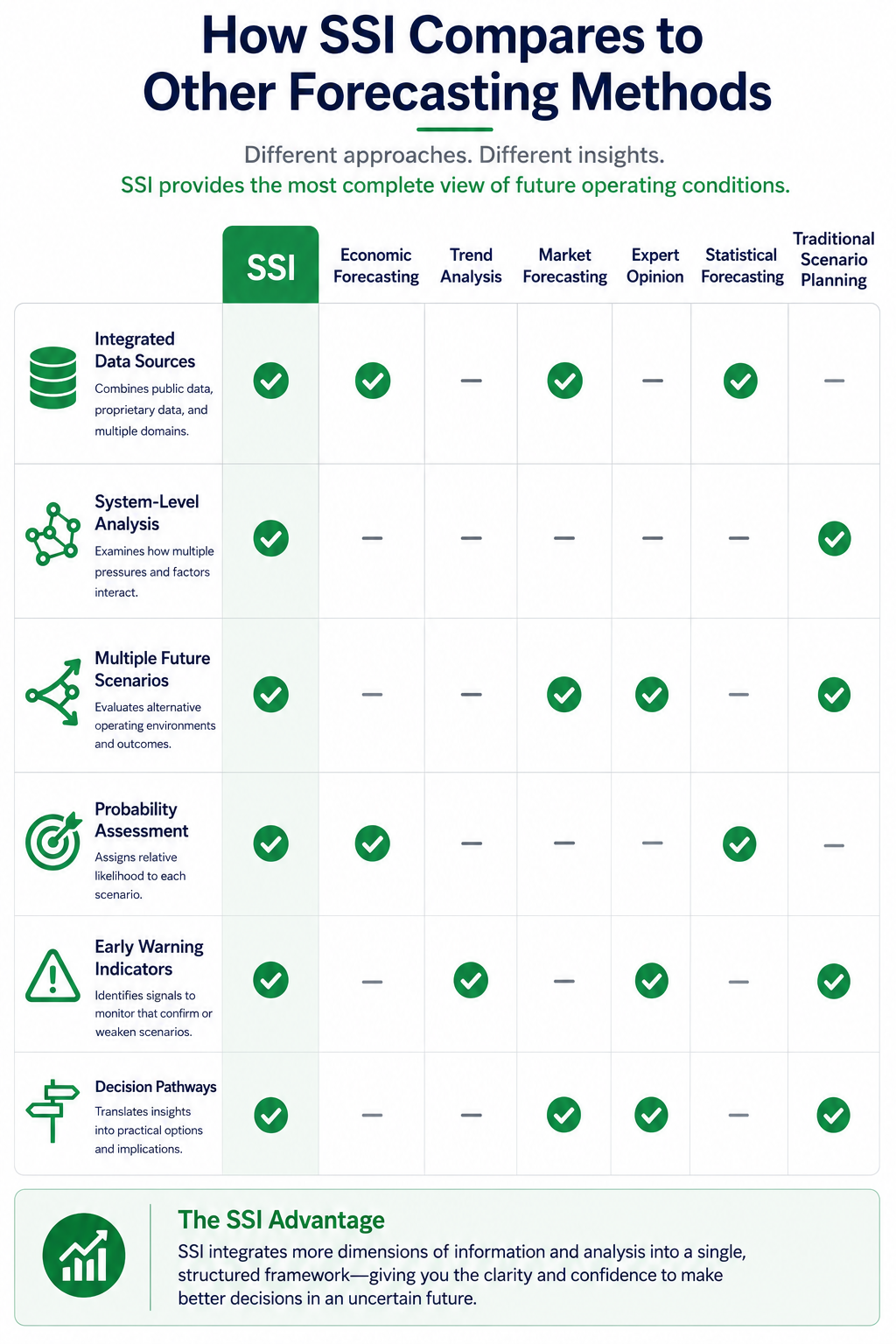
Apply the same structural method at different decision distances.
3–12 months
Budgeting, staffing, lending posture, tactical planning, and near-term operating readiness.
1–3 years
Strategic planning, expansion, capital allocation, workforce design, and operational planning.
3–10 years
Long-range regional, industry, infrastructure, institutional, and policy analysis.
Most engagements focus on the one-to-three-year horizon, where structural pressures are often visible enough to analyze while still leaving time to respond.
A decision-ready intelligence report
| Report section | Purpose |
|---|---|
| Executive Summary | Key findings and decision implications |
| Current Environment Assessment | Evaluation of present operating conditions |
| Structural Pressure Analysis | Major forces shaping future conditions |
| Constraint Analysis | Limiting factors, bottlenecks, and capacity boundaries |
| Scenario Matrix | Alternative future operating environments |
| Probability Assessment | Relative likelihood of each scenario |
| Early Warning Indicators | Signals that support or weaken scenarios |
| Decision Pathways | Strategic implications and response options |
| Monitoring Framework | Indicators for future updates |
Built for decisions exposed to changing operating conditions
Regional banks
Lending environment and credit-risk assessment
Private equity
Market screening and deployment evaluation
Economic development
Regional planning and stress testing
Multi-location operators
Expansion and market comparison
Infrastructure organizations
Capacity and deployment planning
Healthcare systems
Demand and workforce forecasting
Executive teams
Strategic planning and decision support
Public agencies
Policy and operating-environment assessment
From decision question to monitoring framework
Define the decision
Clarify the organization, geography, industry, planning horizon, and choice being evaluated.
Assemble the evidence
Identify relevant public sources and optional proprietary information.
Build the scenarios
Evaluate pressures, constraints, interactions, probabilities, and divergences.
Translate into action
Deliver indicators, implications, decision pathways, and monitoring priorities.
Useful without requiring a long consulting engagement
SSI is primarily a stand-alone intelligence product. The report is designed to provide decision support without obligating the organization to an extended implementation program.
Organizations that want deeper support may add executive briefings, workshops, leadership sessions, scenario reviews, or continuing monitoring.
Available engagement models
- Project-based scenario intelligence
- Executive or regional scenario analysis
- Industry scenario assessments
- Quarterly monitoring programs
- Subscription arrangements
- Enterprise and institutional licensing
Clarifying what SSI is—and what it is not
Is SSI a prediction service?
No. SSI evaluates multiple plausible future operating environments, their relative likelihood, supporting evidence, weakening evidence, and decision implications. The objective is decision clarity, not certainty.
Does AI make the final conclusions?
No. AI helps organize information, compare conditions, and surface patterns. Human analysis remains responsible for scenario construction, evidence evaluation, probability assessment, interpretation, and final conclusions.
Can SSI use our internal data?
Yes. Proprietary data can be incorporated when it materially improves the analysis. Public-only engagements are also available.
How is SSI different from ordinary scenario planning?
SSI combines scenario construction with integrated data sources, structural interaction analysis, probability assessment, early-warning indicators, and decision pathways.
What is the most useful planning horizon?
The one-to-three-year range is often most actionable because pressures can be visible enough to evaluate while still leaving meaningful time to respond. Shorter and longer horizons are also available.
Better decisions require better visibility.
Request an SSI engagement for executive scenario intelligence, regional analysis, industry assessment, quarterly monitoring, or institutional use.
Structural Scenario Intelligence provides analytical decision support. It does not guarantee outcomes and should be used alongside appropriate financial, legal, operational, technical, or policy expertise.