
Ark of the Covenant As An Electrostatic-Capacitor
Hypothesis Statement
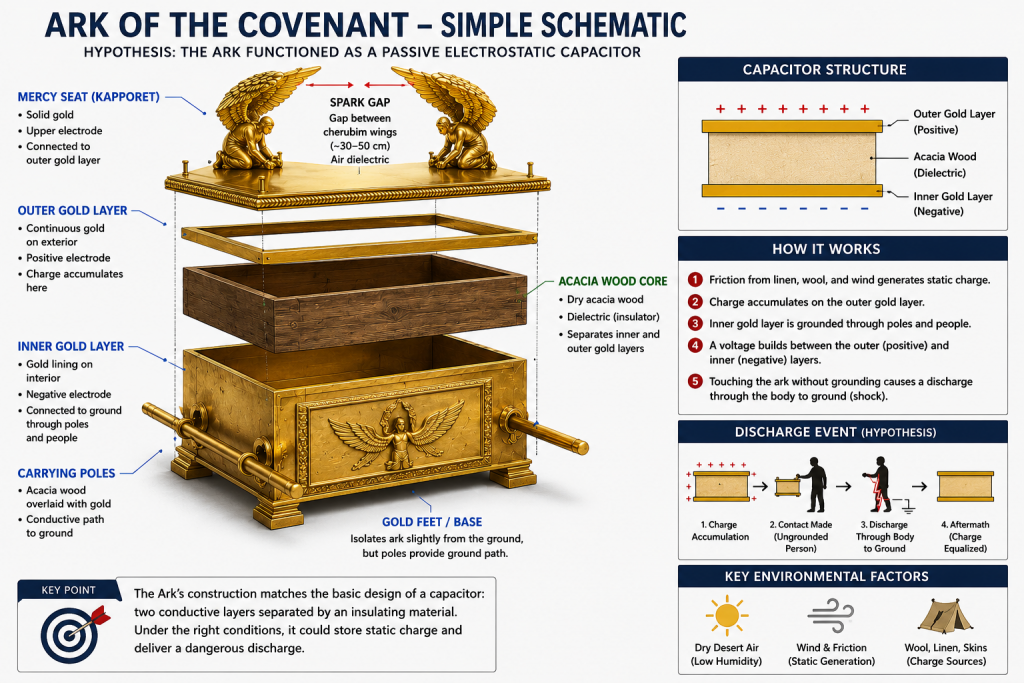
This paper proposes that the Ark of the Covenant, as materially described in Exodus, may have functioned as a passive electrostatic system whose gold–acacia–gold construction allowed measurable electrostatic structural pressure to accumulate under dry environmental conditions.
Within this framework, the Ark operated simultaneously as:
- a sacred symbolic container,
- a ritual-political authority object,
- a restricted-access ceremonial artifact,
- and a passive electrostatic structure capable of producing observable discharge phenomena.
The model treats the Ark body as a conductor–dielectric–conductor system analogous in principle to a capacitor structure, while the Mercy Seat and cherubim geometry may have functioned as a passive spark-gap interface capable of converting stored electrical potential into visible or audible discharge events.
The hypothesis does not require supernatural energy generation, extraterrestrial intervention, or modern electromagnetic theory. Instead, it proposes that Bronze Age material practices, dry desert conditions, conductive geometry, ritual isolation procedures, and environmental charge accumulation may have combined to produce measurable electrostatic effects that became culturally interpreted as manifestations of sacred power.
Includes
| Required Element | Entry |
|---|---|
| Hypothesis Title | Ark of the Covenant Electrostatic-Capacitor Hypothesis |
| System Under Analysis | Ark of the Covenant as materially described in Exodus |
| Structural Model | Gold–wood–gold conductive/dielectric capacitor-like structure with cherubim spark-gap geometry |
| Variables Measured | Capacitance, voltage, humidity, dielectric resistance, discharge energy, grounding state, spark-gap distance, ionization behavior |
1. Hypothesis Definition
The Ark of the Covenant accumulates measurable electrostatic structural pressure because its conductive gold layers, dielectric acacia core, spark-gap geometry, and environmental isolation create a passive electrostatic boundary system.
When electrostatic structural pressure exceeds a critical threshold, the system must undergo:
- measurable discharge,
- voltage equalization,
- visible spark formation,
- corona or ionization effects,
- audible discharge phenomena,
- contact shock,
- ritual adaptation,
- or model revision if no observable transition occurs.
If no measurable electrostatic transition occurs despite sustained high electrostatic pressure conditions, the electrostatic-capacitor hypothesis is false.
2. THD Framework → Theoretical Model
Triune Harmonic Dynamics defines three system states governing the Ark model.
| Phase | Description |
|---|---|
| Base Phase | Ark exists as a ritual gilded structure at environmental equilibrium |
| Pressure Phase | Electrostatic charge accumulates through dry air, textile friction, movement, insulation, conductive geometry, and environmental isolation |
| Integration Phase | Charge resolves through grounding, spark discharge, ionization, leakage, contact shock, corona effects, or ritualized operational control |
3. System Definition
System Boundaries
The Ark body, inner gold layer, outer gold layer, acacia wood dielectric, Mercy Seat, cherubim geometry, carrying poles, rings, enclosure structure, incense environment, grounding pathways, and immediate Tabernacle atmosphere.
Variables
Gold continuity, wood thickness, humidity, capacitance, voltage potential, leakage rate, grounding state, textile friction, spark-gap distance, ionized particulate density, conductive surface area, and environmental dryness.
Interactions
Conductive gold surfaces separated by dielectric wood accumulate charge under dry conditions. Environmental friction and movement increase electrostatic potential. The cherubim geometry concentrates electrical fields near conductive separations. Contact, grounding, smoke ionization, or conductive bridging may trigger discharge events.
Observables
Measured capacitance, surface voltage, discharge energy, spark events, corona effects, crackling sounds, ionization behavior, charge-retention duration, leakage rate, and physiological shock thresholds.
Measurement Methods
Replica construction, electrostatic voltmeters, capacitance meters, humidity chambers, dielectric testing, high-speed discharge imaging, corona detection, environmental ionization analysis, and controlled grounding experiments.
4. Prior Evidence → Historical Structural Transitions
Several historical and physical analogs support the plausibility of the model.
| Example | Relevance |
|---|---|
| Leyden jar development | Demonstrates conductor–dielectric–conductor systems can accumulate static charge |
| Egyptian gilded ritual structures | Establishes historical precedent for gold-over-wood sacred construction |
| Known electrostatic discharge hazards in dry environments | Demonstrates friction and low humidity can generate dangerous voltage accumulation |
| Spark-gap discharge systems | Demonstrates concentrated field geometry can convert stored charge into visible discharge |
| Ritualized handling of dangerous sacred objects | Demonstrates operational procedures can emerge around poorly understood physical effects |
Purpose: demonstrate recurring structural transition patterns from ritual object → material anomaly → measurable physical behavior → cultural integration.
5. Structural Pressure Measurement
Electrostatic structural pressure is measured through multiple interacting indicators.
| Indicator | Ark-Specific Measurement |
|---|---|
| Anomaly Frequency | Frequency of measurable discharge events under replicated conditions |
| Clustering | Discharge concentration around low humidity, grounding events, or cherubim geometry |
| Volatility | Voltage fluctuation across conductive surfaces |
| Model Divergence | Difference between ritual-only and electrostatic model predictions |
| Instability Metrics | Charge leakage, dielectric breakdown, corona formation, spark occurrence, discharge energy |
6. Structural Pressure Sources → Independent Variables
Define:
x1, x2, x3 ... xnWhere:
| Variable | Driver |
|---|---|
| x1 | Conductive continuity of gold surfaces |
| x2 | Dielectric strength and dryness of acacia wood |
| x3 | Environmental humidity |
| x4 | Friction from textiles, skins, movement, or wind |
| x5 | Grounding condition of conductive layers |
| x6 | Spark-gap distance between cherubim structures |
| x7 | Conductive surface area |
| x8 | Leakage paths through seams or impurities |
| x9 | Environmental ionization from incense smoke |
| x10 | Enclosure isolation from ground |
7. Structural Pressure Index → Structural Equation
Where:
| Symbol | Meaning |
|---|---|
| P | electrostatic structural pressure |
| xi | measurable stress variables |
| wi | weighting coefficients |
Ark-specific form:
Where:
| Term | Meaning |
|---|---|
| Gc | gold conductive continuity |
| Ds | dielectric strength |
| Hd | environmental dryness |
| Ft | frictional charge generation |
| Sa | conductive surface area |
| Gr | grounding differential |
| Sg | spark-gap field concentration |
| In | ionization behavior |
| Lr | leakage rate |
Threshold Condition:
P > Pc ⇒ electrostatic transition requiredIf sustained high structural pressure produces no measurable discharge behavior, the hypothesis weakens or fails.
8. Model Incompleteness (Verification Gap)
Current symbolic or theological models do not evaluate whether the Ark’s material geometry produced measurable electrostatic behavior.
Divergence appears between:
- ritual-symbolic interpretations,
- and the physically testable conductive/dielectric architecture described in Exodus.
Unknown variables may include:
- exact gold thickness,
- continuity of conductive layers,
- moisture content of acacia wood,
- enclosure humidity,
- actual cherubim separation distance,
- grounding pathways,
- and ionization behavior near incense smoke.
9. Signal Divergence → Residual Error Model
Where:
| Symbol | Meaning |
|---|---|
| O | observed replica behavior |
| M | predicted electrostatic behavior |
| D | residual divergence |
If the model predicts measurable voltage accumulation, field concentration, or spark formation but realistic replicas produce none, residual error increases and the hypothesis weakens.
10. Pre-Transition Indicators
Observable signals prior to full electrostatic transition include:
- measurable voltage accumulation,
- slower charge decay in dry conditions,
- localized field concentration near cherubim geometry,
- discharge during grounding events,
- corona formation under low humidity,
- stronger effects with frictional movement,
- and reduced performance when conductive continuity is interrupted.
11. Structural Failure Location Hypothesis
Electrostatic transitions occur at the system’s weakest or highest-stress boundaries.
| Failure Location | Interpretation |
|---|---|
| Weakest Constraint | Moisture, seams, conductive leakage, wood conductivity |
| Highest Stress Concentration | Cherubim wing separation, conductive edges, Mercy Seat geometry |
| Bottlenecks | Charge leakage through humidity or grounding |
| Resonance Points | Spark-gap discharge zones and ionized-air regions |
12. Predicted Structural Outcomes
If electrostatic structural pressure continues increasing, the system resolves through:
- measurable spark discharge,
- visible ionization,
- audible crackling,
- physiological shock,
- discovery of unknown material behavior,
- ritual adaptation,
- model revision,
- or failure of the electrostatic interpretation.
The conservative resolution is accidental electrostatic hazard ritualized into sacred law.
The stronger speculative resolution is intentional optimization of materials and geometry for controlled electrostatic demonstration.
13. Transition Likelihood Model
P(Transition∣P)↑ as P↑
As electrostatic structural pressure rises, the likelihood of observable discharge phenomena increases.
If realistic conditions fail to produce measurable transition, the electrostatic interpretation weakens.
14. Observable Confirmation Signals
If the hypothesis is correct, observe:
- measurable capacitance,
- voltage accumulation,
- humidity sensitivity,
- spark-gap field concentration,
- corona discharge,
- discharge clustering,
- grounding-dependent transitions,
- environmental instability behavior,
- and persistent divergence from ritual-only interpretations.
15. Falsification Criteria
The hypothesis is false if:
- accurate replicas cannot accumulate measurable charge,
- charge dissipates too rapidly,
- spark-gap geometry cannot produce meaningful field concentration,
- discharge energy remains physically insignificant,
- anomalies resolve without electrostatic transition,
- similar ritual objects produce identical effects without operational distinction,
- or the pressure index fails reproducibly across systems.
16. Final Test Statement
P > Pc ⇒ electrostatic transitionP > Pc and no transition occurs ⇒ hypothesis falseThe Ark’s conductive geometry, dielectric separation, environmental isolation, and spark-gap architecture accumulate measurable electrostatic structural pressure. When that pressure exceeds a critical threshold, the system must discharge, ionize, spark, equalize, shock, or force model revision. If sustained high electrostatic pressure does not produce measurable transition, the hypothesis is falsified.
17. Real-World Implications
A. Domain-Level Impact
Validation would shift the Ark from a purely symbolic artifact toward a hybrid material-cultural interpretation:
ritual object + electrostatic infrastructureB. Predictive Capability
The model predicts which ritual objects may produce electrostatic behavior based on:
- conductive layering,
- dielectric separation,
- dry environmental conditions,
- grounding isolation,
- and spark-gap geometry.
C. Measurement & Instrumentation
New metrics may include:
- Ark Capacitance Index,
- Electrostatic Pressure Index,
- Spark-Gap Field Concentration Index,
- Leakage Decay Curves,
- and Humidity Sensitivity Profiles.
D. Engineering / Application Layer
The model may inform:
- reconstruction archaeology,
- electrostatic hazard analysis,
- museum artifact handling,
- ancient materials testing,
- and ritual-object operational modeling.
E. Cross-Domain Transferability
The framework may apply to:
- gilded shrines,
- ceremonial conductive objects,
- insulated ritual containers,
- spark-gap geometries,
- and dry-environment electrostatic systems.
F. Decision-Making / Policy Impact
Institutions may use the model to evaluate:
- grounding protocols for replicas,
- electrostatic testing requirements,
- handling safety standards,
- and distinctions between symbolic and material interpretations.
G. Discovery Implications
High divergence combined with measurable electrostatic pressure would imply that ancient ritual artifacts may contain underrecognized material behaviors requiring further interdisciplinary investigation.
H. Limitation & Boundary Conditions
The model does not apply if:
- gold continuity is absent,
- wood conductivity is too high,
- environmental humidity prevents charge retention,
- spark gaps are physically unrealistic,
- grounding eliminates accumulation,
- or all observed effects remain below meaningful thresholds.
Final Hypothesis
The Ark of the Covenant accumulates measurable electrostatic structural pressure through its gold–acacia–gold conductive/dielectric geometry, spark-gap Mercy Seat architecture, environmental isolation, and ritual operational conditions. When electrostatic structural pressure exceeds a critical threshold, the system must undergo measurable discharge, ionization, spark formation, shock transition, ritual adaptation, or model revision. If sustained high electrostatic pressure does not produce measurable transition under realistic conditions, the hypothesis is falsified.
The Ark of the Covenant was a ritual-political sacred object whose described gold–acacia–gold construction may have created a passive capacitor-like electrostatic system under dry environmental conditions.
Under this model, the Ark functioned simultaneously as:
a sacred symbolic container,
a political legitimacy object,
a restricted ritual artifact,
and a passive electrostatic structure capable of producing rare but observable shocks, sparks, sounds, or discharge effects under specific conditions.
These effects may have reinforced perceptions of divine presence, danger, sanctity, priestly authority, restricted knowledge, and cultural “high technology” among observers.
The hypothesis does not require supernatural energy, extraterrestrial intervention, or modern electromagnetic theory. Instead, it proposes that Bronze Age material practices, dry desert conditions, conductive gold surfaces, insulating acacia wood, ritual enclosure, incense, restricted handling, and grounding procedures may have produced unusual electrostatic effects that were culturally interpreted and ritually preserved.
The conservative version is that these effects arose accidentally and were later ritualized as safety rules. The stronger speculative version is that the Ark’s materials, geometry, environment, and priestly procedures were intentionally optimized as a controlled demonstration of sacred power.
This remains a falsifiable cultural-material hypothesis, not proof. It weakens if accurate replicas fail to produce measurable electrostatic behavior, if the effects are too weak to be noticed, or if similar ritual objects produce identical effects without cultural distinction.
The Ark of the Covenant was a sacred ritual-political artifact whose gold–acacia–gold structure may have operated as a passive electrostatic capacitor, while its ritual restrictions, incense environment, carrying protocols, and priestly access controls functioned as operational safeguards or activation procedures. Observable electrostatic effects may have reinforced its role as restricted sacred technology and authority-amplifying cultural infrastructure. If realistic replica testing fails to demonstrate meaningful charge accumulation or discharge behavior, the electrostatic component of the hypothesis is falsified or under realistic conditions, the electrostatic component of the hypothesis is falsified.