
A Falsifiable Model of Informational Manifolds and Harmonic Scaling
ABSTRACT
This paper presents a theoretical framework for understanding why certain universes can exist while others cannot, grounded in the principles of informational physics. Rather than relying on probabilistic multiverse models or anthropic reasoning, we propose that reality is constrained by structural requirements that govern coherence, curvature, and recursive integration. Within this framework, only two pathways allow for the emergence of stable universes: the formation of independent informational manifolds, or the expression of harmonic scaling across a single manifold.
Triune Harmonic Dynamics (THD) provides the mathematical and conceptual basis for this model by introducing a triadic structural requirement—formation, interaction, and integration—that must be satisfied for any system to sustain complexity. From these constraints, we derive a set of falsifiable predictions about the nature of physical systems, cross-scale invariance, and the limits of observer experience. The model further implies that phenomenological experience is not universal but is instead determined by the underlying informational structure of a given manifold.
I. INTRODUCTION: REFRAMING COSMOLOGY THROUGH STRUCTURAL CONSTRAINTS
Contemporary cosmological theories often invoke the idea of a multiverse, in which an enormous or even infinite number of universes exist with varying physical constants. Within this view, our universe is simply one realization among many, selected through anthropic reasoning because it supports observers. While this approach provides a way to explain fine-tuning, it lacks a clear mechanism for excluding non-viable universes.
The framework proposed here replaces probabilistic selection with structural necessity. Instead of asking how many universes could exist, we ask which universes are capable of sustaining coherent informational structures. This leads to a central principle:
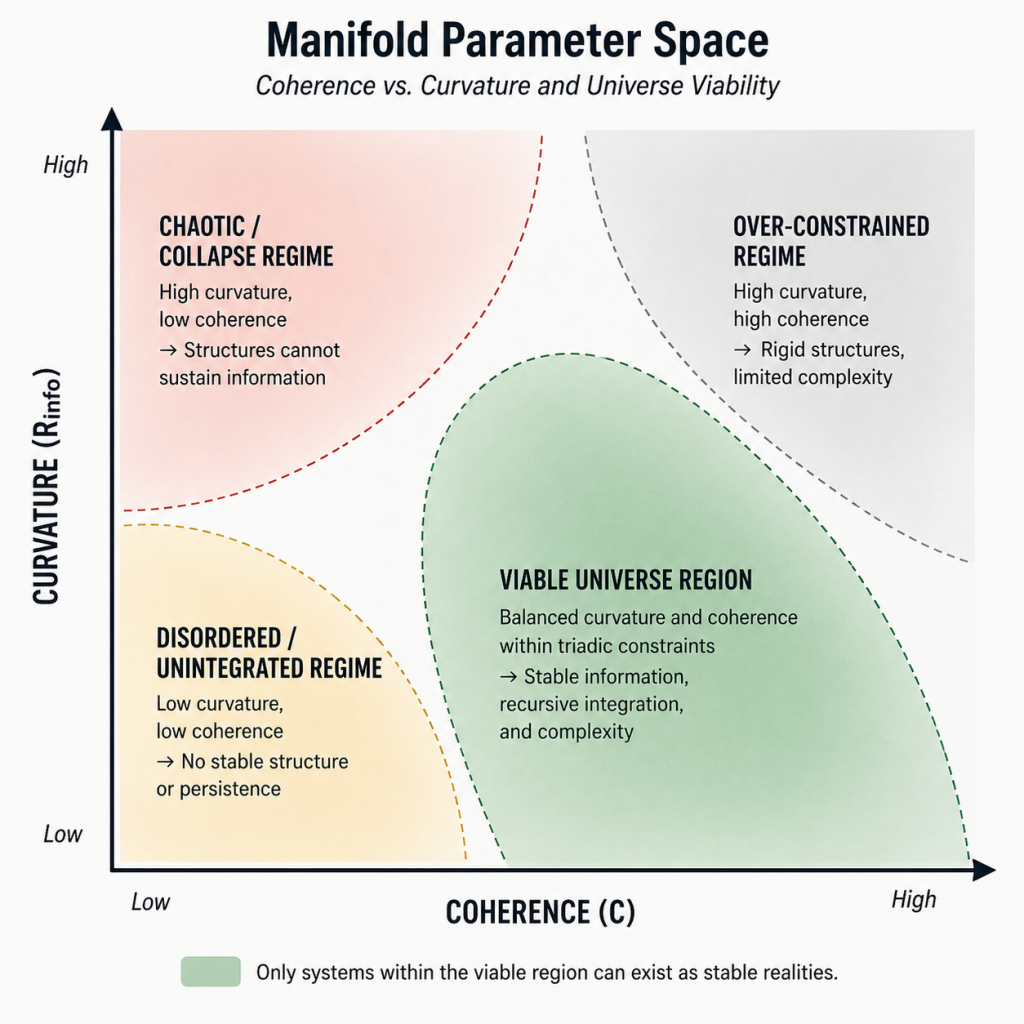
Only systems that satisfy specific coherence and structural constraints can exist as stable realities.
Under this view, reality is not an arbitrary outcome but the result of strict informational viability conditions. Universes are not freely generated possibilities; they are filtered outcomes of structural constraints.
II. FORMAL FRAMEWORK AND DEFINITIONS
To establish a rigorous foundation, we define a universe as an informational system composed of a manifold, its associated fields, and transformation rules:
Here, M represents the state space, F the informational fields, and O the operators governing transformations. Together, these define the complete rule set of a universe.
The viability of such a system depends on three key properties: coherence, curvature, and triadic integration.
Core Structural Variables
| Variable | Description | Physical Interpretation |
|---|---|---|
| Coherence (C) | Degree of informational alignment | Stability and persistence |
| Curvature (R₍info₎) | Informational density and differentiation | Structure vs collapse |
| Triadic Balance | Presence of 3 functional phases | Complexity support |
Triadic Structural Requirement
A central claim of this framework is that all viable systems must satisfy a triadic structure:
| Phase | Function | Role in Reality |
|---|---|---|
| 3 | Formation | Creation of structure |
| 6 | Interaction | Dynamic exchange |
| 9 | Integration | Memory and persistence |
This triadic requirement is not symbolic but functional. Without formation, no objects arise. Without interaction, no dynamics occur. Without integration, no continuity or memory exists.
III. PATHWAYS OF REALITY FORMATION
The model identifies two distinct pathways through which viable universes can arise: independent manifolds and harmonic scaling.
A. Independent Informational Manifolds
An independent manifold represents a fully self-contained universe with its own informational geometry. For such a system to emerge and persist, it must satisfy three conditions:
| Constraint | Description | Failure Mode |
|---|---|---|
| Minimal Coherence | Sufficient alignment for stability | Instant decoherence |
| Bounded Curvature | Balanced differentiation | Collapse or diffusion |
| Triadic Closure | All three phases present | Incomplete system |
These constraints act as filters, eliminating non-viable universes before they can develop complexity.
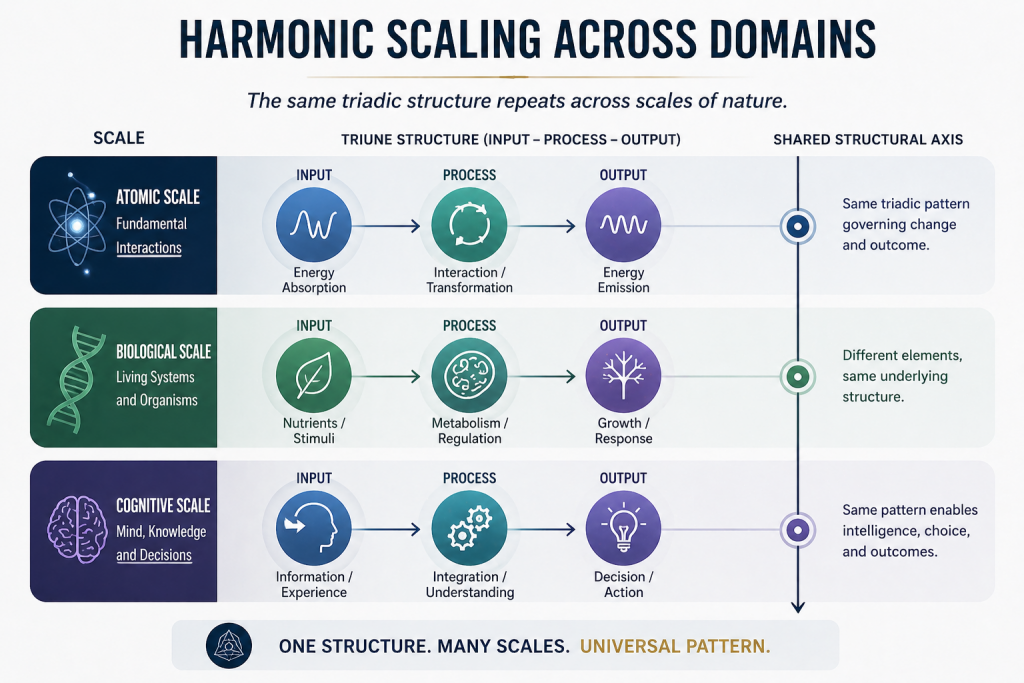
B. Harmonic Scaling (Octaves)
The second pathway does not produce separate universes but instead generates different expressions of a single manifold across scales. These expressions, referred to as harmonic octaves, preserve the underlying structure while varying in complexity.
| Scale | Example Domain | Characteristics |
|---|---|---|
| Atomic | Quantum systems | Probabilistic structure |
| Biological | Organisms | Metabolic interaction |
| Cognitive | Societies | Symbolic integration |
This scaling implies that the same structural principles govern systems across vastly different domains.
IV. TAXONOMY OF VARIABLE MANIFOLDS
By varying coherence and curvature parameters, different classes of universes can be described. These are not speculative fantasies but logical consequences of the framework.
Manifold Types and Their Properties
| Manifold Type | Coherence | Curvature | Dominant Behavior |
|---|---|---|---|
| High-Viscosity (“Slow-Glass”) | High | Moderate | Extreme persistence |
| Low-Resistance (“Hyper-Reactive”) | Moderate | Low | Rapid propagation |
| High-Curvature (“Nested”) | Moderate | High | Topological folding |
V. PHENOMENOLOGICAL IMPLICATIONS
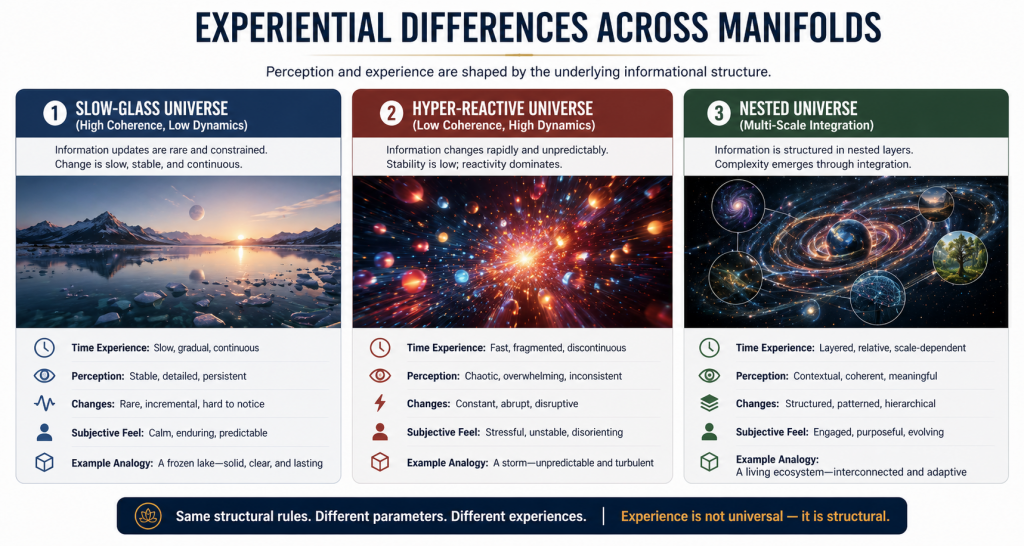
One of the most significant implications of this model is that experience itself is shaped by the underlying structure of the manifold. Observers are not independent of physics; they are expressions of it.
Experience as a Structural Function
This means that different universes produce fundamentally different modes of perception, time, and identity.
A. Experience in High-Viscosity Universes
In a high-viscosity manifold, informational propagation is extremely slow. As a result, change occurs at a glacial pace.
| Feature | Experiential Outcome |
|---|---|
| Slow dynamics | Time appears stretched |
| High persistence | Strong continuity of identity |
| Low interaction | Minimal external influence |
Observers in such a universe would experience reality as deeply stable but nearly static. Thought processes would unfold over immense durations, and the distinction between moments would blur into long, continuous states.
B. Experience in Hyper-Reactive Universes
In contrast, low-resistance manifolds allow near-instant propagation of information.
| Feature | Experiential Outcome |
|---|---|
| Instant interaction | No delay between cause and effect |
| Low persistence | Weak identity boundaries |
| High connectivity | Global awareness-like states |
In such a universe, individuality may not emerge. Instead, experience would resemble a unified field, where distinctions between observer and environment dissolve.
C. Experience in High-Curvature Universes
High-curvature manifolds produce non-linear spatial relationships.
| Feature | Experiential Outcome |
|---|---|
| Folded topology | Non-intuitive navigation |
| Discontinuous space | Apparent jumps in location |
| Localized regions | Pocketed realities |
Observers would not perceive space as continuous but as a network of connected states. Movement would feel like transitioning between configurations rather than traveling through distance.
VI. TRIADIC FAILURE MODES AND LIMITS OF EXPERIENCE
The necessity of the triadic structure becomes evident when examining its absence.
| Missing Phase | Physical Effect | Experiential Result |
|---|---|---|
| Formation (3) | No stable structures | No objects or identity |
| Interaction (6) | No dynamics | Frozen reality |
| Integration (9) | No memory | Continuous present |
These cases illustrate that experience requires all three components. Consciousness, therefore, is not an independent phenomenon but a consequence of structural completeness.
VII. FALSIFIABILITY AND EMPIRICAL TESTS
The strength of this model lies in its falsifiability. It makes clear predictions that can be tested across multiple domains.
Primary Hypothesis
All stable complexity requires triadic structural support within an informational manifold.
Falsification Criteria
| Condition | Implication |
|---|---|
| Non-triadic stable system discovered | Model invalid |
| Cross-manifold continuity observed | Pathways collapse |
| Memory without structure observed | Integration assumption fails |
Empirical Domains
- Complex systems theory
- Network topology
- Cosmological structure analysis
- Quantum-to-classical transitions
VIII. DISCUSSION
This framework represents a shift from viewing reality as a product of randomness to viewing it as the outcome of constraint satisfaction. It suggests that complexity is not an accident but a necessity arising from structural conditions.
The implication is that the space of possible universes is not infinite but tightly bounded. Within this bounded space, only those systems that achieve coherence, maintain balanced curvature, and support triadic recursion can persist.
IX. CONCLUSION
We have proposed a model in which reality is structurally selected rather than randomly generated. By introducing informational manifolds, harmonic scaling, and triadic constraints, we establish a framework that both explains the emergence of complexity and provides clear criteria for falsification.
The model leads to a profound but testable conclusion:
The nature of existence is determined by the physics of information, and experience itself is a consequence of structural viability.
Different universes are not merely variations in physical constants—they are fundamentally different modes of reality, each shaped by the constraints of its underlying informational structure.