
A Constraint-Based Proposal for Reviewing Narrowband Archival Radio Data from November 7–9, 2025
By: Kevin L. Brown
Date: April 2026
Abstract
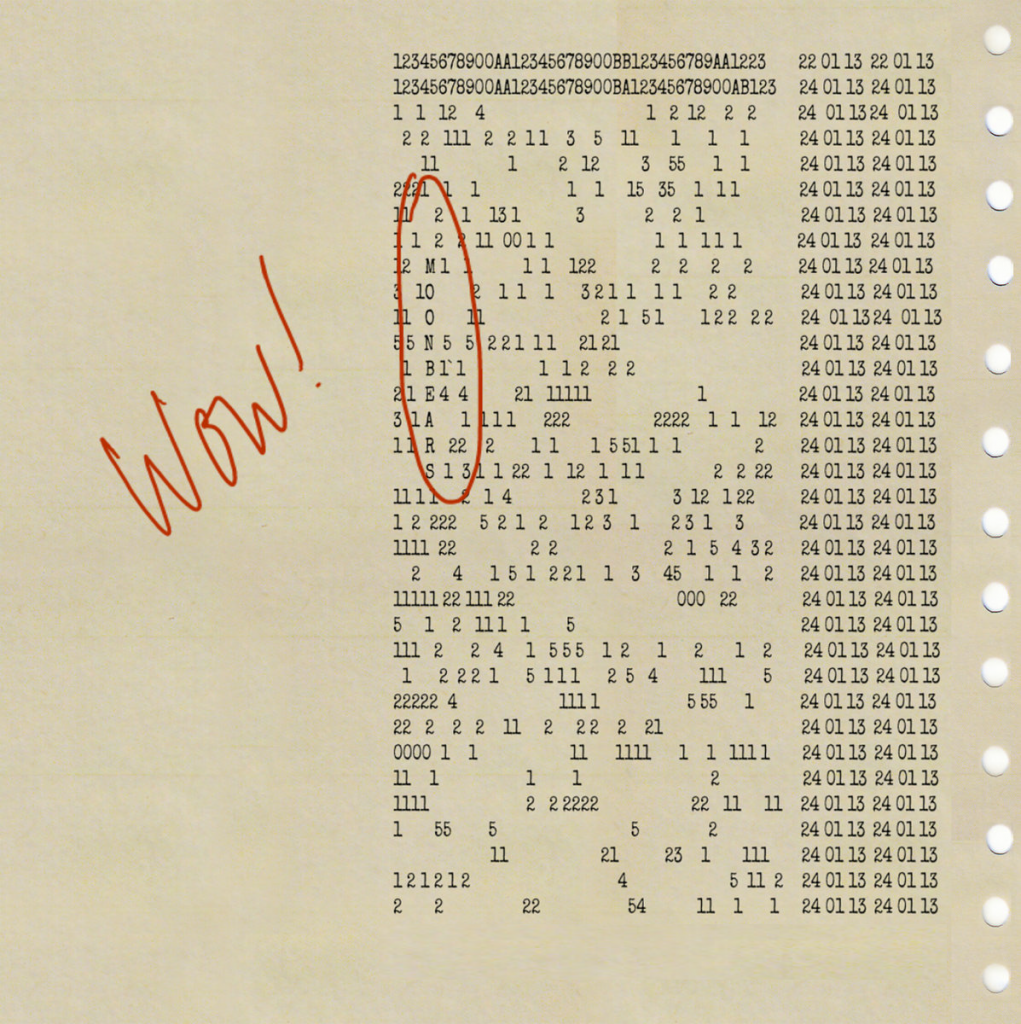
The Wow! Signal remains one of the most discussed unresolved narrowband radio events in the history of SETI. This paper does not claim that the Wow! Signal has been solved, nor does it claim that a recurrence has been confirmed. It proposes a narrower and falsifiable archival-data search.
Using the original observational constraints of the 1977 Wow! Signal, together with refined coordinate and frequency constraints reported in recent Arecibo Wow! archival analyses, this paper identifies November 7–9, 2025 UTC as a high-priority search window for reviewing retained, downgraded, discarded, or RFI-flagged radio data. The proposed search is focused on the refined Wow! Signal sky region near RA 19h25m02s or RA 19h27m55s, Dec −26°57′ J2000, with primary spectral attention near 1420.726 MHz and broader secondary attention across the protected hydrogen-line region near 1420 MHz.
The purpose of this paper is to define a testable search specification. If no structurally similar narrowband candidate exists in relevant data from the proposed window, the model fails. If a candidate does exist, it should be subjected to normal radio-astronomical review, including RFI rejection, Doppler-drift analysis, telescope-coverage verification, beam-response modeling, and comparison against known astrophysical hydrogen-line phenomena.
1. From Mystery Claim to Search Specification
The Wow! Signal is often treated as an isolated anomaly or cultural mystery. A more useful scientific framing is to treat it as a constrained observational event.
The 1977 signal had several defining properties:
| Constraint | Relevance for Any Recurrence Search |
|---|---|
| Narrowband behavior near the hydrogen-line region | Limits the spectral search space |
| Beam-shaped temporal profile of approximately 72 seconds | Implies transit through a fixed telescope beam |
| Sagittarius-aligned sky origin | Limits the spatial search region |
| Non-repetition in follow-up attempts | Suggests either rare source behavior, sampling limitation, or false-positive conditions |
| Single-beam detection geometry | Requires attention to beam response and instrument geometry |
A recurrence search should therefore not begin with the broad question, “Did the Wow! Signal return?” It should begin with a narrower question:
During what observational window would a structurally similar narrowband event have been most likely to appear in archived radio data, and where should researchers look for it?
This paper proposes that November 7–9, 2025 UTC is one such high-priority window.
2. Primary Search Parameters
The following table reduces the proposal to a technical search specification.
| Parameter | Proposed Search Definition |
| Primary time window | November 7–9, 2025 UTC |
| Secondary comparison windows | November 3–5, 11–13, 15–17, and 19–21, 2025 UTC |
| Primary sky region | Refined Wow! Signal fields reported in recent archival analysis |
| Right ascension field A | RA 19h25m02s ± 3s, J2000 |
| Right ascension field B | RA 19h27m55s ± 3s, J2000 |
| Declination | Dec −26°57′ ± 20′, J2000 |
| Primary frequency target | 1420.726 ± 0.005 MHz |
| Secondary frequency region | Hydrogen-line region near 1420 MHz, including nearby narrowband candidates |
| Expected bandwidth | Narrowband; primary comparison scale approximately 10 kHz or less, with narrower sub-channel review if available |
| Expected duration | Beam-shaped event on the order of 72 seconds, with allowance for telescope-specific beam width and scan strategy |
| Expected morphology | Gradual rise, central peak, gradual decline, consistent with beam transit or equivalent observing geometry |
| Drift assumption | No hard Doppler-drift requirement should be imposed initially; search should test zero-drift, low-drift, and modest-drift narrowband candidates |
| Candidate location in data | Cleaned datasets, RFI-flagged intervals, discarded buffers, intermediate products, and downgraded anomaly logs |
| Falsification test | No structurally similar candidate exists in relevant data with confirmed coverage of the target window and sky/frequency region |
3. Why Recent Arecibo Wow! Work Matters
The most important recent development is that the Wow! Signal has become more technically tractable through archival reanalysis.
The Arecibo Wow! project has reframed the signal as a comparative archival-data problem rather than only a historical mystery. The first Arecibo Wow! paper reported narrowband signals near the hydrogen line in archived Arecibo observations and argued that some Wow-like features may arise from cold neutral hydrogen clouds or stimulated hydrogen-line emission. The second Arecibo Wow! paper refined the original signal’s sky position, peak flux, and frequency, narrowing the search space substantially.
This paper builds on that shift. It does not compete with the Arecibo Wow! interpretation. It asks whether a later time window can be formulated in a way that is testable against similar archival or pipeline-filtered data.
The key implication is that a candidate event does not need to be assumed extraterrestrial. A structurally similar event could be:
- astrophysical,
- instrumental,
- RFI,
- statistical,
- pipeline-related,
- or a genuine technosignature candidate.
The purpose of the search is not to pre-select the explanation. The purpose is to identify whether the proposed window contains any candidate worth classifying.
4. Detection Opportunity Function
A possible recurrence must satisfy more than source behavior. It must satisfy detection conditions.
This paper models detection opportunity as the interaction of three factors:
R(t) = A(t) × O(t) × D(t)
Where:
| Term | Meaning |
| A(t) | Alignment between the target sky region and observable telescope geometry |
| O(t) | Observational coverage of the relevant sky/frequency region |
| D(t) | Probability that the candidate survives filtering, flagging, retention, or archive review |
This formulation deliberately does not claim to know the source behavior. It asks when detection would have been most possible if a structurally similar event occurred.
The critical insight is that a signal may be detectable and still not appear in a final cleaned product. Narrowband anomalies near a protected radio band may be flagged, downgraded, or excluded before later review. Therefore, the highest-value search target may not be the polished public dataset, but the intermediate and rejected data products.
5. Spatial Constraint: Sky Region
Earlier discussions of the Wow! Signal often referred broadly to a Sagittarius-aligned origin. That is not specific enough for a modern archival search.
For this proposal, the primary sky-region definition should use the refined fields reported in recent Arecibo Wow! archival work:
| Candidate Field | Coordinate Definition |
| Field A | RA 19h25m02s ± 3s, Dec −26°57′ ± 20′, J2000 |
| Field B | RA 19h27m55s ± 3s, Dec −26°57′ ± 20′, J2000 |
A modern search should first determine whether any relevant observatory, survey, or public archive had coverage of either field during the primary window of November 7–9, 2025 UTC.
If neither field was observed by a relevant instrument during that window, the proposed search window weakens substantially. If one or both fields were observed in the relevant frequency region, the next step is to inspect narrowband candidate detections, flagged intervals, and discarded or downgraded data products.
6. Spectral Constraint: Frequency and Bandwidth
The original Wow! Signal was associated with the hydrogen-line region near 1420 MHz. Recent Arecibo Wow! II analysis reports a refined frequency of approximately 1420.726 ± 0.005 MHz.
For testing purposes, the search should use a tiered spectral strategy:
| Search Tier | Frequency Definition | Purpose |
| Tier 1 | 1420.726 ± 0.005 MHz | Direct comparison to refined Wow! Signal frequency |
| Tier 2 | 1420.70–1420.75 MHz | Allows for nearby candidates, calibration variation, and velocity-related uncertainty |
| Tier 3 | Broad hydrogen-line neighborhood near 1420 MHz | Captures structurally similar narrowband events outside the strict refined frequency |
| Tier 4 | Instrument-specific flagged narrowband events near L-band | Captures RFI-flagged or pipeline-downgraded candidates |
Expected bandwidth should be treated conservatively. A first-pass search should prioritize narrowband candidates at approximately 10 kHz or less, while retaining the ability to examine finer-resolution data if available.
This matters because a strict search that only uses one exact frequency and one exact bandwidth may miss structurally similar events. Conversely, a search that is too broad will generate too many false positives. The tiered strategy keeps the test constrained while allowing scientifically useful comparison.
7. Drift Assumptions
A modern technosignature search often incorporates Doppler drift, especially when evaluating potential artificial signals. However, for this paper, drift should not be treated as a precondition for candidate inclusion.
The search should evaluate at least three drift classes:
| Drift Class | Description |
| Zero-drift or near-zero-drift | Candidate remains effectively stationary in frequency over the event window |
| Low-drift | Candidate shows slight frequency drift consistent with relative motion or instrumental effects |
| Moderate-drift | Candidate remains narrowband but moves enough to require standard SETI drift-search tools |
| High-drift | Lower priority unless morphology and sky alignment are strong |
This paper does not assert a specific drift rate. Instead, it recommends that drift be treated as a classification feature after initial candidate retrieval. A candidate should not be discarded prematurely solely because it lacks an assumed technosignature drift pattern.
8. Temporal Constraint: Why November 7–9, 2025?
The original paper identified several November 2025 windows based on alignment, observational opportunity, and retention risk. This revision keeps the same structure but narrows the primary test window.
Approximate high-priority windows:
| Date Range | Approximate UTC Priority Window | Interpretation |
| November 3–5, 2025 | 01:30–03:00 UTC | Strong alignment and early-month coverage possibility |
| November 7–9, 2025 | 01:00–02:30 UTC | Primary search window; strongest modeled convergence |
| November 11–13, 2025 | 00:30–02:00 UTC | Sustained high alignment |
| November 15–17, 2025 | 00:00–01:30 UTC | Still viable but tapering |
| November 19–21, 2025 | 23:30–01:00 UTC | Late-month comparison window |
The November 7–9 block is prioritized because it represents the modeled convergence of:
- refined Wow! Signal sky-region observability,
- nighttime observing conditions for many northern-hemisphere observatories,
- continued availability of the Sagittarius-adjacent region,
- and a high likelihood that relevant narrowband anomalies, if detected, could be filtered rather than promoted.
This does not mean a recurrence occurred. It means the window is sufficiently constrained to justify asking whether relevant data exist.
9. Candidate Datasets and Observatories
This proposal cannot be evaluated unless the relevant sky/frequency region was actually observed. Therefore, the first empirical task is not signal classification. It is coverage verification.
Potential data sources include:
| Data Holder / Facility Type | Why It Matters | Status of Coverage |
| Breakthrough Listen public archives | SETI-oriented radio data, narrowband pipeline products, possible L-band coverage | Must verify target-field coverage during November 7–9, 2025 |
| Green Bank Telescope / Breakthrough Listen observations | Sensitive radio observations with technosignature search infrastructure | Must verify scheduled observations and public or internal data availability |
| MeerKAT / Breakthrough Listen-related observations | Southern sky access and SETI-related observing potential | Must verify whether target fields and frequency were covered |
| Parkes / Murriyang archives | Historical and ongoing radio astronomy relevance, southern sky access | Must verify November 2025 coverage |
| FAST public or collaborative archives | High-sensitivity radio telescope capable of hydrogen-line observations | Must verify field accessibility, archive access, and frequency coverage |
| VLA / NRAO archival data | Possible L-band observations of relevant fields | Must verify scheduling and archive products |
| Hydrogen-line survey archives | Useful for astrophysical comparison rather than technosignature confirmation | Must verify cadence and resolution |
| RFI databases or pipeline logs | Necessary to inspect rejected/downgraded narrowband anomalies | Access may require institutional cooperation |
This paper does not assert that any of these facilities observed the target field during November 7–9, 2025. It identifies them as plausible coverage candidates to be checked.
The first practical question for any reviewer is therefore:
Which observatories or datasets had coverage of RA 19h25m02s or RA 19h27m55s, Dec −26°57′ J2000, near 1420.726 MHz during November 7–9, 2025 UTC?
If the answer is “none,” the proposed primary window fails as a testable recurrence search. If the answer is “some,” then the data can be searched using the candidate criteria below.
10. Candidate Retrieval Criteria
A candidate event should be retrieved for review if it satisfies several of the following features:
| Feature | Priority |
| Occurs during November 7–9, 2025 UTC | Required for primary-window candidate |
| Falls within or near the refined Wow! Signal fields | High priority |
| Appears near 1420.726 MHz or hydrogen-line region | High priority |
| Has narrowband structure, preferably approximately 10 kHz or less | High priority |
| Persists on the order of tens of seconds to several minutes | High priority |
| Shows beam-consistent rise/fall morphology or telescope-specific equivalent | High priority |
| Was flagged, downgraded, or excluded as RFI | Important, not disqualifying |
| Has no obvious terrestrial source | Important |
| Appears in only one beam or one observing interval | Not disqualifying, given original Wow! geometry |
| Has polarization, drift, or repeat behavior available for review | Useful for classification |
A candidate does not need to match every feature to be worth preliminary review. However, the strongest candidate would satisfy the time, sky-region, frequency, bandwidth, and morphology constraints simultaneously.
11. Candidate Scoring Model
To prevent the search from becoming subjective, candidate events should be scored with a structural similarity model.
A simple first-pass model could use:
S = Fs + Bs + Ts + Gs + Ms + Rs
Where:
| Term | Meaning |
| Fs | Frequency similarity to 1420.726 MHz or hydrogen-line region |
| Bs | Bandwidth similarity to narrowband Wow-like behavior |
| Ts | Temporal similarity to a beam-shaped event |
| Gs | Geometric similarity to refined sky fields |
| Ms | Morphological similarity to rise/peak/fall transit profile |
| Rs | Resistance to ordinary RFI explanation |
A candidate with high Fs, Bs, Ts, Gs, and Ms should be reviewed even if initially flagged as RFI. A candidate with weak frequency and sky alignment should be downgraded even if temporally interesting.
This approach gives reviewers a way to classify the window without accepting the broader model.
12. Falsification Criteria
The model is falsifiable.
It fails under any of the following conditions:
| Falsification Condition | Effect |
| No relevant telescope or survey covered the target fields during November 7–9, 2025 | Primary window is not testable |
| Relevant data exist but contain no structurally similar narrowband candidate | Recurrence model fails for that window |
| Candidate exists but is clearly identified as ordinary RFI | Candidate rejected |
| Candidate exists but falls outside the sky-region and frequency constraints | Weakens or rejects recurrence classification |
| Candidate morphology is incompatible with telescope beam or observing geometry | Weakens or rejects recurrence classification |
| Candidate is explained by a known astrophysical hydrogen-line cloud or maser-like event | Not a technosignature, but still scientifically relevant |
| Candidate appears only after unconstrained parameter expansion | Indicates post hoc fitting rather than prediction |
The model is strengthened only if a candidate exists inside the predefined window and parameter space before the search is broadened.
13. What Would Count as a Positive Result?
A positive result would not mean the Wow! Signal has been solved.
A positive result would mean:
A structurally similar narrowband event exists in relevant November 7–9, 2025 data, within or near the refined Wow! Signal sky fields and hydrogen-line frequency region, and the event is strong enough to justify independent classification.
That candidate would then require standard review:
- telescope logs,
- calibration data,
- beam geometry,
- RFI environment,
- satellite and aircraft checks,
- drift analysis,
- polarization review,
- repeat search,
- comparison with hydrogen-line cloud data,
- and independent pipeline reprocessing.
The strongest possible result would be a candidate that survives RFI rejection and remains consistent with known Wow! Signal structural constraints. The more likely useful outcome may be different: identifying a natural or instrumental false-positive class that clarifies how Wow-like candidates can arise.
Either outcome is scientifically useful.
14. Why This Search May Matter Even if It Fails
A failed search would still produce useful information. It would show that a constraint-derived recurrence window did not produce a candidate in available data. That would weaken this specific timing model and help define better future constraints.
A successful candidate retrieval would not automatically support an extraterrestrial interpretation. It would create a defined object of study.
The real value of this proposal is that it moves the Wow! Signal discussion from broad speculation into a narrow archival test:
| Broad Question | Testable Replacement |
| Did the Wow! Signal return? | Was a structurally similar candidate recorded during a predefined search window? |
| Was the signal extraterrestrial? | Does the candidate survive RFI and astrophysical classification? |
| Should researchers look again? | Which datasets covered the refined fields at the relevant frequency and time? |
| Is the theory true? | Does the predefined parameter space retrieve anything? |
That is the intended shift.
15. One-Page Search Summary for Reviewers
Proposed Search
Review archived, intermediate, downgraded, or RFI-flagged radio data for a structurally similar Wow-like narrowband event during November 7–9, 2025 UTC.
Primary Coordinates
Field A: RA 19h25m02s ± 3s, Dec −26°57′ ± 20′, J2000
Field B: RA 19h27m55s ± 3s, Dec −26°57′ ± 20′, J2000
Primary Frequency
1420.726 ± 0.005 MHz
Secondary Frequency Region
Hydrogen-line region near 1420 MHz, including nearby narrowband candidates.
Expected Bandwidth
Approximately 10 kHz or narrower, with finer-resolution review if available.
Expected Duration and Morphology
Approximately 72-second beam-shaped rise/peak/fall event, adjusted for telescope-specific beam size, scan mode, and integration cadence.
Drift Assumption
Do not impose a single drift assumption at retrieval. Evaluate zero-drift, low-drift, and moderate-drift candidates after initial filtering.
Highest-Value Data Products
Cleaned data, RFI-flagged intervals, discarded buffers, intermediate pipeline outputs, anomaly logs, candidate lists, and retained narrowband event records.
First Test
Determine whether any relevant observatory or archive covered the refined Wow! fields near 1420.726 MHz during November 7–9, 2025 UTC.
Falsification
If no coverage exists, the primary window fails as a testable search. If coverage exists but no structurally similar candidate is present, the recurrence model fails for that window.
Conclusion
The purpose of this paper is not to declare a return of the Wow! Signal. It is to define a narrow, falsifiable search.
Recent archival work has refined the Wow! Signal’s sky position and frequency enough to make a targeted search more practical. The proposed November 7–9, 2025 UTC window is not offered as proof of recurrence. It is offered as a high-priority archival-review window where a structurally similar narrowband event, if present, should be detectable in retained, downgraded, discarded, or RFI-flagged data.
The critical question is therefore no longer whether the Wow! Signal returned in some general sense. The critical question is:
Did any radio telescope or SETI archive cover the refined Wow! Signal fields near 1420.726 MHz during November 7–9, 2025 UTC, and if so, does the retained or filtered data contain a structurally similar narrowband candidate?
If the answer is no, the model fails. If the answer is yes, the result becomes specific enough for independent scientific review. If the signal data was both detectable and likely to be discarded, and whether that moment can now be reconstructed from the remaining data.