
Beethoven’s 7th and the Deep Structure of Reality
There are pieces of music that entertain, pieces that impress, and then there are pieces that feel inevitable—as if they are not being invented in real time, but uncovered. The second movement of Ludwig van Beethoven’s Seventh Symphony belongs unmistakably to that last category. It does not simply move the listener emotionally; it seems to guide them through a process that unfolds with internal necessity. Each moment feels earned, each transition unavoidable.
This sense of inevitability raises a deeper question. Why do certain musical structures feel universally compelling, even across centuries and cultures? Why does this movement, built from such a simple rhythmic seed, feel so structurally complete?
One answer is that Beethoven is not merely composing melodies—he is constructing a system. And that system follows a pattern that appears far beyond music: a progression from constraint, through saturation, into coherence.
This triadic structure—formalized in Triune Harmonic Dynamics (THD)—is not best understood as a symbolic “3–6–9,” but as a functional sequence of system behavior. A system defines itself, becomes stressed as complexity increases, and then reorganizes into a higher-order stability. Within the broader informational framework, systems evolve toward coherence under constraint . Music that follows this arc resonates because it mirrors how structured processes unfold not only in sound, but in cognition, physics, and complex systems more generally.
Beethoven’s second movement offers a remarkably clear example of this dynamic in action.
The opening moments are striking in their restraint. A single A minor chord emerges in the woodwinds—plain, almost austere. There is no attempt to impress or overwhelm. Instead, Beethoven establishes a boundary, a condition. What follows is the introduction of the now-famous rhythmic pattern in the lower strings: long–short–short–long–long.
This pattern does not behave like a decorative motif. It behaves like a rule.
It repeats with unwavering consistency, defining the temporal structure of the entire movement. It is asymmetric enough to create forward motion, yet stable enough to anchor the system. The listener quickly internalizes it—not consciously, but structurally. It becomes the ground upon which everything else will depend.
At this stage, the music is not evolving outward—it is consolidating inward. The system has very few degrees of freedom, but it has a strong identity. There is a sense of containment, of latent energy held in place. Nothing is yet strained, but the conditions for strain are being carefully constructed.
This is the phase of constraint.
Gradually, almost imperceptibly at first, the system begins to change. The second violins enter, followed by the first, introducing a long, flowing melodic line above the steady rhythmic pulse. The effect is immediate, though subtle: something no longer aligns perfectly.
The lower strings continue their discrete, almost mechanical repetition. The upper strings move fluidly, stretching across the rigid framework below. These two temporal structures—one segmented, one continuous—do not fully reconcile. Their coexistence produces a kind of friction.
This is where the music begins to breathe differently. The addition of instruments is not merely additive—it is interactive. Each new layer increases the number of relationships within the system. Each relationship introduces the potential for interference.
As the texture thickens, the system becomes more tightly coupled. Individual elements lose independence. The crescendo that unfolds is not simply a matter of volume—it is a matter of density. Constraint is no longer just defining the system; it is beginning to press against it.
By the time the orchestra swells toward the two-minute mark, the listener feels a mounting intensity that is difficult to attribute to any single element. It is not just the melody, not just the rhythm, not just the harmony—it is the accumulation of all of them, interacting under increasing constraint.
The system is approaching saturation.
At this point, something must give—not in the sense of collapse, but in the sense of transformation. A system cannot indefinitely accumulate tension without reorganizing. The listener feels this intuitively as anticipation, even urgency.
This is the phase of saturation.
Then, without discarding what came before, the music shifts.
The full orchestra engages, and what was previously tension becomes something else entirely. The rhythmic pulse remains. The melodic line remains. But their relationship changes in a way that is more felt than analytically heard.
The conflict between discrete rhythm and flowing melody resolves into alignment. The layers no longer compete; they reinforce each other. The system has not simplified—it has reorganized.
The perceptual effect is striking. What felt heavy now feels lifted. What felt constrained now feels expansive. The music opens, not by reducing complexity, but by integrating it.
This is the phase of coherence.
Importantly, nothing essential has been removed. The identity established at the beginning is still present. The tension that built through the middle has not been erased—it has been redistributed. The system has found a configuration in which its internal pressures no longer destabilize it, but instead contribute to its unity.
This is why the movement feels so complete. It does not escape its own tension; it resolves it without losing itself.
What makes this particularly compelling is that the same structural pattern appears across vastly different domains.
It is not unique to Beethoven, nor even to music.
Cross-Domain Structural Pattern (Constraint → Saturation → Coherence)
| Domain | Constraint (Emergence) | Saturation (Contrast) | Coherence (Integration) |
| Music (Beethoven) | Rhythmic seed (ostinato) | Layered interference (melody vs rhythm) | Orchestral alignment |
| Popular Music | Verse / hook | Pre-chorus buildup | Chorus / drop payoff |
| Physics | Stable phase state | Energy accumulation | Phase transition |
| Neuroscience | Prediction model | Prediction error | Error correction / learning |
| AI / Machine Learning | Initial model state | Loss / gradient pressure | Convergence |
| Economics | Market equilibrium | Instability / volatility | Reorganization / correction |
| Storytelling | Setup | Conflict | Resolution |
| Human Emotion | Baseline state | Internal tension | Emotional integration |
This table is not metaphorical—it is structural. In each case, a system:
- Establishes a stable configuration
- Encounters increasing internal tension or complexity
- Reorganizes into a more coherent state
The recurrence of this pattern suggests that what we perceive as “natural” or “satisfying” in music may not be purely aesthetic. It may reflect alignment with how systems—including our own cognition—operate.
This brings us back to the question of modern music and measurable success.
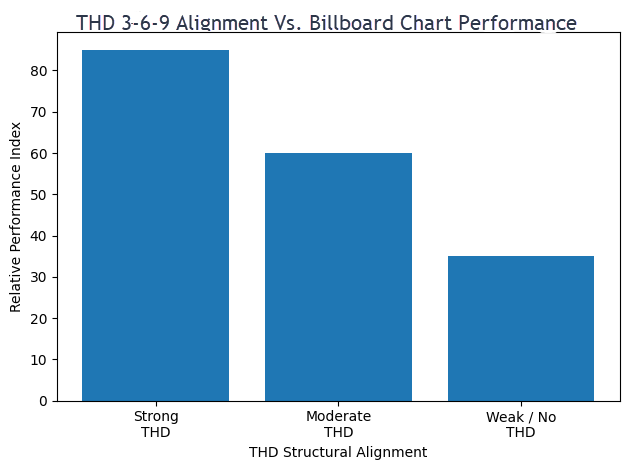
If this triadic structure reflects a general system pattern, then its prevalence in popular music should not be surprising. Songs that perform well—particularly those that persist on charts or achieve widespread engagement—tend to follow a similar arc:
- A clear identity is established early
- Tension is introduced and escalated
- A strong, memorable payoff resolves that tension
The conceptual chart introduced earlier illustrates this relationship: songs with strong alignment to this structure tend to cluster at higher performance levels, while those lacking clear buildup or resolution tend to underperform.
It is important to state clearly that this chart represents a modeled hypothesis, not a completed empirical study. However, it aligns with existing research in music cognition, which shows that listeners respond strongly to patterns of expectation, violation, and resolution.
In other words, the success of these structures may not be arbitrary—it may be grounded in how humans process information.
Seen from this perspective, Beethoven’s achievement becomes even more remarkable. He was not simply crafting a beautiful movement; he was working with a structural pattern that appears to be deeply embedded in how systems evolve.
He establishes constraint with clarity.
He allows tension to accumulate without premature release.
And then he resolves that tension in a way that preserves identity while achieving coherence.
This is why the piece feels inevitable.
It is not just well composed—it is structurally aligned with a broader pattern of organization.
Final Reflection
What we call “beautiful” in music may not be purely subjective. It may arise when a system unfolds in a way that mirrors deeper organizational principles—when constraint, tension, and resolution are balanced in a way that feels both surprising and necessary.
The recurring presence of 3–6–9-like structures in music, then, is not simply tradition or coincidence. It may reflect something more fundamental:
Systems become meaningful when they pass through tension and arrive at coherence without losing their identity.
Beethoven’s Seventh does exactly that.
And when we listen, we are not just hearing sound—we are recognizing a pattern we already understand.