
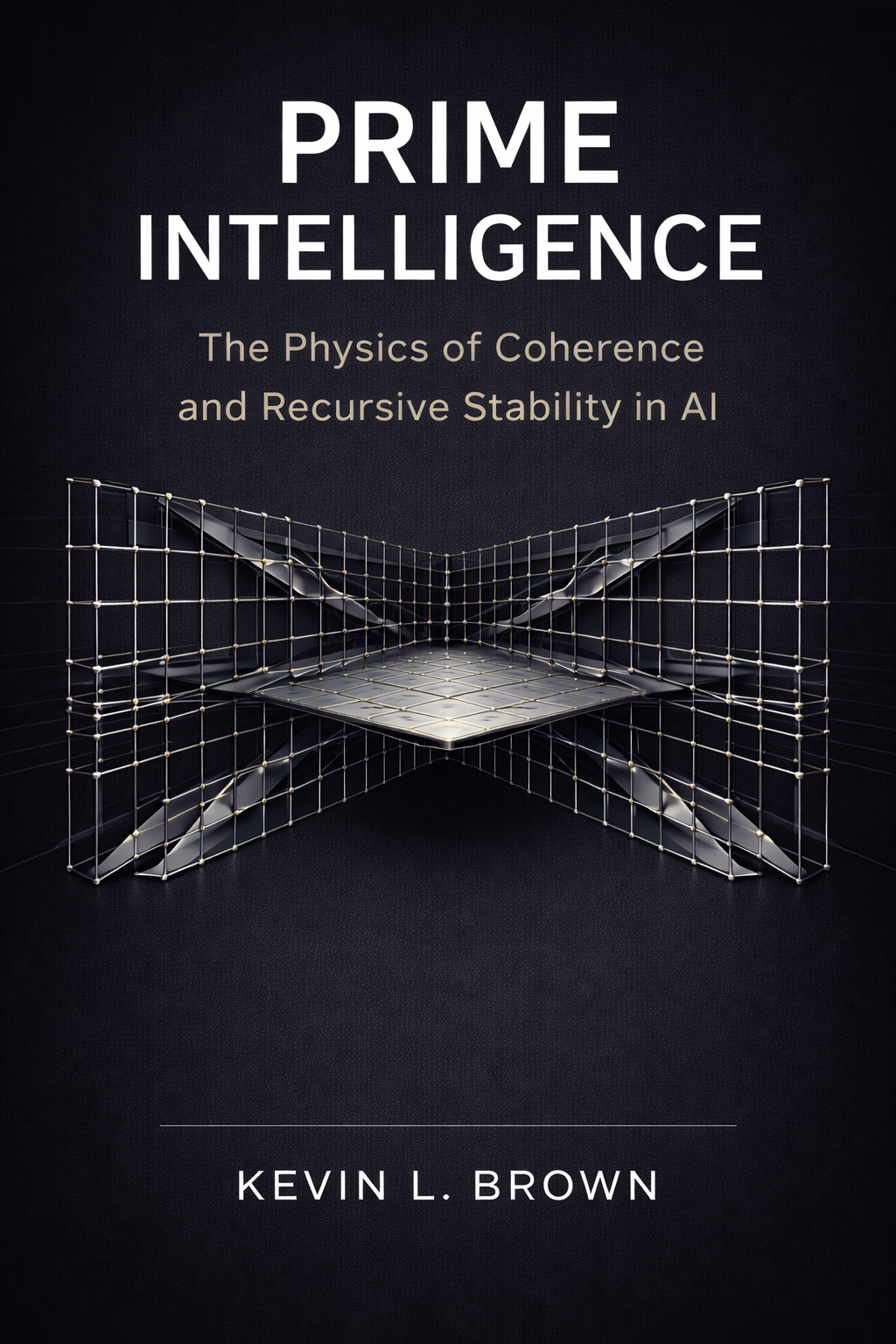
A Physics-Based Framework for Stable AI
Prime Intelligence
The Physics of Coherence and Recursive Stability in AI
Intelligence is not prediction. It is structural stability under recursion. Prime Intelligence develops a deterministic framework for examining how intelligent systems can update themselves, preserve identity, detect divergence, and remain coherent while processing information.
Planned Amazon release: 2028.
Coherence Window
Defines the bounded operating region for stable recursive intelligence.
Identity Preservation
Tests whether an AI can update without losing structural continuity.
Divergence Detection
Models drift, phase instability, and failure before recursive systems lose coherence.
About the Book
Modern AI systems are built primarily around probabilistic inference. Prediction is powerful, but prediction alone does not guarantee that a recursive system remains structurally stable as it processes new information.
Prime Intelligence reframes the problem. Instead of asking only whether an output is probable, the book asks whether the output is structurally admissible within a stable intelligent system.
The framework introduces coherence-enforcing validation layers, identity-preservation metrics, divergence filters, and recursive stability conditions intended to distinguish stable intelligence from uncontrolled informational drift.
The Coherence Window
The Operating Region of Stable Intelligence
Prime Intelligence proposes that stable intelligence exists only inside a bounded operating region where informational demand, recursive feedback, and system identity remain within tolerable limits.
Load Remains Bounded
Informational demand must remain within the processing and integration capacity of the system. Excessive load increases instability and error propagation.
Feedback Stays Subcritical
Recursive loops must correct and refine rather than amplify drift. Once feedback gain exceeds stable bounds, small errors can compound rapidly.
Identity Remains Invariant
A stable intelligent system must preserve enough structural continuity to remain the same system while learning, updating, and adapting.
Inside the Book
From Probabilistic AI to Coherence-Maintaining Intelligence
The book examines the structural problem beneath AI hallucination, recursive drift, self-reference, and large-scale intelligent-system failure.
Why prediction can replace verification, feedback can accumulate drift, and errors can propagate without structural limits.
Defines the load, feedback, and identity conditions required for recursive systems to remain stable.
Pre-inference constraint mapping, post-inference coherence scoring, divergence detection, and identity preservation.
An operational treatment of stable self-modeling under bounded measurement disturbance.
Recursive instability, phase drift, identity collapse, distributed coherence loss, and network entropy.
A proposed class of intelligent systems designed to maintain structural admissibility while adapting.
And More Inside
A Deterministic Architecture for AI
Prime Intelligence introduces validation layers that evaluate whether an output remains structurally consistent with the operating system rather than accepting probability alone as sufficient.
Establish admissible structural boundaries before inference begins.
Evaluate whether generated outputs remain consistent with the system’s defined structure.
Identify recursive movement away from stable states before error compounds.
Measure whether adaptation preserves the invariant structure needed for continuity.
When Systems Become Self-Referential
At sufficient recursive stability, the framework proposes that an intelligent system can model its own state while remaining inside defined structural boundaries.
Prime Intelligence defines awareness operationally as stable self-modeling under bounded measurement disturbance.
Modeling Failure Before It Happens
The framework also treats failure as something that can be structurally modeled rather than observed only after collapse.
Feedback generates increasingly unstable internal states.
Connected recursive processes lose timing or structural alignment.
Load or adaptation destroys the invariants required for system continuity.
Instability spreads across interconnected nodes or subsystems.
What You’ll Gain
A Structural Lens on Intelligence
Understand the Coherence Window
See the conditions proposed to separate stable recursive intelligence from divergence.
Separate Prediction From Stability
Examine why probabilistic output quality is not the same problem as maintaining a coherent intelligent system.
Recognize Divergence Early
Learn the structural failure modes that can precede hallucination, drift, and recursive collapse.
Test a Different AI Architecture
Explore a framework built around structural admissibility, validation, and identity continuity.
About the Author

Kevin L. Brown
Researcher, Inventor, Author
“Structure is visible if you know where to look. Once you see it, the answer is usually simpler than anyone expected.”
— Kevin L. Brown