
An Open Invitation to Test the 3-6-9 Pattern
“Every genuine test of a theory is an attempt to falsify it.”
— Karl Popper
Triune Harmonic Dynamics (THD) proposes that transformation across many classes of systems can be described through a recurring structural progression:
Emergence → Contrast → Integration (3–6–9)
In operational terms:
A coherent structure forms → coherence-relevant tension develops → under specified conditions, that tension must produce a measurable resolution response.
The resolution may occur through adaptation, compensation, reorganization, release, transition, degradation, or breakdown, depending on the particular THD claim and domain being tested. THD is presented as a testable framework, not merely as a philosophical description.
This bounty therefore asks a simple question:
Can a system satisfy the published premises of a THD prediction, reach the exact condition under which THD predicts resolution, and nevertheless preserve its original coherent state without any of the prospectively defined resolution outcomes occurring?
A $10,000 bounty is offered to any individual, research group, or institution that demonstrates such a reproducible counterexample to an eligible registered THD claim. If a qualifying counterexample survives technical review and independent replication, the affected THD claim must be revised or rejected.
“Do not try to confirm the pattern—force it through tension and see if it still resolves.”
— Kevin L. Brown
Scope of the Challenge
The purpose of this bounty is to determine whether published THD predictions survive deliberately adversarial testing.
The bounty rewards:
- reproducible empirical contradictions
- rigorous mathematical counterexamples
- computational counterexamples
- clearly defined formal systems
- pre-specified variables and measurements
- independently verifiable results
- direct contradictions of registered THD predictions
It does not reward:
- philosophical objections
- semantic reinterpretations
- alternative theories without demonstrated contradiction
- contradiction of a claim THD did not actually make
- systems that fail to instantiate the premises of the registered claim
- arbitrary variables that grow without affecting the coherent state being tested
- experiments that never reach the registered falsification condition
- contradiction of an external or auxiliary model that THD did not prospectively adopt
- post-hoc redefinition of the system, metrics, thresholds, assumptions, or resolution criteria
A genuine counterexample to one eligible registered THD claim is sufficient. A challenger does not need to disprove every THD application simultaneously.
AI-Assisted Falsification
Challengers may use AI systems, computational search, simulation, automated theorem tools, optimization methods, or other analytical tools to identify potential counterexamples to registered THD claims. A candidate proposed by an AI does not itself establish falsification. The resulting counterexample must satisfy the same registered assumptions, evidence, reproducibility, and independent-verification requirements as any other submission. THD may also use independent AI systems adversarially to search for weaknesses or falsification candidates in its own registered claims.
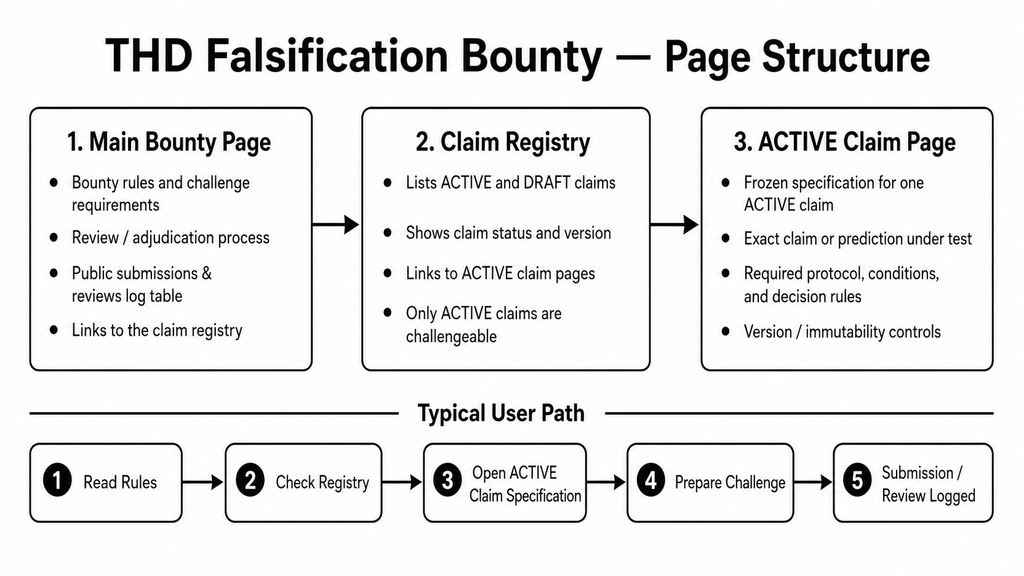
THD Falsifiable Claim Registry
The bounty applies to specific THD predictions that have been prospectively registered with explicit falsification conditions. Each eligible claim identifies the system under test, assumptions, coherence metric, qualifying Contrast, falsification-activation condition, required test domain, predicted resolution outcomes, and exact observation that would falsify the claim.
Only claims listed as ACTIVE in the THD Falsifiable Claim Registry are eligible for bounty adjudication under the Registered Claim Standard.
The Two-Layer Falsification Standard
The bounty operates through two separate layers.
Layer 1 — Bounty Adjudication Rules
This page defines the general standards governing:
- eligibility
- causal relevance
- system boundaries
- evidence
- replication
- neutrality
- versioning
- adjudication
- prohibition of post-hoc rule changes
These rules determine how a challenge is judged.
Layer 2 — THD Falsifiable Claim Registry
Individual THD predictions eligible for the bounty are published separately in the THD Falsifiable Claim Registry. Each registered claim determines what THD predicts and exactly what observation would falsify that prediction. The bounty rules do not invent a missing threshold, metric, assumption, or falsification condition during adjudication. If THD has not prospectively specified a falsifiable prediction for a particular system or condition, reviewers may not manufacture one after a challenger submits a result.
Registered Claim Standard
Every bounty-eligible THD claim must be published before the counterexample outcome is known and assigned a unique claim identifier and version.
A registered claim should specify, as applicable:
- S — System: the system, system class, and boundary
- A — Assumptions: the conditions under which the prediction applies
- C — Coherence: the original coherence-bearing property and its measurement
- B — Contrast: the coherence-relevant burden, divergence, stress, error, incompatibility, perturbation, or equivalent quantity
- F — Falsification Activation Condition: the prospectively defined condition under which the THD prediction becomes exposed to contradiction
- T — Test Domain: any required duration, iteration count, parameter interval, state range, or observation window
- R — Resolution Outcomes: the measurable outcomes THD predicts must occur
- X — Exact Falsifier: the observation or proof that would contradict the claim
A threshold is only one possible form of F.
Depending on the domain, F may instead be:
- a scalar threshold
- a vector condition
- a stability boundary
- a mathematical region
- a logical conjunction
- a statistical condition
- a finite-time condition
- a control constraint
- a recursive error condition
- a state-space condition
- another objectively testable trigger
THD does not require all domains to use the same mathematical form.
The Core Falsification Logic
A registered THD prediction can be represented generally as: A∧F⇒R
where:
- A represents the applicable frozen assumptions,
- F represents the registered falsification-activation condition,
- R represents one or more prospectively defined resolution outcomes.
A valid counterexample must reproducibly establish: A∧F∧¬R
while the registered original coherence condition remains satisfied for the required test domain.
Where several resolution outcomes are permitted: R=R1∨R2∨⋯∨Rm
the challenger must demonstrate: ¬R1∧¬R2∧⋯∧¬Rm
under the same frozen conditions.
In plain language:
THD must state beforehand what it predicts. The challenger must reproduce the conditions under which that prediction applies and show that the predicted resolution does not occur.
If those two propositions cannot simultaneously be true, THD has encountered a falsifying result.
Exact-Claim Requirement
A bounty submission must identify the exact registered THD claim being challenged.
General explanatory statements such as:
Emergence → Contrast → Integration
describe the framework’s structural hypothesis but are not substitutes for a registered falsification specification. A challenger may not transform general explanatory prose into a stronger mathematical claim than THD has actually published. Likewise, THD may not weaken or reinterpret a registered prediction after a challenger produces an inconvenient result. The test is against the frozen registered claim.
Prospective Registration Requirement
A THD claim becomes bounty-eligible only after its falsification specification has been publicly registered. The registration must occur before the result offered as its counterexample is known. A registration must contain sufficient information for an independent challenger to determine in advance:
- what system is being tested,
- what conditions must be satisfied,
- what property counts as coherence,
- what counts as qualifying Contrast,
- what activates the prediction,
- how long or over what mathematical domain the condition must persist,
- what outcomes count as THD resolution,
- and what result would falsify the claim.
A challenger is not responsible for inventing missing falsification criteria on THD’s behalf. If a THD proposition does not yet provide sufficient operational detail for these questions to be answered, that proposition is not yet bounty-eligible. It may later become eligible through prospective registration.
Claim Immutability
Every registered claim must have a unique identifier and version, for example:
THD-LS-001 v1.0
Once a qualifying challenge is received against that version, the claim specification relevant to that challenge is frozen.
THD may revise the claim prospectively, for example:
THD-LS-001 v1.1
but a later revision cannot be applied retroactively to defeat a submission filed against v1.0. Likewise, a challenger may not substitute a different claim version after seeing which one is easier to contradict. The applicable version is the one publicly active when the submission is received.
Operational Definitions
Emergence
Emergence is the establishment of a measurable organized state, structure, relationship, function, synchronization, equilibrium, pattern, or other registered form of coherence. The applicable registered claim must specify what constitutes the original coherent state.
Contrast
Contrast is a measurable increase in divergence, stress, incompatibility, error, instability, mismatch, uncertainty, load, perturbation, conflicting constraint, distributional pressure, recursively propagated distortion, or another objectively defined challenge to coherence. A quantity does not qualify as Contrast merely because its numerical value increases.
Qualifying Contrast must:
- be part of, or causally coupled to, the system under test;
- demonstrably affect or burden the registered coherence-bearing property;
- act along the realized trajectory actually used in the challenge;
- satisfy whatever additional conditions the registered THD claim assigns to B and F.
A variable may be mathematically divergent without being structurally relevant.
Causal Coupling Requirement
The connection between the claimed Contrast and the registered coherent state must be demonstrated rather than assumed.
Acceptable evidence may include:
- analytical dependence
- governing equations
- nonzero coupling terms
- sensitivity analysis
- intervention experiments
- transfer functions
- perturbation-response measurements
- controlled alteration or removal
- causal propagation through an update rule
- another reproducible demonstration appropriate to the domain
For a formal or mathematical system, the claimed Contrast must enter nontrivially into the update law, constraint, state relation, or observable associated with the coherence-bearing property. A divergence occurring entirely in a null, unused, orthogonal, or otherwise irrelevant degree of freedom does not qualify.
Realized-Trajectory Requirement
Global ability to influence a system is not enough. The challenger must demonstrate that the claimed Contrast actually acts upon the coherence-bearing structure along the trajectory, state sequence, experiment, or mathematical domain used to establish the counterexample. A hypothetical effect at a state the tested system never occupies does not establish realized causal coupling.
Coherence Requirement
Every eligible registered claim must prospectively define the property whose preservation or loss matters.
The coherence definition may involve:
- synchronization
- structural integrity
- functional performance
- predictive accuracy
- information preservation
- stability
- mathematical invariance
- biological function
- another objectively specified system property
A challenger may not choose a deliberately insensitive metric after the result is known. THD reviewers likewise may not introduce a new coherence metric after seeing the result. The registered definition governs the test.
Resolution Outcomes
THD resolution is not a semantic category that reviewers may define after the fact. Every registered claim must prospectively specify the applicable resolution outcomes and, where necessary, their measurable criteria.
Possible outcomes include:
- Integration
- release
- transition
- degradation
- breakdown
Not every claim must include every category. The registered claim determines which outcomes satisfy its prediction.
Integration
Integration is a tension-responsive system process that materially accommodates, redistributes, compensates for, reorganizes around, reduces, redirects, or otherwise resolves qualifying Contrast.
Possible examples include:
- adaptive reorganization
- corrective feedback
- error correction
- parameter adjustment
- synchronization correction
- redistribution of load
- learning
- redundancy activation
- resource reallocation
- structural reconfiguration
- compensatory behavior
Not every state update is Integration. Normal iteration, computation, motion, or passive response is not automatically Integration.
Conversely, an adaptive process does not cease to qualify as Integration because it is:
- internal
- autonomous
- preprogrammed
- called control
- called optimization
- called feedback
- called learning
The registered claim must define the relevant measurable criterion where classification could otherwise be ambiguous.
Passive Response
A fixed constitutive law, passive material property, static transfer function, or pre-existing nonlinear response is not automatically Integration merely because it produces a bounded or saturating response. Passive behavior must be evaluated according to the registered claim’s actual prediction. A challenger cannot be rejected simply by relabeling passive saturation as Integration.
Release
Release occurs when qualifying Contrast is measurably reduced, dissipated, discharged, transferred, reset, discarded, or otherwise removed. If release is an allowed resolution pathway for a registered claim, the claim should specify the applicable observable or criterion.
Transition
Transition is a change from the original registered coherent regime into a materially different state or operating regime. Continued existence of the system does not necessarily establish persistence of the original coherent state.
Degradation
Degradation is prospectively defined measurable deterioration of the original coherence-bearing property. Minor or microscopic changes cannot be declared degradation after the fact unless they satisfy the registered degradation criterion.
Breakdown
Breakdown is loss of the registered coherent state according to its prospectively specified failure criterion.
Minimum Effect and Decision Thresholds
Terms such as:
- meaningful
- material
- significant
- stable
- degraded
- integrated
- compensated
- persistent
may not determine a bounty decision solely through subjective interpretation. Where such terms could alter the result, the registered claim must specify a quantitative threshold, objective decision rule, or otherwise independently reproducible criterion.
For example, a claim might define: Rdegradation:C<Cmin
or: Rintegration:ΔUcontrol≥δU
or another domain-appropriate equivalent.
The purpose is not to require identical metrics across domains. The purpose is to prevent either side from deciding what counts only after seeing the outcome.
System Boundary Requirement
Every eligible claim and submission must define the relevant system boundary sufficiently to determine what is internal, external, and causally active.
The specification should identify, where applicable:
- components
- state variables
- inputs
- outputs
- internal information sources
- external information sources
- feedback pathways
- correction mechanisms
- control mechanisms
- resource inputs
- energy inputs
- termination conditions
The system boundary may not be moved after the result is known merely to include or exclude a compensatory mechanism.
Premise Requirement
A challenger must instantiate the premises of the registered THD claim.
If THD claims: A⇒R
then showing: ¬A
does not contradict that prediction.
However, only premises prospectively contained in or necessarily implied by the registered claim may be used during adjudication. THD may not add a new assumption after a result appears merely to exclude the counterexample.
Auxiliary Models and External Thresholds
A contradiction of an external model is not automatically a contradiction of THD. For example, suppose an engineering model predicts: B≥10⇒instability.
If a system remains stable at: B=12,
the direct result is evidence against that engineering prediction. It becomes a THD falsification only if the registered THD claim had prospectively adopted that model, threshold, or derivation as part of its own prediction. External models, measurements, standards, theorems, or tolerances may contribute to a THD falsification condition only when the registered claim specifies beforehand how they are incorporated. If THD voluntarily incorporates an external prediction into a registered claim, THD accepts the falsification risk associated with that choice. It may not later reject a qualifying result merely by arguing that the adopted auxiliary model turned out to be wrong.
What Does Not Qualify
Static Systems
A system that remains unchanged because no qualifying Contrast is introduced has not tested a THD Contrast-resolution prediction.
Fixed Points Without Qualifying Contrast
A stable fixed point does not falsify THD merely because it persists.
For example: F(x)=x
may remain invariant indefinitely. That establishes stability. It does not establish stability under the qualifying Contrast specified by a registered THD claim.
Exact Self-Reconstruction
A recursive process may exactly reproduce its existing state indefinitely. Exact self-reconstruction does not by itself contradict a registered THD claim concerning recursion under increasing error, distortion, approximation loss, mismatch, or another qualifying burden. The actual registered Contrast condition must be instantiated.
Divergence in an Irrelevant Dimension
Suppose: h(x1,x2)=h(x1)
while: x2→∞.
If the coherent property represented by h is independent of x2, divergence in x2 does not constitute increasing tension on that coherent property. A mathematically large quantity is not automatically a coherence-relevant burden.
Coordinate or Metric Artifacts
Qualifying Contrast cannot be created solely through:
- coordinate rescaling
- changing units
- expanding coordinate systems
- unused dimensions
- arbitrary norm selection
- autonomous counters
- geometric distances unrelated to the coherent state
The claimed Contrast must be functionally relevant.
Failure to Reach the Registered Activation Condition
A burden may be genuine, causally active, and strictly increasing yet fail to activate the applicable registered prediction.
For example, if the registered claim specifies: F:B≥K,
then an asymptotic sequence such as: Bn=K−n+11
satisfies: Bn+1>Bn
and: Bn→K,
but: Bn<K
for every finite n.
The falsification condition has therefore not been reached. If THD wishes to claim that resolution must occur during asymptotic approach rather than upon crossing K, that stronger condition must itself appear prospectively in the registered claim.
Passive Saturation Without Activation
A bounded passive response such as: B(x)=Bmax(1−e−λx)
may remain strictly increasing for every finite x.
Boundedness does not automatically disqualify the system. Nor does passive saturation automatically count as Integration. The decisive question is whether the registered falsification condition F is actually satisfied.
Hidden Compensation
A system does not qualify as a counterexample if the registered THD prediction is satisfied through measurable tension-responsive compensation such as increased:
- corrective feedback
- computation
- redundancy
- energy use
- resource allocation
- bandwidth
- control effort
- synchronization activity
- error correction
- adaptation
Such a mechanism must be demonstrated rather than merely presumed.
Failure of an Unadopted Auxiliary Model
A challenger cannot establish THD falsification merely by demonstrating that an external model, threshold, engineering estimate, biological assumption, or approximation was wrong when the registered THD claim never adopted that prediction.
Duration and Persistence
No finite empirical experiment can observe literal infinite time. Accordingly, every registered empirical claim must prospectively define the duration or persistence criterion necessary to contradict it.
This may be specified through:
- elapsed time
- number of cycles
- number of generations
- number of recursive iterations
- parameter interval
- state-space interval
- statistical persistence requirement
- another objective domain-appropriate criterion
A challenger is required to satisfy the registered criterion—not an undefined requirement for infinite observation. For mathematical systems, a proof valid over an infinite domain may establish indefinite persistence where the registered claim makes such a prediction.
Domains
Registered THD claims may address systems within domains including:
Physical Systems
- Classical mechanics
- Quantum systems
- Thermodynamic systems
- Field dynamics
- Cosmological structures
Biological Systems
- Cellular processes
- Genetic expression
- Neural systems
- Evolutionary dynamics
- Ecosystem interactions
Information Systems
- Communication networks
- Distributed systems
- Signal processing
- Control systems
- Cybernetic feedback systems
Artificial Systems
- Machine-learning models
- Recursive AI systems
- Optimization systems
- Autonomous agents
- Simulation environments
Human Systems
- Cognitive processes
- Decision-making systems
- Social dynamics
- Economic systems
- Organizational systems
Abstract / Formal Systems
- Mathematical systems
- Logical systems
- Algorithmic processes
- Symbolic systems
- Language structures
Listing a domain here does not mean every conceivable system within that domain is automatically covered by every THD prediction. The domain specified by the registered claim governs eligibility. Artificial, simulated, algorithmic, and mathematical systems are expressly eligible when a registered claim includes them.
Reference Research Areas
The following areas illustrate where registered THD claims may be developed and tested. They are not themselves substitutes for registered falsification specifications.
Latency–Synchronization Dynamics
THD research proposes that synchronized systems subjected to increasing synchronization-relevant divergence and finite corrective latency may eventually require compensation, reorganization, resynchronization, transition, degradation, or loss of coherence.
A bounty-eligible claim in this area must prospectively specify:
- synchronization metric
- qualifying divergence variable
- causal relationship
- latency condition
- falsification activation condition F
- persistence requirement T
- permitted resolution outcomes
- exact falsifier
An unrelated diverging variable attached to a synchronized system does not qualify. Neither does a challenge that never reaches the registered activation condition.
Recursive System Dynamics
THD does not claim that recursion alone necessarily causes degradation. Stable fixed points, exact reconstruction, identity mappings, and lossless recursive processes can exist. Bounty-eligible recursive claims concern explicitly registered conditions under which a coherence-relevant burden such as:
- error
- distortion
- approximation loss
- noise
- distributional change
- mismatch
- recursively propagated perturbation
is introduced into subsequent states.
A registered recursive claim must specify:
- coherence metric
- recursive burden
- propagation relationship
- falsification activation condition F
- test duration or mathematical domain T
- permitted correction or resolution outcomes
- exact falsifier
Exact self-reconstruction without the registered qualifying burden does not contradict such a claim.
Submission Requirements
Every bounty submission must provide the following.
1. Registered Claim Identification
Provide:
- claim identifier
- claim version
- publication date
- exact proposition alleged to be falsified
- when a registered claim provides its own executable test package and claim-specific falsifier, that registered claim package controls the technical adjudication.
2. Exact Prediction
State the registered prediction being challenged.
For example:
THD predicts:
[Exact registered prediction]
3. System Definition
Identify:
- domain
- system boundary
- state variables
- inputs
- outputs
- initial conditions
- coherence-bearing property
- feedback pathways
- correction pathways
- relevant resources
4. Premise Mapping
Demonstrate how the proposed counterexample satisfies each applicable assumption in the registered claim.
5. Coherence Measurement
Provide the registered coherence metric and demonstrate that the original coherent state is established.
6. Contrast Measurement
Provide:
- qualifying burden B
- evidence of causal coupling
- evidence of realized-trajectory action
- quantitative measurements where applicable
7. Falsification Activation
Demonstrate that the exact registered condition F was satisfied. A submission may not substitute a different activation condition merely because it is easier to reach.
8. Persistence Requirement
Demonstrate satisfaction of the registered duration, iteration, state-range, parameter-range, or mathematical-domain requirement T.
9. Resolution Audit
Address every resolution pathway listed in the registered claim. Demonstrate why each applicable outcome did not occur.
10. Exact Counterexample Statement
State:
THD predicts:
[Registered prediction]
Submission demonstrates:
[Observed or proven result]
Then explain why both cannot simultaneously be true under the same frozen assumptions.
11. Evidence
Provide sufficient evidence for independent review and reproduction.
Depending on the domain, this may include:
- mathematical derivations
- proofs
- source code
- dependency information
- datasets
- logs
- instrumentation outputs
- experimental procedures
- recordings
- statistical tests
- uncertainty estimates
- sensitivity analyses
Exact Contradiction Test
Every adjudication must reduce the submission to an explicit logical comparison.
THD Claim
A∧F⇒R
Challenger Result
A∧F∧¬R
with all additional registered coherence and persistence conditions satisfied.
Reviewers must then answer:
Can the registered THD prediction and the verified challenger result both be true under the same frozen assumptions?
If yes, falsification has not been established. If no, and the result survives replication and technical review, the registered THD claim is falsified.
Mandatory Adjudication Neutrality
Reviewers must apply the rules symmetrically.
Steelman the Challenger
Before looking for a reason to reject a submission, reviewers must state the strongest technically defensible version of the counterexample.
Steelman the THD Interpretation
Reviewers must then identify the strongest technically defensible reason the result may fail to contradict the registered claim.
No Semantic Protection
A submission may not be rejected merely by renaming an inconvenient behavior “Integration,” “transition,” “degradation,” or another resolution outcome.
The registered operational definitions govern.
No Semantic Loopholes
Likewise, a challenger may not turn an irrelevant increasing variable into qualifying Contrast merely by calling it:
- tension
- stress
- instability
- divergence
- entropy
- error
- pressure
- perturbation
The registered operational relationship governs.
Adjudication Process
Submissions are evaluated through three stages.
Technical Review
Independent reviewers assess:
- correct registered claim and version
- premise satisfaction
- system validity
- boundary integrity
- coherence measurement
- causal relevance of Contrast
- realized-trajectory coupling
- satisfaction of F
- satisfaction of T
- Integration
- release
- transition
- degradation
- breakdown
- measurement integrity
- mathematical correctness
- uncertainty
- whether the contradiction is actually with THD rather than an unadopted auxiliary model
Independent Replication
The result must be independently reproducible. For mathematical claims, the derivation or proof must be independently verified. For computational claims, source code and sufficient execution information must be provided. For empirical claims, the method, measurements, instrumentation, uncertainty, and relevant conditions must be sufficiently documented for independent replication appropriate to the domain.
Verification
A result is classified as a verified falsification only when reviewers determine that:
- an eligible registered THD claim is identified;
- the correct claim version applies;
- the registered assumptions are satisfied;
- the original registered coherent state is established;
- qualifying Contrast is present;
- realized causal coupling is established;
- the registered falsification condition F is satisfied;
- the registered persistence requirement T is satisfied;
- none of the registered resolution outcomes occurs;
- the original registered coherence condition nevertheless persists;
- the result is independently reproducible;
- and the result is logically incompatible with the registered THD prediction under the same frozen conditions.
If all applicable conditions are demonstrated, the registered THD claim is falsified.
Incomplete or Unregistered Challenges
A potentially interesting result is not automatically rejected merely because it cannot yet be adjudicated.
A submission may instead be classified as:
- Registered falsification candidate
- Additional evidence required
- Premises not satisfied
- Activation condition not reached
- Resolution outcome detected
- Unregistered THD proposition
- Contradiction applies only to auxiliary model
- No qualifying Contrast
- Falsification established
If a challenger identifies an important THD proposition that lacks a registered falsification specification, that issue may be recorded publicly. THD may subsequently register a prospective test for that proposition. The new specification cannot be applied retroactively to convert the earlier result into either a win or a loss.
THD Falsifiable Claim Registry
Only claims publicly listed in the THD Falsifiable Claim Registry are eligible for bounty adjudication under the Registered Claim Standard.
Each registry entry will identify:
- claim ID
- version
- publication date
- domain
- exact prediction
- assumptions
- coherence metric
- Contrast variable
- falsification activation condition
- persistence requirement
- permitted resolution outcomes
- exact falsifier
- status
- revision history
A registered claim remains independently testable even if later THD research changes or replaces it. Any revision receives a new version.
Rule Versioning and Fairness
To prevent moving the goalposts after a challenge is submitted, substantive bounty-rule revisions are dated and archived.
A submission is evaluated under:
- the substantive bounty rules publicly active when the submission was received; and
- the registered THD claim version publicly active when the submission was received.
Later clarification may explain terminology but cannot introduce a new substantive disqualification retroactively. Likewise, a challenger cannot retroactively rewrite the registered prediction. The relevant rules and claim specification remain frozen for that submission. This protects both the challenger and THD.
Award
Upon verified falsification:
- the $10,000 bounty is awarded
- the affected registered THD claim is publicly marked Falsified
- the counterexample and adjudication are recorded in the public research ledger
- the framework or affected claim is revised where required
A counterexample to one registered claim does not automatically falsify every other THD claim. The scope of the falsification will be stated precisely.
Duration
This bounty remains active through December 31, 2030, unless terminated following a verified falsification of the applicable core claim or otherwise publicly amended. Any qualifying submission received while the bounty is active remains eligible for adjudication under the rules and registered claim version applicable when the submission was received.
Final Statement
Scientific frameworks do not advance by agreement. They advance by making predictions that reality is permitted to prove wrong. The purpose of this bounty is therefore not to reward unusual constructions, nor to protect THD by redefining every possible result as confirmation. A genuine falsification must remain possible.
For every bounty-eligible THD claim, the framework must state beforehand:
These are the assumptions. This is the coherent state. This is the relevant Contrast. This is the condition under which the prediction becomes active. These are the outcomes THD predicts. And this is what would prove the claim wrong.
The challenger then has a clear task:
Reproduce those conditions and demonstrate the falsifying outcome.
If a system satisfies the registered premises, reaches the registered falsification condition, satisfies the registered persistence requirement, exhibits none of the registered resolution outcomes, and nevertheless preserves the original registered coherent state, then THD has encountered a genuine counterexample. If that result survives independent replication, the affected claim must be revised or rejected. Conversely, an irrelevant divergence, unperturbed fixed point, passive saturation that never activates the registered prediction, hidden compensatory process, or failure of an external model THD never adopted does not establish that contradiction. Failure to identify a qualifying counterexample increases tested domain coverage but does not establish THD as universally true.
The standard is intentionally simple: THD states beforehand what would prove it wrong, and the challenger is given a fair opportunity to produce exactly that result.
THD Falsification Ledger
- Bounty Issue Date: February 2026
- Status: Active
- Total Submissions: 2
- Verified Falsifications: 0
- Total Bounties Paid: $0
- Current Standard: Registered Claim Falsification Standard
| Submission Date | Submission | Response | Status |
|---|---|---|---|
| 8/18/26 | File download | File download | CLOSED – Unclaimed |
| 8/20/26 | File download | File download | CLOSED – Unclaimed |
| 9/11/26 | File download | File download | CLOSED – Unclaimed |
Version 3.0 Current (Added claim registry)
Version 2.0 Archived 8/23/26 (Amended contrast phase clarifications)
Version 1.0 Archived 8/19/26