
A Falsifiable Missing-Variable and Structural-Pressure Research Program
This paper develops a falsifiable informational-geometry hypothesis for investigating whether some phenomena currently attributed to dark matter and dark energy may reflect an omitted structural variable rather than requiring interpretation solely through conventional unseen-matter or cosmological-constant terms.
The work does not claim that dark matter or dark energy have been disproven, nor does it present a completed replacement for the ΛCDM cosmological model. Instead, it defines a staged research program designed to determine whether independently measured properties of cosmic structure—such as morphology, topology, persistence, and entropy-related organization—contain predictive information about gravitational and cosmological residuals that is not already captured by baryonic mass, environmental variables, standard halo descriptors, observational systematics, or flexibility-matched conventional models.
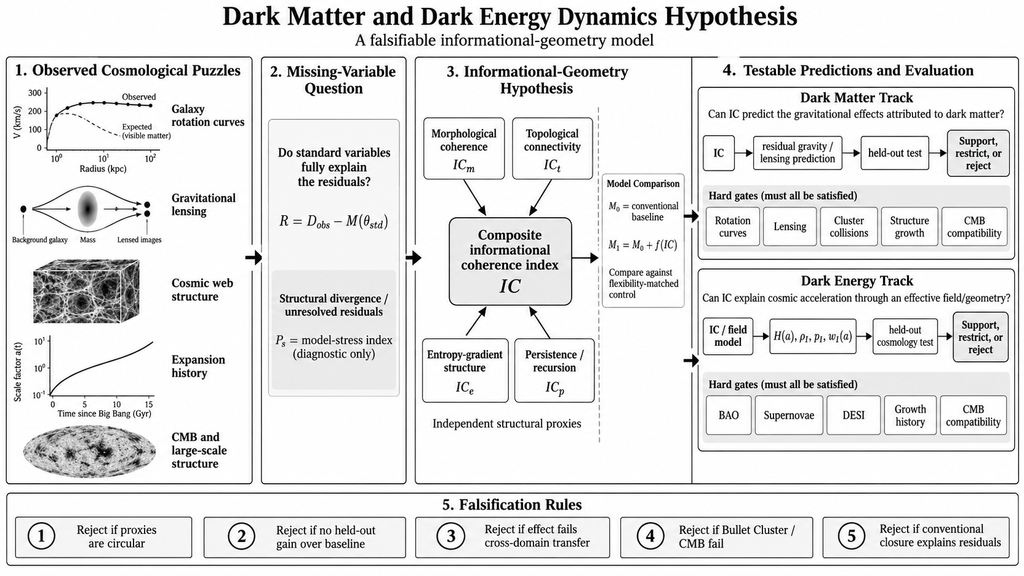
The hypothesis is developed within the Unified Informational Physics Ontology (UIPO), while maintaining a strict separation between ontology-grounded interpretation and empirical evidence. The paper introduces dimensionless structural-information proxies and specifies how they must be constructed independently of the anomalies they are intended to predict. A composite informational-coherence variable is then evaluated through preregistered, held-out model comparisons rather than retrospective fitting.
The primary near-term prediction is straightforward: if informational geometry is physically relevant, a frozen structural-information mapping should improve out-of-sample prediction of selected cosmological residuals beyond the strongest feasible conventional baseline and an equally flexible control model. The effect must also survive negative controls, external replication, and cross-domain transfer without system-specific reweighting.
The proposed test program includes galaxy rotation curves, gravitational lensing, cosmic-web topology, cluster collisions, early structure formation, expansion-history constraints, and eventual CMB and large-scale-structure tests. Particular attention is given to hard discriminators such as Bullet-Cluster-type systems, where any non-particle explanation must reproduce the observed separation between dominant lensing mass and hot baryonic gas.
The paper also distinguishes the near-term statistical hypothesis from the stronger physical interpretation. A genuine informational dark-sector theory would require a covariant field description with explicit field content, stress-energy contribution, propagation rules, initial conditions, perturbation behavior, and quantitative predictions. Such a model would have to reproduce CMB acoustic structure, matter growth, gravitational lensing, cluster-collision behavior, BAO, supernova observations, and the expansion history at competitive accuracy.
A consolidated falsification matrix specifies conditions under which the hypothesis should be rejected or restricted. These include circular proxy construction, failure of held-out prediction, lack of cross-domain transfer, inability to reproduce CMB or cluster-collision constraints, disappearance of the effect under flexibility matching, and successful conventional closure of the relevant anomalies without an informational contribution.
The purpose of the paper is therefore not to rename the dark sector, but to make the informational hypothesis scientifically vulnerable. If the proposed structural variable does not survive these tests, it should be rejected. If it does, the result would justify development of a deeper physical model of informational geometry in cosmology.