A Structural Framework for Stability in Individuals, Organizations, and Societies
Introduction: The Discovery Behind Stability
Most scientific breakthroughs do not arrive as new objects, but as new patterns.
The Coherence Map is based on one such discovery:
stable systems—across physics, biology, psychology, and civilization—organize themselves through the same three-step structural sequence.
Not metaphorically.
Not spiritually.
Structurally.
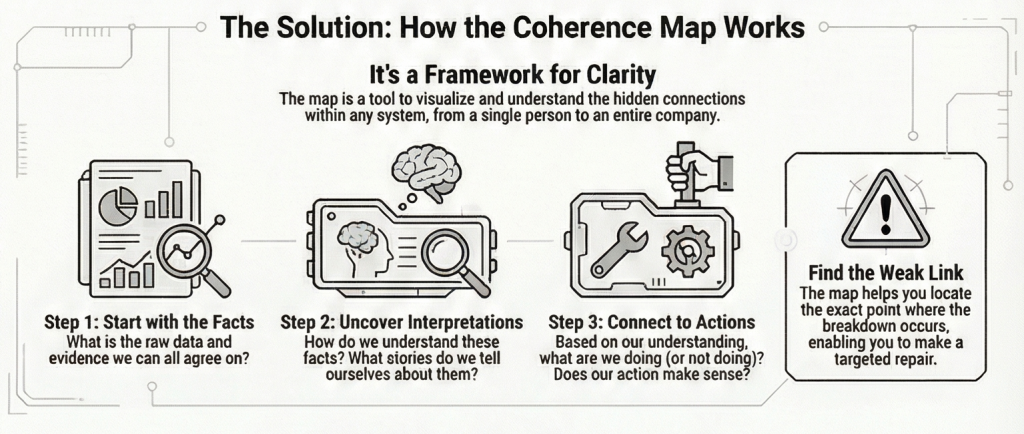
Across domains, systems move toward stability by aligning:
- Facts — what is objectively present
- Meaning — how those facts are interpreted
- Connection — whether interpretation and reality actually translate into action
When these three layers are aligned, systems stabilize.
When they are misaligned, systems fragment.
The Coherence Map Protocol (CMP) is the operational framework that makes this structure measurable, diagnosable, and correctable—at the level of individuals, teams, institutions, and civilizations.
This is not a philosophy. It is a structural model of coherence grounded in Informational Physics.
Section I — The Core Discovery: Stability Is a Three-Step Structure
Across every scale studied, stable systems follow the same progression:
Emergence → Contrast → Integration
Translated structurally:
| Phase | Structural Role | Description |
|---|---|---|
| Emergence | Facts | What exists, what is measurable, what is materially or objectively present |
| Contrast | Meaning | Interpretation, reasoning, models, beliefs, plans |
| Integration | Connection | Whether facts and meaning actually align in behavior and outcomes |
Stability does not come from facts alone.
It does not come from knowledge alone.
It comes from successful integration.
A system can be information-rich and still unstable if connection fails.
This pattern repeats fractally—from neurons to nations.
Section II — The Coherence Map
The Coherence Map converts this three-layer structure into a diagnostic system.
It asks one simple question:
Where is coherence breaking down—at the level of facts, meaning, or connection?
Instead of blame, CM provides structural diagnosis.
Instead of vague advice, it provides targeted repair.
The protocol evaluates systems across three domains:
- Foundational reality (Facts)
- Interpretive structure (Meaning)
- Relational execution (Connection)
When instability appears, CMP identifies which layer failed and why.
Section III — The Five Structural Factors (TEI)
Integration is not a feeling.
It is a constraint problem.
The Coherence Map resolves integration into five measurable structural factors, collectively called the Triune Equilibrium Index (TEI).
The Five Factors
| TEI Factor | What It Constrains | Structural Meaning |
|---|---|---|
| Stability (T) | Persistence over time | Can the system maintain direction without drift? |
| Uncertainty (Cᵤ) | Coherence under stress | Does the system hold together when information is incomplete? |
| Change (Cᵣ) | Adaptation without collapse | Can the system update without breaking identity? |
| Boundary (B) | Protection from external chaos | Is the system insulated from noise and attack? |
| Harmony (H) | Fit between action and purpose | Do actions align with stated goals and values? |
A system is only as stable as its lowest factor.
Raising one weak constraint often stabilizes the entire system.
Section IV — The Three Structural Failure Modes
Instability is not random.
It follows predictable patterns.
| Failure Mode | Layer Failed | Description |
|---|---|---|
| Factual Blindness | Facts | Missing or distorted foundational data |
| Interpretive Error | Meaning | Incorrect models, beliefs, or reasoning |
| Relational Fragmentation | Connection | Knowing the right thing but failing to act |
The most dangerous failure is relational fragmentation:
- Facts are present
- Meaning is correct
- Action still fails
This is the root of burnout, hypocrisy, institutional paralysis, and systemic decay.
Section V — Mapping Real-World Use Cases to TEI
Individual Level
| Issue | TEI Factor Low | Structural Diagnosis |
|---|---|---|
| Chronic procrastination | Boundary (B) | External noise overwhelms execution |
| Burnout | Stability (T) | Overextension without recovery |
| Anxiety under pressure | Uncertainty (Cᵤ) | Stress collapses coherence |
| Identity crisis | Change (Cᵣ) | Beliefs cannot update safely |
| Feeling “off-purpose” | Harmony (H) | Actions misaligned with values |
Organizational Level
| Issue | TEI Factor Low | Structural Diagnosis |
|---|---|---|
| Missed deadlines | Stability (T) | Direction resets too frequently |
| Crisis mismanagement | Uncertainty (Cᵤ) | Poor stress coherence |
| Failed pivots | Change (Cᵣ) | Adaptation triggers collapse |
| Security breaches | Boundary (B) | Weak operational edges |
| Culture drift | Harmony (H) | Mission-action mismatch |
Societal Metrics
GDP measures output, not coherence.
CMP allows GDP to be contextualized:
- High GDP + low Boundary (B) → fragile prosperity
- High GDP + low Change (Cᵣ) → growth without adaptability
- Rising GDP + falling Harmony (H) → misaligned economic expansion
GDP becomes meaningful only when nested inside TEI.
Section VI — Predictive Power and Falsifiability
CMP makes testable predictions:
- Systems with higher TEI persist longer under stress
- Drops in Boundary (B) precede external failure
- Drops in Change (Cᵣ) precede revolutions or collapse
- Repairing the lowest TEI factor raises overall stability
How to falsify CMP:
- Show high-TEI systems collapsing without warning
- Show targeted TEI repair failing to improve outcomes
- Show instability emerging without constraint failure
If these predictions fail, the model must be revised or rejected.
Section VII — Why This Changes Problem-Solving
Old model:
“Try harder. Be better. Fix everything.”
Coherence Map model:
“Find the weakest structural constraint and repair only that.”
This replaces moral judgment with engineering logic.
Flow is not luck.
Stability is not personality.
Failure is not weakness.
They are structural states.
Conclusion — Coherence Is a Physics Problem
The Coherence Map shows that stability is not achieved through effort alone, but through alignment.
Facts must be accurate.
Meaning must be sound.
Connection must be real.
When those three align—through balanced TEI constraints—systems stabilize naturally.
This applies to:
- People
- Teams
- Economies
- Civilizations
The universe does not reward force.
It rewards coherence.
And coherence is measurable.