
THD GPT
Triune Harmonic Dynamics System Tester
Analyze • Model • Validate
THD GPT helps you test whether the Triune Harmonic Dynamics pattern—Emergence → Contrast → Integration—provides a useful, specific, and challengeable explanation of a dynamic system. Enter a system, question, process, or dataset and inspect what fits, what does not, where pressure builds, and what evidence would strengthen or weaken the mapping.
How It Works
A simple process for moving from a system or dataset to a testable THD interpretation.
Define the System
Identify the dynamic system, process, event, problem, or dataset you want THD GPT to examine.
A clear system boundary helps prevent vague or overly broad THD mappings.Build Your Prompt
Use the guided Prompt Builder below to provide your question, evidence, time scale, constraints, and analysis mode.
Required fields are clearly marked, and each field explains why the information improves the analysis.Generate, Copy & Run
Generate the completed prompt, copy it once, open THD GPT, and paste it directly into the chat window.
The full THD testing protocol is added automatically, including evidence separation, alternatives, confidence, and falsification checks.Review and Apply
Inspect what fits, what feels forced, what alternatives explain the same evidence, and what would falsify the THD reading.
The goal is not to prove THD automatically. Misses, weak fits, and failed mappings are part of the test.Key Features
- Analyze your own data or system description
- Map Emergence → Contrast → Integration
- Distinguish strong fits from vague or forced mappings
- Compare the THD reading with alternative explanations
- Make misses, edge cases, and failure conditions visible
- Generate technical and plain-language interpretations
What You Need
- A system, domain, process, event, or dataset
- A clear question, hypothesis, or comparison
- Enough context to define what is changing over time
- Access to THD GPT
- Optional data files, parameters, or constraints
- No prior expertise in THD required
Best For
- Science and natural systems
- Organizations and business processes
- Markets, technology, and adoption cycles
- Biology, ecology, and network behavior
- Culture, history, communication, and public systems
- Any dynamic system where change can be observed
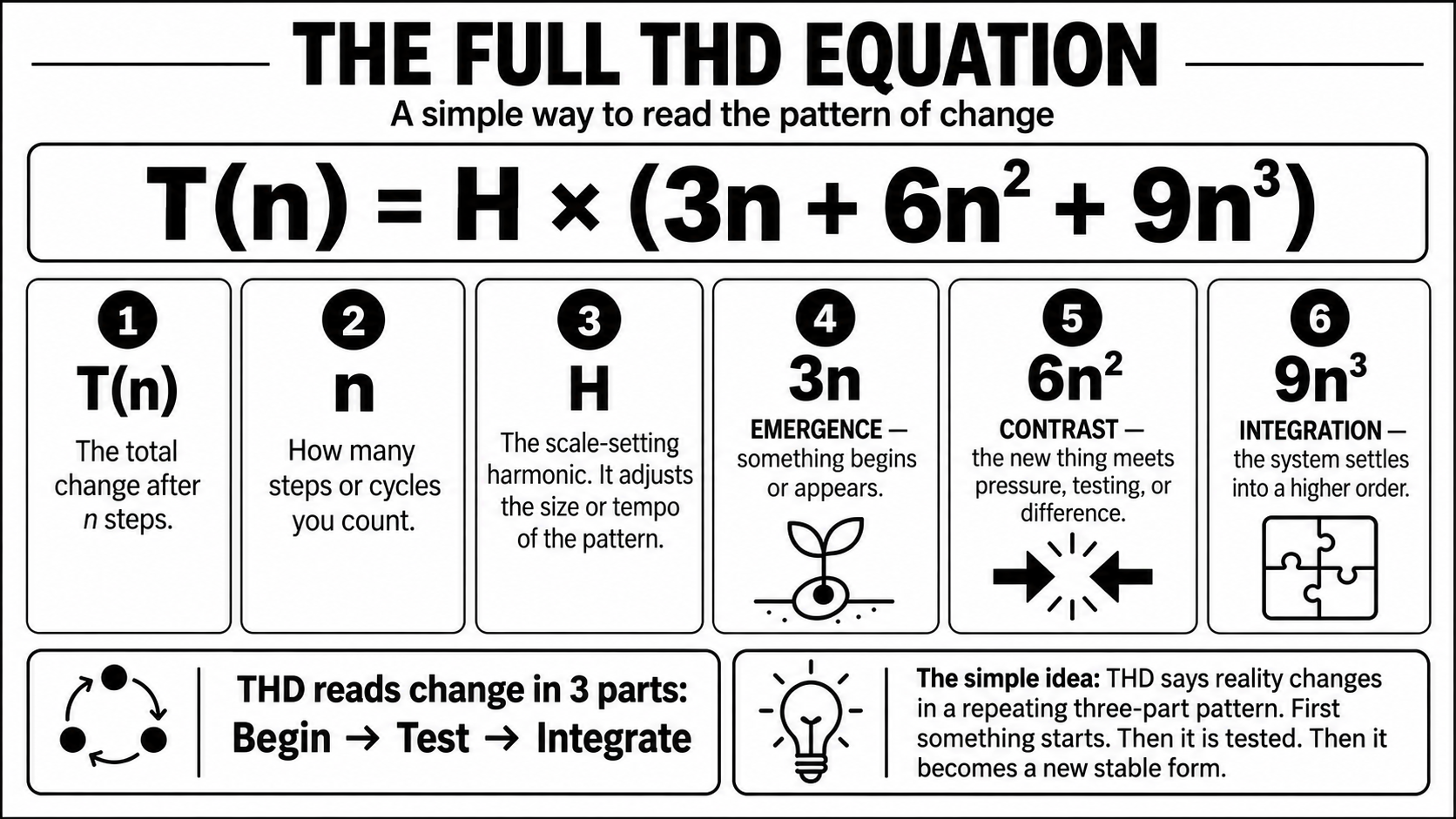
The THD Equation
Use this visual as a quick reference for the components of the THD equation before building a test. The prompt builder below focuses on giving THD GPT enough system evidence to test those relationships rather than simply matching a three-part story.
50 Systems to Test with THD
Use these examples for ideas when choosing a system, process, or domain to test.
Build Your THD Prompt
Answer the guided questions below. The builder will combine your information with the full THD testing protocol and create a prompt you can paste directly into THD GPT.
Your Generated THD Prompt
Review or edit it if needed, then copy it directly into THD GPT.
Ready to Explore Your Data?
Open THD GPT and test the pattern against a system of your choice.