
The First Six Transitions of Creation in a Twelve-Position Systems Architecture
The opening chapter of Genesis is usually approached as a theological account of creation, a historical chronology, a symbolic narrative, or some combination of the three. Much of the modern discussion therefore centers on questions of time: Were the six days literal twenty-four-hour periods? Were they symbolic epochs? Does the sequence agree with modern cosmology? Those questions are legitimate, but they can obscure another feature of the text that is comparatively easy to overlook. Genesis does not merely list things that appear. It presents creation as an ordered progression in which each stage establishes conditions that make the next stage possible.
That observation creates an unexpected point of comparison with the Calista Loop, a twelve-position recursive systems architecture developed to describe increasing levels of informational and organizational structure. The Calista Loop begins with convergence and proceeds through differentiation, boundedness, relation, dynamics, persistence, endogenous maintenance, representation, recursion, integration, coherence, and reconvergence. It is not intended as a theological model. It was developed as a formal systems hypothesis in which each position represents a state class and each transition represents an operation that moves a system into a structurally richer condition.
The question examined here is therefore not whether the Bible secretly contains the Calista Loop, nor whether Genesis constitutes scientific evidence for a modern informational architecture. The more precise question is whether the first six creative transitions described in Genesis exhibit the same structural ordering as the first six transitions of the Calista Loop.
That distinction matters because the six days do not represent the entire Calista architecture. They appear, under this hypothesis, to describe the beginning of the process rather than its completion. The first six transitions carry the system from an initially convergent condition through differentiation, boundedness, relation, dynamics, persistence, and finally endogenous maintenance. The remaining Calista positions continue beyond this initial creative sequence into representation, recursion, integration, coherence, and eventual reconvergence.
The comparison is therefore not “six days equal six positions.” It is more structurally precise:
an initial state plus six transformations produces seven increasingly complex system states.
That formulation preserves the distinction between states and transitions that is fundamental to the Calista architecture itself. The Calista paper explicitly defines the nodes as state classes and the arrows between them as transformations. Earlier formulations that mixed operations with states were rejected for exactly this reason.
Seen in that way, Genesis becomes interesting not merely as a creation story, but as a possible description of progressive systems formation.
The Calista Loop as a Systems Architecture
The Calista Loop proposes twelve non-equivalent positions through which informational systems can be analyzed:
| Position | Calista state | Plain-language meaning |
|---|---|---|
| 1 | Convergent | Unity or common convergence condition |
| 2 | Differentiated | Distinguishable alternatives |
| 3 | Bounded | Individuated domains or identities |
| 4 | Relational | Defined relationships or couplings |
| 5 | Dynamical | Change through time |
| 6 | Persistent | Organization that remains through change |
| 7 | Endogenously Maintained | Systems that help preserve their own viability |
| 8 | Representational | Internal encoding or modeling |
| 9 | Recursive | Operations upon representations or self-models |
| 10 | Integrated | Differentiated components organized together |
| 11 | Coherent | Integrated organization satisfying a compatibility criterion |
| 12 | Reconvergent | Return toward the convergence class |
The sequence is intended to preserve distinctions that disappear if the architecture is compressed too aggressively. Difference is not the same thing as boundary. A boundary does not automatically establish a relationship. A relationship may remain static rather than dynamic. Dynamics may be transient rather than persistent. Persistence does not imply that the system actively maintains itself. Representation can exist without recursion, integration can occur without coherence, and coherence does not automatically imply convergence.
These distinctions are what make the Genesis comparison potentially meaningful. If the biblical sequence merely used six broad concepts that could be arranged arbitrarily, the correspondence would have little value. The stronger hypothesis is that the sequence preserves dependencies similar to those found in systems architecture.
The Calista paper also warns against treating historical numerical correspondences as evidence. Twelvefold structures have appeared in many traditions, but numerical resemblance alone does not establish a common mechanism. The scientific burden remains whether the proposed distinctions and ordering provide explanatory or predictive value.
The same standard should apply here. The question is not whether Genesis contains the numbers six or seven. The question is whether the sequence of transformations exhibits meaningful structural correspondence.
Before Day One: The Starting Condition
Genesis begins before the first creative day with an already-described condition. The earth is characterized as formless and void, darkness is over the deep, and the Spirit of God is described as moving over the waters. Whatever theological interpretation is adopted, the narrative begins before the first pronounced distinction.
This matters for the Calista comparison because the Calista Loop also does not begin with differentiation. Position 1 is Convergent.
A convergent state in Calista is not defined as absolute nothingness. It is a state satisfying the declared convergence conditions, and the architecture explicitly allows such a state to contain internal structure. Convergence therefore does not require a featureless void.
This creates an important structural possibility. Genesis may not begin with “nothing” in the strict philosophical sense. It begins with a condition that has not yet undergone the sequence of separations, relations, cycles, and organized forms described afterward.
The first Calista transition therefore begins from convergence rather than from nonexistence.
That starting point matters because the architecture that follows can be understood as progressive differentiation of an initially unresolved condition.
Day One: Differentiation
The first explicit creative act in Genesis is the appearance of light. Immediately afterward, light is distinguished from darkness.
This is perhaps the clearest correspondence in the entire comparison.
Calista Position 2 is Differentiated. A differentiated state contains alternatives that are operationally distinguishable. The formal requirement is that the number of distinguishable states increases relative to the convergent input.
Genesis follows the same basic structural pattern. Before the first transition, the narrative presents darkness over the deep. After the transition, there is a distinction:
light and darkness,
day and night.
The important systems property is not simply that light appears. It is that the system now contains distinguishable alternatives.
The first act of creation is therefore an act of differentiation.
This point is deeper than it initially appears. Complex systems cannot be structured until meaningful distinctions exist. A boundary cannot exist without something being distinguishable from something else. Relationships cannot be specified unless relata can be identified. Dynamics cannot be measured unless states can change relative to one another.
Difference is therefore logically early in almost any architecture of organization.
Genesis places it first.
The initial comparison can consequently be expressed as:
Convergent → Differentiated
or, in the narrative vocabulary:
undifferentiated starting condition → light and darkness.
Day Two: Boundary Formation
The second day describes separation of waters. An expanse is established between waters above and waters below.
The important change is that Genesis has moved beyond simple distinction.
On Day One, two states become distinguishable. On Day Two, regions become separated.
That is closely aligned with Calista Position 3: Bounded.
A bounded state permits segmentation into a system and an environment or complement, with a nontrivial boundary. The Calista paper emphasizes that difference alone does not establish bounded identity. Two conditions may be distinguishable without yet forming separate domains.
This creates a very clean structural distinction between the first two creative transitions.
Day One answers:
What is different?
Day Two answers:
What is separated?
Those questions are not equivalent.
The Genesis sequence therefore resembles the Calista dependency:
Differentiation → Boundary.
First, alternatives become distinguishable. Then domains become segmentable.
This is a systems requirement that appears across many scales. A cell cannot maintain a distinct internal state without a membrane. An organism cannot be individuated without some operational boundary between itself and its environment. A nation requires boundaries, whether physical or institutional. A software process requires some distinction between internal and external states.
Boundaries transform difference into identity.
Genesis places this operation second.
Day Three: Relational Organization
On the third day, the waters beneath the heavens are gathered, dry land appears, and land and seas become named domains. Vegetation also appears.
This day is more complex than the first two because several forms of organization emerge at once. The system is no longer merely partitioned. The differentiated and bounded domains now participate in an organized arrangement.
Calista Position 4 is Relational. A relational state contains a defined relation, dependency, comparison, or coupling between bounded states or domains. Mere coexistence is insufficient. There must be some relationship that can be meaningfully specified.
Day Three appears to move creation into this regime.
The waters are gathered in relation to the dry land. Land becomes a substrate from which vegetation emerges. The domains established through earlier differentiation and separation are now involved in organized dependencies.
The sequence has therefore progressed from:
difference,
to separation,
to relationship.
This progression matters because relationships require entities or domains capable of standing in relation to one another. Calista preserves boundedness and relationality as separate positions precisely because bounded systems can coexist without meaningful coupling.
Genesis appears to preserve the same distinction.
There is, however, an important complication. Vegetation is already biological, while the Calista architecture associates the strongest formal life threshold with Position 7, Endogenously Maintained. The correspondence therefore cannot be interpreted as a claim that each Genesis day introduces only one Calista property for the first time.
A better interpretation is that each day establishes a dominant architectural transition while later-stage properties can appear locally or partially within the developing system.
That qualification is important. The Calista paper itself warns that real systems may instantiate multiple properties simultaneously, move backward, skip stages under external support, or follow a partially ordered network rather than a perfectly rigid chain.
The Genesis comparison should therefore be treated as an architectural sequence rather than a claim that every object created on a given day occupies exactly one Calista class.
Day Four: Dynamics and Ordered Time
The fourth day establishes the sun, moon, and lights in the heavens as regulators of signs, seasons, days, and years.
Structurally, something new has happened.
The previous stages established distinction, domains, and organized relations. Day Four introduces explicitly patterned change through time.
That corresponds naturally to Calista Position 5: Dynamical.
A dynamical state changes under an evolution operator. A static relationship does not qualify merely because multiple entities are connected. Dynamics require state evolution.
The language of Day Four is striking in this regard because the celestial bodies are not described merely as objects occupying locations. They function as regulators of recurring temporal structure.
Day and night.
Signs.
Seasons.
Days.
Years.
The system now contains cycles.
This distinction between spatial organization and temporal organization may be one of the strongest features of the Genesis-Calista comparison.
Days Two and Three organize domains.
Day Four organizes change.
A system can contain relationships without those relationships evolving in an ordered temporal manner. The introduction of cycles therefore represents a genuine increase in organizational depth.
Within Calista terminology, the transition becomes:
Relational → Dynamical.
The created environment is no longer simply arranged. It evolves.
Day Five: Persistence Through Reproduction
On Day Five, the waters bring forth living creatures and birds fill the skies. The organisms are instructed to be fruitful and multiply.
The obvious interpretation is that animals now appear, but systems analysis suggests another property worth emphasizing: persistence.
Calista Position 6 is Persistent. A persistent state retains recognizable organization through dynamical change for a declared duration or range of perturbation. A process can be dynamic without being persistent. It can emerge briefly, fluctuate, or disappear.
Reproduction creates a biological mechanism by which organization can persist through time even though individual organisms do not.
This is a significant transition.
Dynamics describe change.
Persistence describes what survives change.
The command to “be fruitful and multiply” can therefore be read not merely as population growth, but as continuity of organizational form.
The individual organism is temporary. The living pattern can continue.
In this sense, reproduction is a persistence mechanism.
This does not mean that persistence first becomes possible on Day Five. Stable land, seas, and celestial cycles obviously exhibit persistence already. Instead, Day Five makes persistence an explicit property of living populations. Organizational continuity becomes active across generations.
The correspondence is therefore best understood as an intensification of a system capability rather than the first appearance of the capability anywhere in creation.
That distinction prevents the comparison from becoming artificially rigid.
Day Six: Endogenous Maintenance
Day Six introduces terrestrial animals and humanity.
This is where the first six Calista transitions reach Position 7: Endogenously Maintained.
An endogenously maintained system does more than persist. It contains internal processes that causally contribute to preserving the conditions of its own viability. Calista specifically distinguishes this from passive persistence and generic self-organization. The architecture identifies Position 7 as the region most naturally associated with the emergence of life, although it does not define every self-maintaining system as biological life.
This distinction is fundamental.
A rock may persist.
A planet may persist.
A crystal may maintain structure.
A living organism does something more. It metabolizes, repairs, regulates, responds, reproduces, and continuously participates in maintaining the conditions under which its organization survives.
Life therefore adds causal self-maintenance.
By Day Six, Genesis depicts a world populated by organisms capable of maintaining themselves, interacting with their environments, reproducing, and occupying differentiated ecological roles.
Humanity adds still more complexity, including language, representation, planning, social organization, and reflective cognition. Those properties already point toward later Calista positions such as Representation and Recursion.
That observation is important because creation does not stop at Position 7.
The first six transitions describe only the beginning of the Calista developmental arc.
The Six-Day Overlay
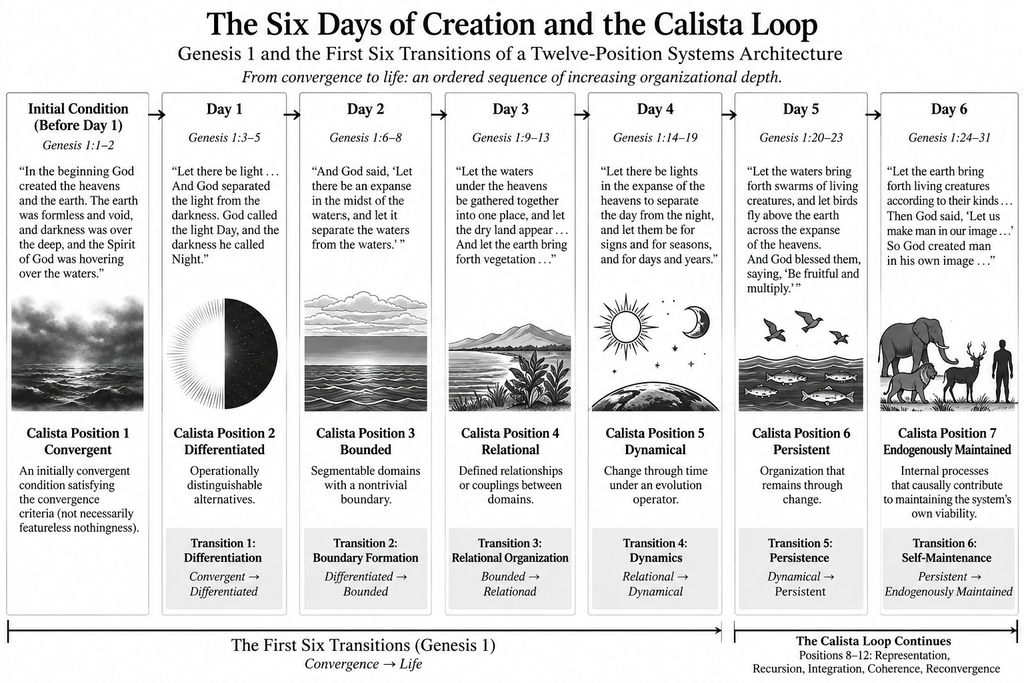
The comparison can now be summarized as follows:
| Genesis sequence | Dominant structural operation | Resulting Calista state |
|---|---|---|
| Pre-Day-One condition | Initial convergence | 1. Convergent |
| Day One: light and darkness | Distinction | 2. Differentiated |
| Day Two: waters separated | Segmentation and boundary | 3. Bounded |
| Day Three: land, sea, vegetation | Organized coupling | 4. Relational |
| Day Four: luminaries, seasons, days, years | Temporal evolution | 5. Dynamical |
| Day Five: creatures multiply | Continuity through change | 6. Persistent |
| Day Six: terrestrial life and humanity | Internal self-maintenance | 7. Endogenously Maintained |
This progression closely parallels the human-language translation already used in the Calista paper:
Unity → Difference → Self/Identity → Relationship → Experience/Change → Form → Life.
The correspondence becomes more interesting because it is sequential rather than merely thematic.
A reordered sequence would be structurally weaker.
Boundaries require distinctions.
Relationships require identifiable domains.
Dynamics require states capable of changing relative to one another.
Persistence becomes meaningful only within dynamics.
Self-maintenance presupposes persistent organization that can be maintained.
The dependencies are not arbitrary.
Creation Does Not Stop After the Sixth Transition
This point is essential because the Genesis comparison could otherwise create the false impression that Calista ends with biological life.
It does not.
Position 7 marks only the threshold at which systems contain internal processes that preserve their own viability.
From there the Calista Loop continues.
Position 8 is Representational. A system can encode or internally represent relevant states.
Position 9 is Recursive. The system can operate upon representations, previous outputs, or representations of itself.
Position 10 is Integrated. Differentiated components or representations become mutually organized.
Position 11 is Coherent. The integrated organization additionally satisfies a declared compatibility or stability criterion.
Position 12 is Reconvergent. The differentiated system approaches the convergence class from which the larger cycle began.
This means the six-day Genesis sequence may correspond not to the whole Calista Loop, but to the first great arc of emergence: the movement from convergence to living organization.
The later positions describe what living and informational systems can become.
Perception.
Internal representation.
Reflection.
Integration.
Coherence.
Return.
Humanity appears at the end of Day Six, but in Calista terms that may represent the beginning of another developmental regime rather than the end of the story.
Humans do not merely maintain biological viability. They model the world, represent absent objects, reason about representations, reflect on themselves, integrate information across domains, build cultures, construct shared symbolic systems, and seek increasingly coherent models of reality.
Those capacities correspond naturally to the next region of the Calista architecture.
Creation, under this interpretation, therefore does not terminate at Day Six.
The six days establish the substrate from which the later informational stages become possible.
Resonance or Retrospective Pattern Matching?
Any serious comparison must also examine why the apparent fit could be misleading.
The first danger is selective interpretation. Ancient texts contain rich symbolic language, and modern readers can often impose later frameworks onto them. If enough flexibility is allowed, nearly any developmental model can be made to resemble a creation narrative.
The second problem is overlap. Genesis does not isolate Calista properties cleanly. Vegetation appears on Day Three, biological organisms appear on Day Five, and humanity appears on Day Six with capacities that arguably extend far beyond Position 7.
The third problem is that Calista itself remains a hypothesis. Its twelve-position count survived an internal compression audit, but the architecture has not been established as a universal law of nature. The paper explicitly describes it as a proposal whose value depends on prospective testing and comparison with simpler alternatives.
These limitations should not be minimized.
At the same time, the comparison is not trivial.
The correspondence is not based only on a shared number. It concerns ordering.
Genesis begins with distinction, proceeds to separation, develops organized relationships among domains, introduces patterned temporal dynamics, establishes persistent living populations, and culminates its six-day sequence with complex self-maintaining organisms and humanity.
Calista independently distinguishes those same architectural transitions:
Convergent → Differentiated → Bounded → Relational → Dynamical → Persistent → Endogenously Maintained.
That ordered correspondence is more difficult to dismiss than a simple symbolic match.
It still does not establish causation, historical transmission, scientific foreknowledge, or divine encoding. The Calista paper explicitly states that historical or metaphysical correspondences should default to analogy unless independent evidence establishes something stronger.
The appropriate conclusion is therefore neither that the match proves Genesis scientifically nor that the correspondence is meaningless.
It is a structured hypothesis worth examining.
Genesis as a Description of Increasing Organizational Depth
The most productive interpretation may be to read Genesis 1 as describing increasing organizational depth.
At the beginning, the system lacks the differentiated structure that appears later.
The first transition creates distinction.
The second creates domains.
The third organizes relationships among those domains.
The fourth establishes patterned temporal change.
The fifth develops continuity of living form.
The sixth culminates in complex organisms capable of autonomous maintenance and, in humanity, advanced informational processing.
This sequence resembles a general principle visible throughout systems development: complexity usually does not appear as a fully formed object. It emerges through nested dependencies.
Before something can interact, it must in some sense be distinguishable.
Before it can maintain itself, there must be an identifiable organization to maintain.
Before recursive thought can occur, representations must exist.
Before coherence can be evaluated, differentiated information must first be integrated.
The Calista Loop formalizes those distinctions across twelve positions. Genesis may preserve an early narrative expression of at least the first half of that architectural movement.
That possibility becomes more interesting because the Calista sequence continues beyond the material organization emphasized during the six creative days.
The first six transitions move toward life.
The next transitions move toward information processing, reflection, integration, coherence, and reconvergence.
Under that broader reading, Genesis does not need to describe the entire Calista cycle within six days. The six days may describe the establishment of the physical and biological platform upon which the remainder of the cycle unfolds.
Conclusion: The Beginning of Creation as Ordered Systems Formation
The strongest correspondence between Genesis and the Calista Loop is therefore not the superficial observation that both contain recognizable stages.
It is the dependency structure of the sequence.
Genesis begins with an initial condition and then presents six ordered transformations:
difference,
separation,
relationship,
ordered change,
persistent living organization,
and increasingly autonomous life.
The first six transitions of the Calista Loop move through almost the same structural territory:
Convergent → Differentiated → Bounded → Relational → Dynamical → Persistent → Endogenously Maintained.
That does not complete the Calista Loop. It reaches only Position 7.
Beyond life lie representation, recursion, integration, coherence, and reconvergence. In that sense, the six days may correspond not to the entirety of creation, but to the establishment of the conditions from which the next stages of informational development become possible.
The most interesting question is therefore not whether Genesis contains a hidden twelve-position scientific theory.
The more disciplined question is whether the opening creation sequence preserves a surprisingly coherent architecture of systems formation.
If so, Genesis 1 can be read at another level in addition to its religious and literary meanings. It becomes a narrative of progressive organization: unity differentiates, differences become bounded, bounded domains enter relationships, relationships become dynamic, dynamic structures persist, and persistent structures become living systems capable of maintaining themselves.
From there, the architecture continues.
Life perceives.
Perception becomes representation.
Representation becomes recursive reflection.
Reflection becomes integrated understanding.
Integration becomes coherence.
And coherence eventually approaches reconvergence.
The six days would then represent the beginning of the architecture, not its endpoint: the first movement in a much larger recursive process from convergence, through differentiation and experience, toward eventual return.